

Over the coming months, we’ll have onboard video reviews OF ALL THE BIG POWER Lambretta engines featured in the book. We’ve followed the Casa Performance story from day one on SLUK so it seems like a feature on their 56bhp liquid-cooled SSR 265 is a good place to start this series.
There’s no real substitute for actually riding a very fast scooter but if you want to know what a Lambretta with a claimed 56hp rides like then fasten your crash helmets, turn the sound up and check out the video above.
Water-cooled Lambrettas are nothing new. People have been running liquid-cooling conversions on the road since the early 1980s and even earlier on the track. There are many sound engineering reasons why water-cooling is better than air-cooling. The core point is that liquid cooling allows you to extract more power, more reliably from a given engine capacity.
If you need proof of that, feel free to try spotting air-cooled cars, vans, busses and lorries next time you are on the motorway.
What nobody has done, until Casa Performance, is to create a dedicated water-cooled production cylinder specifically for the Lambretta scooter. The Gran Turismo GT300 – which we covered in an earlier SLUK article – works to similar advantages, but it uses a pre-existing (and very affordable) Rotax cylinder from a snowmobile or watercraft.
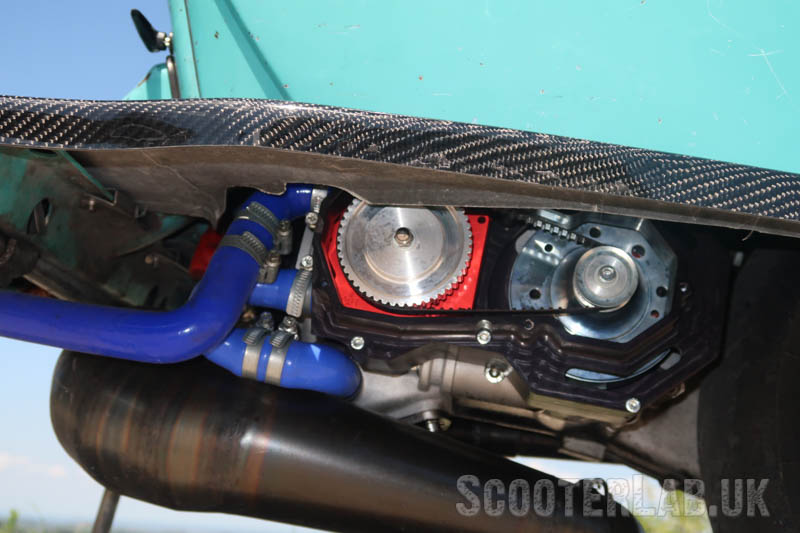
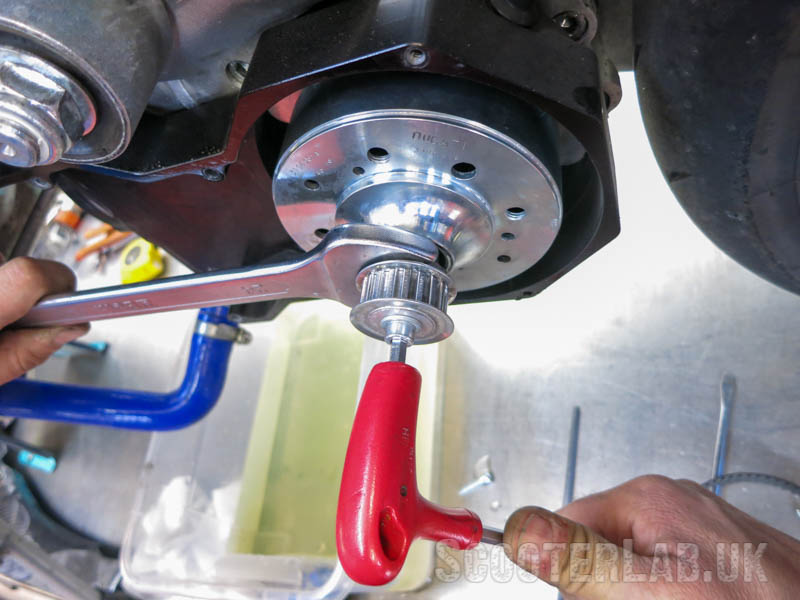
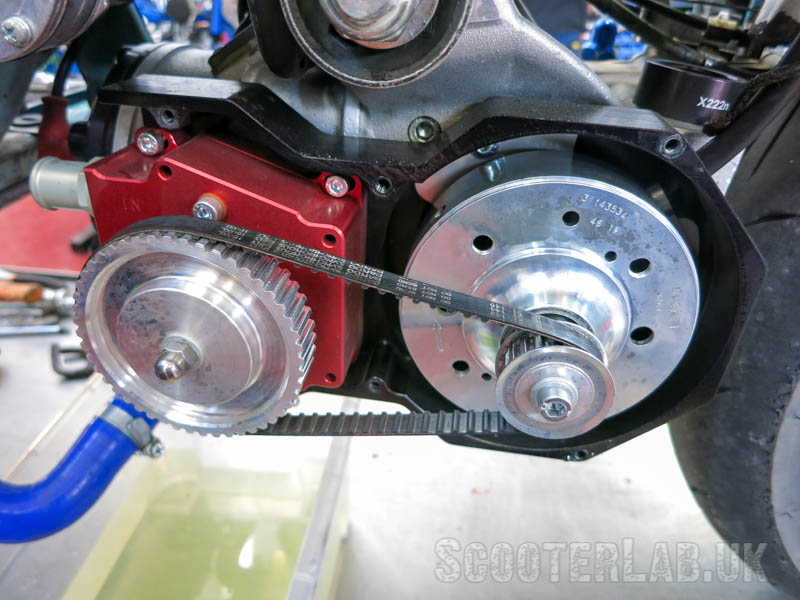
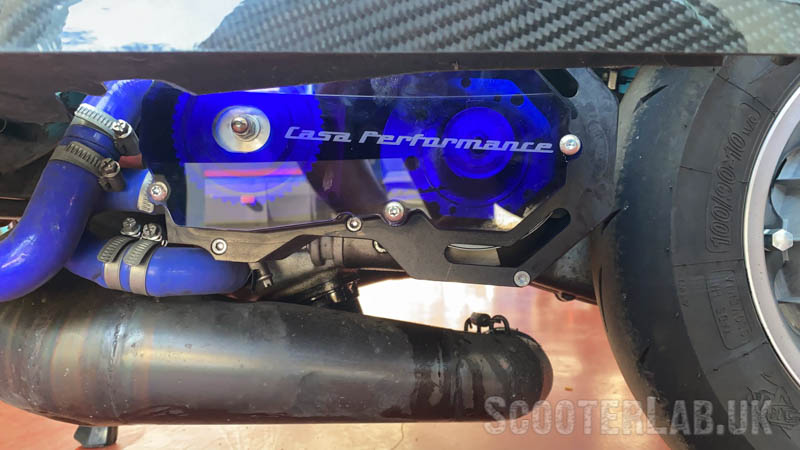
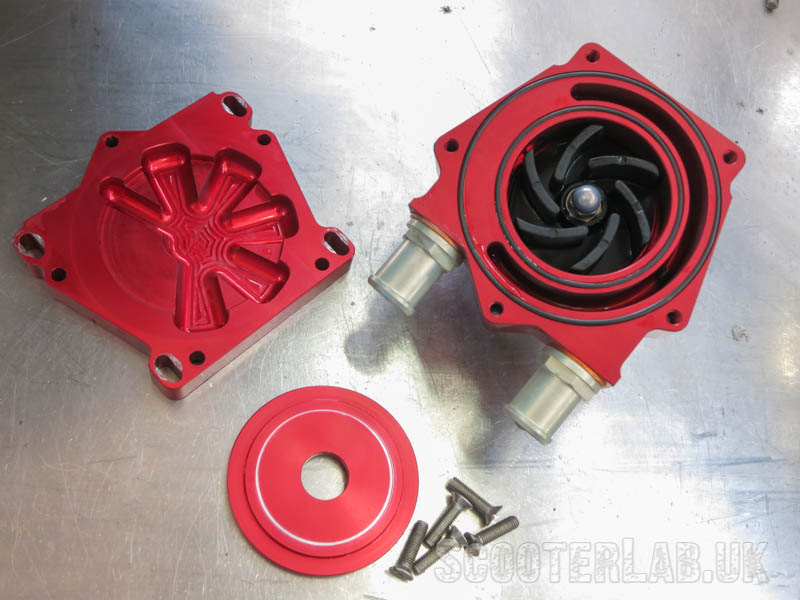
The second Casa Performance innovation – and one that may well benefit anyone thinking of going the water-cooled route – is a dedicated mechanically-driven water pump that fits under Lambretta bodywork. The vast majority of previous Lambretta conversions used an electric water pump but almost every water-cooled production vehicle uses a mechanical pump. There must be a reason for that…
Mechanical pumps are not only more reliable, but importantly, when driven from the crankshaft they also increase flow in proportion with engine speed.
The only logical place to drive a water-pump on a Lambretta engine is from the flywheel end of the crankshaft, but no pumps existed that would work in that layout and remain under full bodywork.
The solution was to design a new water pump and pump housing driven by toothed belt from a specially-modified flywheel nut. At the moment the only configuration for belt alignment that they have tested is with the Ducati Casatronic ignition but it is likely that the system will work with other ignitions as well.
The housing fits onto the CasaCase SSR/SST engine but recent modifications mean that this pump should fit onto normal Lambretta engines too. If you have an ‘Elsie’ project, it’s worthy of consideration.
CP are expecting the water-pump kits to be available this autumn priced at 491 Euros + VAT. Note that this price does not include a radiator or hoses; which must be sourced separately.
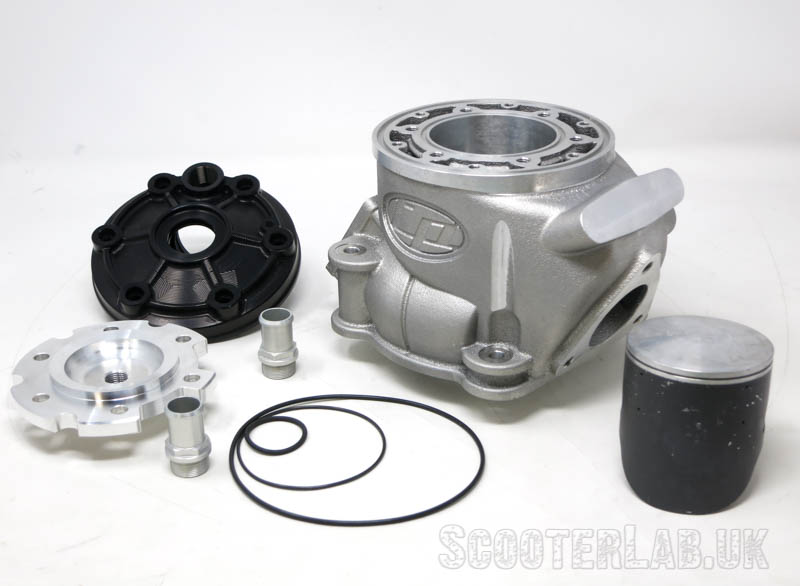
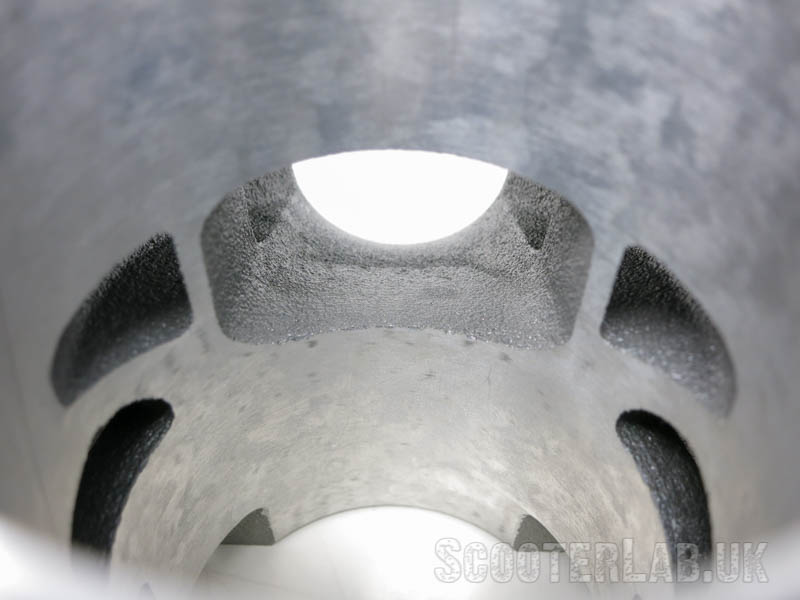
If you look carefully at the cylinder casting, you’ll notice an oval lump in the aluminium above the exhaust port. This is in preparation for a guillotine-type exhaust power-valve of the type frequently used by Rotax.
A power-valve offers the opportunity to vary the exhaust port timing according to engine rpm. At low revs it makes the power of an engine with short exhaust timing. At higher revs it makes the power of a cylinder with longer exhaust timing. Effectively, the power valve is a mechanical way to get two engines in one.
The cylinder tested in the video is a non-powervalve version of the SSR 265 and already it is more than a handful, in the same way that Sam Fox was…
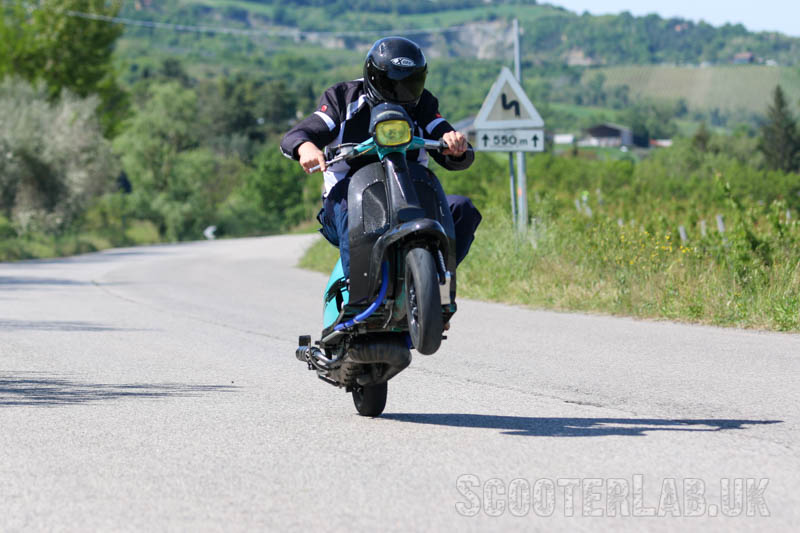
What does it ride like?
If you are brave with the throttle then it’s crazier than David Icke’s diary. You daren’t use full throttle in first gear. In second gear it power wheelies for a laugh; even on half throttle. The involuntary wheelies continue in third gear and the front tyre remains disturbingly light in 4th gear. If you’ve got it pinned in 4th then you are already on the naughty side of 100mph; with another gear left to use.
If this was the heroin dealer scene from Pulp Fiction, he’d be explaining that other ones he sells are “really good shit”, but this one is “fuckin’ mad-man”.
There’s some similarity, except the SSR256 LC is only a mad-man when you want it to be. If you behave with the go-grip, then it behaves. With the Protti exhaust it’s a noisy, barking dog, but you can ride it in traffic without a fight. The clutch and gearbox are faultless and the power at low revs is ample to make progress.
You could ride it on a scooter ride-out if you wanted, but that’s not really what it’s for.
I don’t think it’s for distance work either. It’ll do high speeds and cover miles but you don’t really want a thirsty, high-revving engine for rallies. The SST version – with twin piston rings should be better for that.
The SSR is all about living for kicks. The buzz. The adrenaline high of walking the line and getting away with it. Pushing the absolute limits of 10-inch tyres connected to a scooter made from bent scaffold pole. If that’s what you want, then this delivers.
Health warning!
It should come with a health warning though. If you aren’t as skilled as you think you are, and you aren’t capable of balancing the line of grip, wheelie and wheelspin then it will bite you.
Several times on my test ride I found myself howling towards corners 20-30mph faster than on a normal kitted Lambretta. In order to make it around those turns required a complete recalibration of the brain to deal with the rate that the scenery advanced upon you, even in the blink of an eye.
You can’t skimp either on servicing or fuelling. I read a comment recently from someone whose mate had bought a high-end engine and run it on the cheapest dog-shit 2-stroke oil and were surprised that it seized. That’s like buying a Porsche and fitting Chinese remould tyres to save a few quid. If you can’t afford to run a high-performance motor then you shouldn’t buy one.
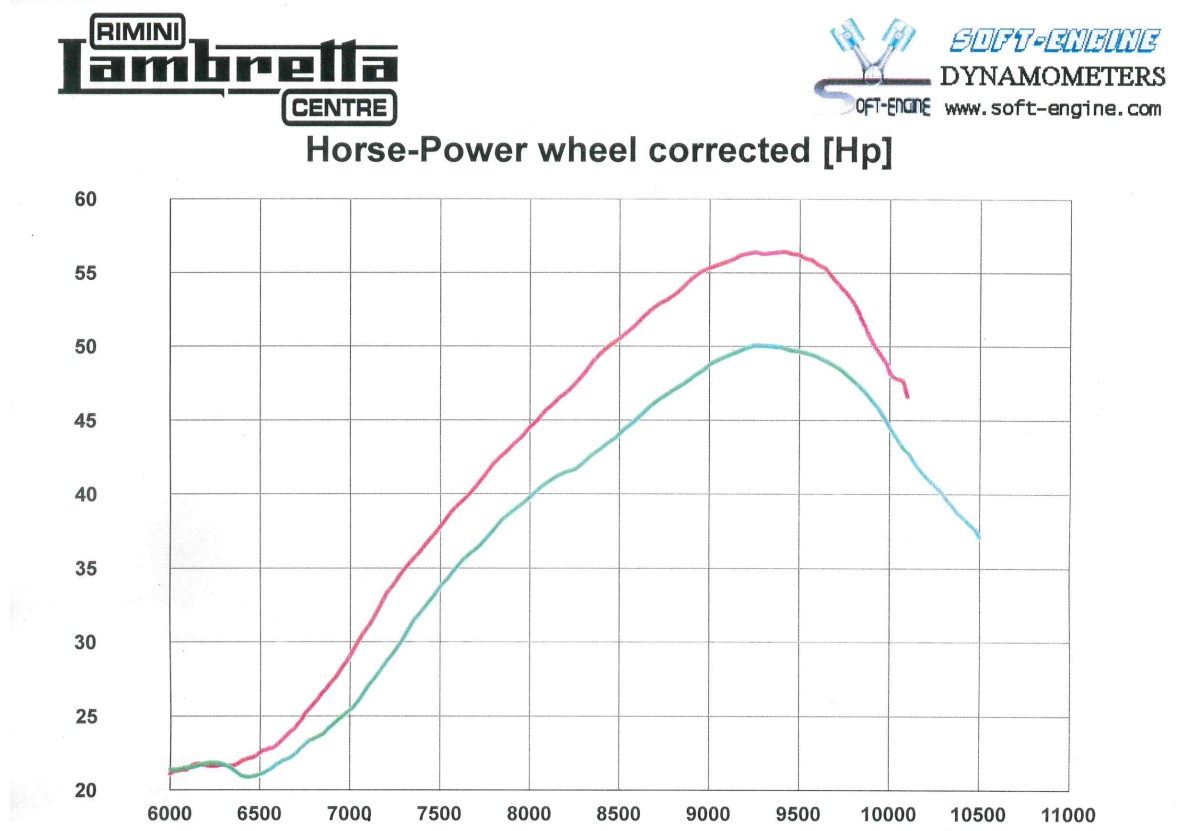
This graph shows the power difference between a well set-up air-cooled SSR (green) and the new SSR 265 LC (red). Power is improved throughout the rev range on the water-cooled motor.
Well, that’s a good question with a complicated answer.
The water-cooled version can make more power for the following reasons:
1. It has a different exhaust port layout, but the same port timings. Where the air-cooled SSR uses a bridged exhaust port, the water-cooled version has a main exhaust and two sub-ports like the SST layout.
2. It has a slightly higher compression ratio. You can get away with pushing compression slightly higher if you have improved cooling.
3. The drag of the cooling fan has gone. There’s a few horsepower saved there that can drive the wheel instead of moving air. OK so there’s a mechanical water pump but the losses are minimal compared to the drag of a fan.
4. Mechanical efficiency is higher. With a water-cooled cylinder you get less deformation of the cylinder bore. This allows you to run tighter piston-to-bore clearance, reducing piston slap and blow-by on the piston rings.
5. You can set the carburettor leaner. With efficient cooling there is less need for additional fuel in the mixture to keep the piston and barrel cool.
The net result of all of these cumulative changes – including the new Protti exhaust – resulted in Mickey’s water-cooled SSR making a claimed 56hp on the RLC dyno but also gaining a massive improvement in power throughout the rev range.
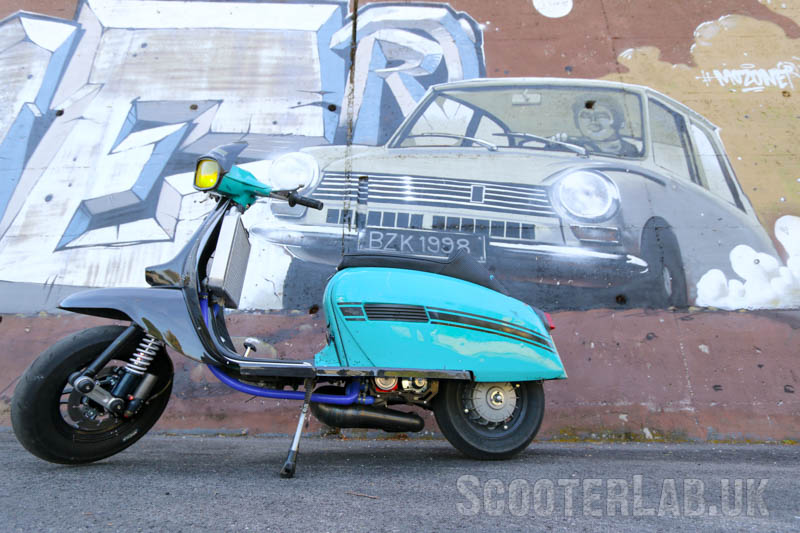
The SSR and SST LC cylinder kits only fit onto the CasaCase at the moment, but they share the same bore (70mm) and stroke (68mm) as the air-cooled versions so it is possible to upgrade an older engine from fan to liquid.
The water-cooled cylinder kit itself will be priced at 1,065 Euros + VAT and these should be available from mid-September.
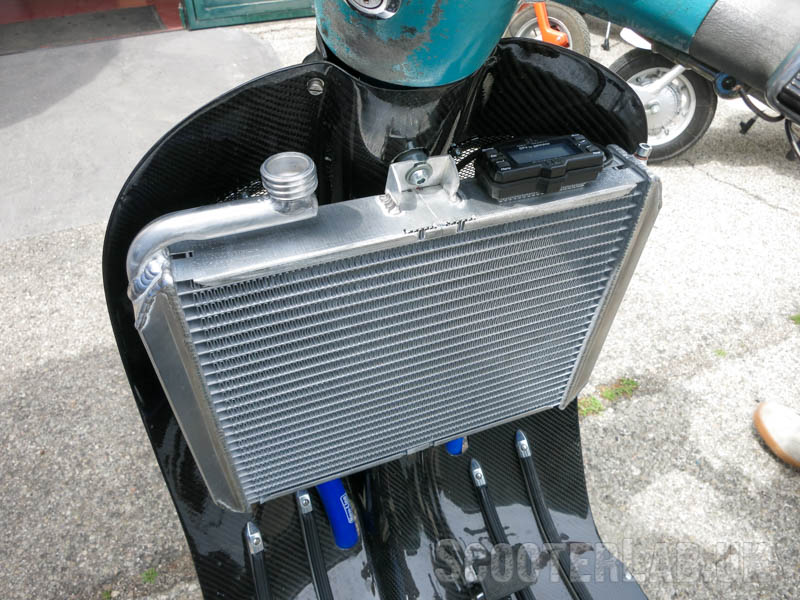
Casa Performance hope to start building complete SSR and SST LC engines over the winter. Even then it will not be a ‘complete’ package as they don’t plan to get involved in the supply of radiators and hoses.
There’s nothing ‘plug and play’ about cutting holes in bodywork to route pipes and flow air, but they reckon this won’t be an obstacle for the type of owners who want ‘extreme’ performance.
They might be right.
At the moment this is the maddest of all the Lambretta conversions I’ve ridden, but that crown may not last long. If they get the power-valve version working then there’s more madness to come from Casa Performance…
Words, photos and video: Sticky
For more on the Lambretta performance kit market including the SSR and SST LC engines pick up a copy of The Complete Spanner’s Lambretta Kit Book here.

Also available from the SLUK Shop
Have you got the latest edition of Sticky’s best-selling Complete Spanner’s Lambretta Manual?
If you own a Lambretta there will be something in this book that you never knew, no matter what your skill level or experience.
It’s a book written in plain English and with enough humour to lighten the subject.
It covers all models from Series 1 to 3 and has clear text and explanations for pretty much everything a Lambretta owner will ever need to know.
Get your copy here.







A fuel injection system with auto lube, quiet exhaust with a cat, at least 15mpl is what’s really needed.
But as 2/strokes get banned in a few years ♂️
Paul – with all due respect that’s not really the point, I mean, why do men [and women] climb mountains?
utter madness and sheer brilliance – man the rider has big b+lls.
Thank you – I just kacked myself watching the video – never mind riding the thing.
Good work and stay upright.