

There has long been a desire to match the performance of aluminium cylinder kits with the style and sound of a ‘Clubman’ box pipe, but results never matched expectations.
Clubman exhausts with TS1 flanges were offered in the 80s. Fletch from our club bought one for his S-type. Performance was way down on his expansion pipe and the Clubman lasted one rally before it shook itself to bits.
Back then we put that one down to experience. Expansion chambers and big mufflers it is from now on then…
Box pipe revival
In this millennium, things have changed a bit. Many Lambrettas got restored. Average owner age got significantly \’more mature\’ and many people revisited the idea of a Clubman-type exhaust on milder tunes where they can work well.
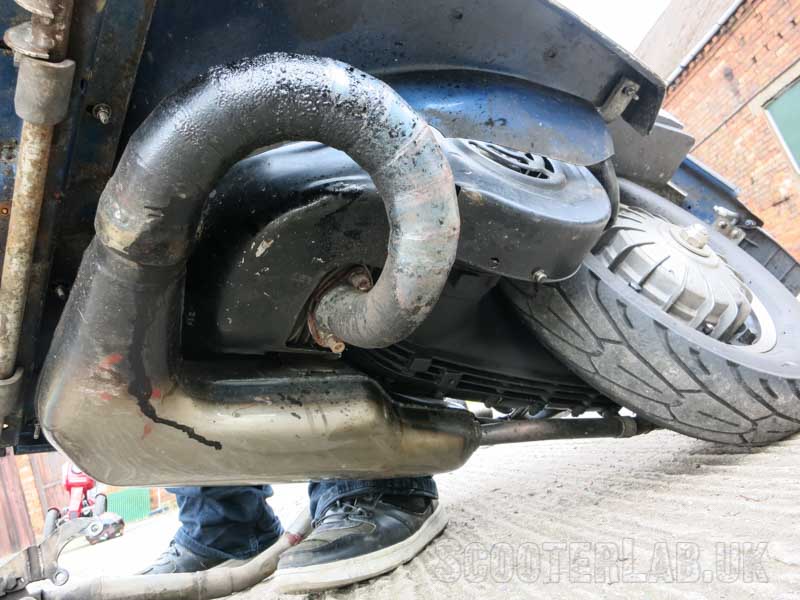
Advantages of box pipes
- You don’t have to trim the rear runner board, like you do with many expansions
- There’s no need for a big muffler on a wobbly bracket
- Most box pipes offer good ground clearance
- Clubman-type pipes tend to offer a far wider power spread than an expansion exhaust, though rarely as high a peak.
- Some people like the sound
Disadvantages of box pipes
- The better performing ones still tend to be loud
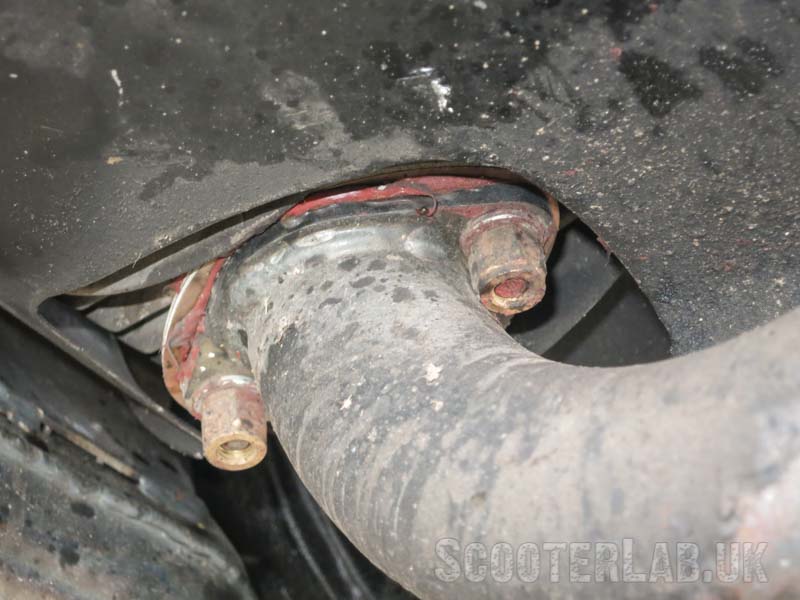
- Those without a separate stub manifold can be a bastard to fit
- Many have fixed-welded brackets that are unable to be adjusted for cylinder packers etc
- They tend to have additional fixings using M6 chaincase studs and also the silly bolt under the casing. If any of these fasteners comes undone then they tend to fall to bits quite quickly.
- Most box pipes still tend not to perform well on kits with longer exhaust durations.
Enter the tapered downpipe
Those of you who also pay attention to the world of Vespa tuning will know that there has been something of a box pipe revival for Vespas as well.
Exhausts like the SIP Road have proved massively popular because they are box pipes that perform way better than previous attempts (like the SITO+) to better the standard exhaust. The key to this extra performance was the abandoning of parallel tube for the downpipe, and moving to a gently expanding conical downpipe design. For reasons of production costs most of the Vespa boxes still utilise some straight tube before moving to rolled cones where the downpipe enters the box
Performance for higher-revving Vespa kits was further increased by increasing the chamber volume on pipes like the BGM Big Box and SIP Road XL.
Enter the Gori GP50
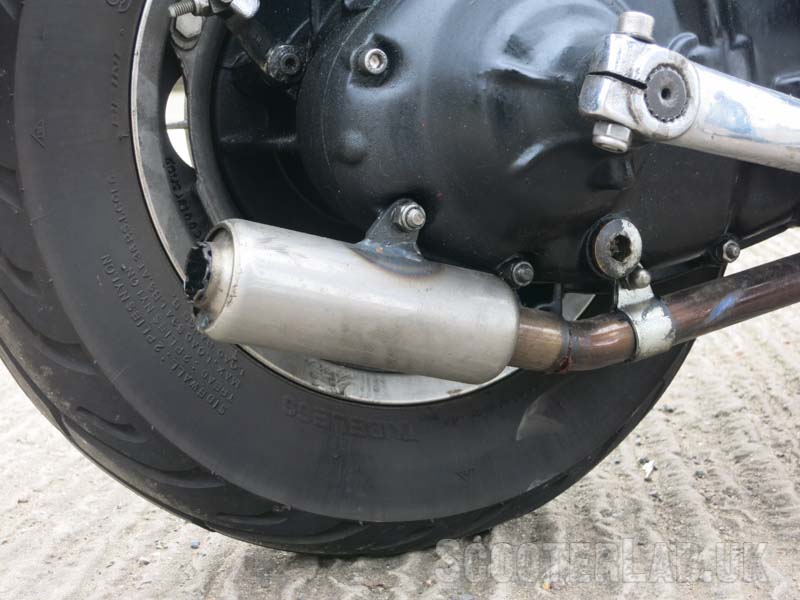
Giancarlo Gori restarted production of his Lambretta Clubman-type exhausts in the last decade, most of which still have parallel downpipes. The best performing versions tend to be the ones devoid of internal baffles but fitted with a tiny muffler on the end of the tailpipe. Even with this they border on annoyingly loud; particularly if you are riding close behind.
More recently Gori released the GP50 version for high performance kits which is a similarly oversized box pipe, but instead of parallel tube it has a fully-tapered conical downpipe. The lads from Rimini Lambretta Centre tried it on their SS225 kits and the results were amazingly good; bettering some expansion chambers in peak performance and offering a better spread of power.
Gori GP50 on a TS1
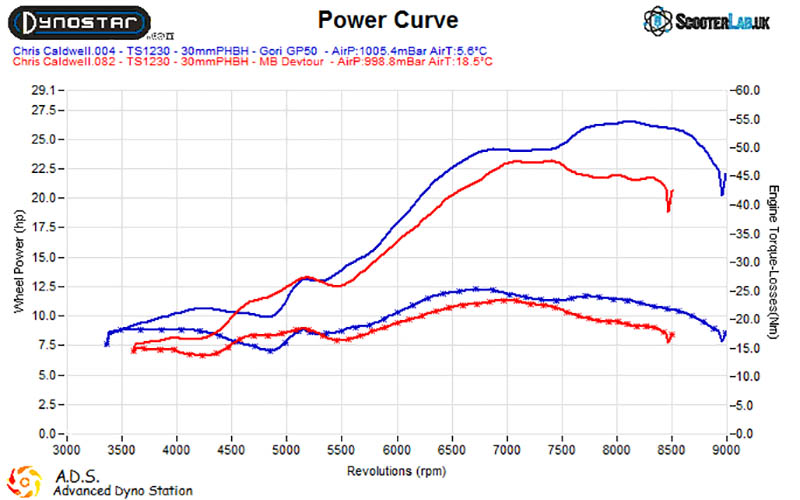
Recently another clubmate – Chris – purchased a GP50 to try on his TS1 230 (60-stroke) so we thought we’d run it on the ScooterLab dyno against his previous pipe; a stainless steel MB Devtour expansion.
Bear in mind that the Devtour is a good all-round rally pipe, though eclipsed for performance by more recently-developed expansion chambers.
Do not take the graphs shown here as scientific back-to-back references. The runs were not carried out on the same day, but they are from the same engine on the same dyno with similarly rich fuelling graphs (jetting is actually the same).
The graphs only serve to show what is possible from a fully-tapered box exhaust like the Gori GP50, but the results are impressive and feel as good on the road as they look on the dyno.
What’s going on?
With a fully-tapered downpipe and a large volume pressed-steel box, this \’Clubman\’ can behave quite like an expansion. The short downpipe length is suited to cylinder kits with longer exhaust timing (TS1 and SS225 etc) and allows the motor to rev around to 9,000rpm without stress. The GP50 won’t fit RB however due to the different exhaust gasket angle.
As with anything 2-stroke there is a see-saw effect. There is a sacrifice of bottom end power which means that this box won’t really suit more modest kits with low exhaust timings.
One word of warning. There are two versions of the Gori GP50 with different tailpipe diameters. The guys at RLC recommend the larger bore tailpipe for all high-performance reed-valve engines (e.g. TS1, Imola, Monza, SS200/225).

Where from?
Gori exhausts are available from many good scooter shops. The model with the larger diameter tailpipe is available from Rimini Lambretta Centre priced at £317 (€375).









I wouldn’t begin to try to understand how an exhaust works, but I do wonder if this bike was re-jetted and re-timed when the pipe was changed over, or, if not, what pipe this bike was originally set up with?
The timing and jetting haven,t changed for the last five years, the powerjet is open half a turn and it was originally set up with a devtour.