

In the UK most petrol stations offer E5 fuel, which is petrol (derived from crude oil) with up to a 5% mix of bio-ethanol (derived from crops).
Currently, there are plans afoot to raise the ethanol content of UK petrol to 10% (E10 fuel) in a supposedly environmentally-friendly move designed to reduce carbon emissions. Countries like France and Belgium already offer E10 fuel at the pumps, and petrol stations in the United States have been selling high ethanol content fuel for years.
Media channels are referring to these proposals as a ‘no-brainer’, but are they really of advantage to scooter riders or even the general public? Sticky delves into this murky subject.

What is Ethanol?
Essentially it is an alcohol, produced in the ancient way by allowing yeast to act on sugars within crops. As you know from flaming sambuccas, alcohol is combustible and can therefore be used as a fuel.
Bio-ethanol fuel is made from commercially-grown crops such as sugar beet and wheat.
As you can imagine, there is an innate attraction to a fuel that you can ‘grow’ in a field, compared to one that has to be extracted from under the earth or seabed, often in a warzone.

What is bad about ethanol in fuel?
Actually, quite a lot; especially for 2-stroke engines.
- Ethanol is a detergent. It acts to strip oil from surfaces, harming the lubricating properties of 2-stroke oil on the moving parts of an engine.
- Ethanol attacks certain materials. Nitrile rubbers that were used in older vehicles for oil-seals, fuel lines, petrol tap and cap gaskets etc are all adversely affected by Ethanol. For this reason most engine builders now recommend the use of Viton oilseals in an engine. Ethanol also attacks some sorts of fibreglass resin and many of the older types of sealer used to line rusty fuel tanks. An increase in ethanol content is likely to increase problems with these parts in older vehicles.
- Ethanol is hygroscopic. This means that Ethanol fuels absorb water from the moisture in the air if not held in a sealed container. Putting water into an engine is not a really great idea because it promotes rust on con-rods and bearing surfaces. Water transferred to the float-bowl of a carburettor can cause massive running problems.
- Ethanol is energy inefficient. Compared to the same volume of premium petrol, Ethanol yields about 33% less energy. This means that fuel economy (miles per gallon) gets progressively worse the greater concentration of Ethanol is in the fuel.
- Ethanol fuel may require engine recalibration. The low calorific value of Ethanol may require adjustment to the fuel-air mixture for the engine to maintain efficiency. Fuel-injected engines built after year 2000 ‘should’ be able to adjust their fuelling dynamically to be able to cope with running on fuel with an ethanol content of up to 10%. Older engines, particularly air-cooled with carburettors, may need to be manually adjusted (made richer by upjetting) when changing to higher ethanol fuels.
VIDEO | Removing ethanol from petrol
Will Ethanol make my engine run hotter?
I’ve read claims of US studies which discovered that using higher concentrations of Ethanol in fuel raised the operating temperature of 2-stroke engines, but I’ve not been able to track these papers down. If true, this result could be explained by several factors:
-
- Increased friction due to reduced lubrication effectiveness.
- Reduced energy available from ethanol meaning that an engine has to be worked harder to achieve the same performance.
- In air-cooled engines where fuel evaporation is used to help cool the engine, a richer mixture of ethanol-rich fuel is required to maintain a similar cooling effect.
Does higher Ethanol content have any good effects on an engine?
Ethanol is actually higher octane-rating than petrol. This means that it is more resistant to engine ‘knock’ than straight petrol. Effectively Ethanol content can be used as an additive to reduce the risk of ‘knock’ or ‘pinking’ where previously other additives (MTBE and before that TEL tetra-ethyl-lead) were used to perform the same job.
There are videos online which show how you can use water to remove the ethanol content from petrol, specifically for old 2-strokes. Sadly this laborious process can’t be advised because it will reduce the octane rating of the remaining petrol. Unless you add octane booster afterwards then you are still risking running on a fuel that will damage your engine.
So if E10 is bad for my engine, what can I do about it?
The first thing to do is not to panic. People on the continent where E10 is far more common continue to ride old scooters and use 2-stroke engines, so the motors can cope when they are set up correctly.
If E10 does become regularly available in the UK we’d advise the following:
- Change all your fuel lines for Ethanol-resistant alternatives.
- Run a good quality 2-stroke oil with excellent lubricity.
- Pay attention if your fuel tap feels stiff to turn. This may be due to the Nitrile washer used in the tap swelling and getting stiff. If this happens the washer can start to break up and the tap will either leak or bits of the washer will find their way through to the carburettor. Viton sealing washers are now available for many old fuel taps.
- When rebuilding a motor ensure that all fuel-facing oilseals are Viton or another ethanol-resistant material.
- If you are using E10 all the time you may well need to upjet your carburettor slightly.
- If you are using E10 all the time then you can in theory retard the ignition timing by a degree or so to cope with the faster burn of E10 fuels. [N.B. this section revised 5/3/20 as a result of reader feedback and checking studies such as this]
- E10 burns cooler and liberates less energy than E0 or E5 fuel so if you use an Exhaust Gas Temperature gauge (EGT) then you should expect to revise your expected temperatures.
- If you aren’t using your scooter for any great length of time then seal the fuel tank breather so that ethanol can’t absorb any water. Want to see how quickly ethanol fuels can absorb water? Watch this video. https://www.youtube.com/watch?v=xzFzYoxxA10
What the introduction of E10 will do is reduce the margin of error for setting up tuned engines. An engine that is on the absolute edge of safely for jetting, ignition timing and cooling on E5 fuel might be tipped over the edge into meltdown or seizure if you fill it with E10.
The solution then will be to increase the margin of safety in respect to your fuelling and lubrication by upjetting and maybe running a slightly richer oil mixture, particularly if you are doing any long-distance work where you’d expect your engine to get hot.

Are anti-ethanol fuel additives any good?
There are dedicated fuel additives – sometimes called stabilisers – that are supposed to counter the effects of Ethanol-rich fuels, however without a degree in Chemistry and months of study in a lab – then it is impossible to know if these additives actually work.
I’ve been involved in the motor trade long enough to be very cynical of any miracle formulas. History teaches us that you can tell people pretty much anything and if they want to believe it works then they’ll spend good money on snake oil, based on bad science.
As an example of bad science, I myself produce a fluid that both wards off vampires and combats the signs of ageing when applied to directly a woman’s face. None of my former girlfriends have died from vampire bites so it has a 100% success rate. Side effects of misuse include pregnancy.
People who use fuel stabilisers might tell you that they 100% work because their engines haven’t blown up. Equally, it could be that their engines wouldn’t have blown up without the additives. This is another example of bad science.
I don’t have enough knowledge to say whether substances like the Millers Oils fuel stabiliser Iggy was using when his Quattrini M210 melted a crank on the way back from Exmouth last year actually work or not but he was advised to stop using it by Chiselspeed.
There are plenty of different additives on the market. The material safety data sheet for Lucas Safeguard Stabiliser shows the main ingredient is up to 80% ‘hydrotreated heavy naphtha’ (petroleum), which is a product derived from crude oil.
Imagine this; if you add more neat petrol (or naphtha) to petrol/ethanol mix, what you are actually doing is reducing the percentage ethanol content in the tank a little bit. It’s certainly not doing any harm but equally it’s impossible to know if any of the other ingredients are doing any significant good either.
So for me, the jury’s still out.

If Ethanol in fuel is so harmful to engines, why is it being promoted as a good thing?
Organisations like Extinction Rebellion have governments in a flap. Most people agree that the climate is changing but not every scientist agrees about why. Carbon dioxide gas emissions are one of the factors getting the blame for the greenhouse effect, so the current buzzword is ‘carbon reduction’.
As a politician this is an ideal time to release a knee-jerk sticking plaster remedy that looks like it might have some environmental benefit, until you actually study it closely. This is where you have to drill down into the news to find out who benefits financially, because the world still remains a money-go-round.
The headline on the news was that increasing Ethanol content from 5% to 10% was going to cut UK carbon exhaust emissions by as much as 6%, but that doesn’t actually make any sense.
Ethanol contains carbon atoms and when you burn it those carbon atoms still combine with oxygen to make carbon monoxide and carbon dioxide as by-products. I’d be surprised if adding this shit to petrol would have a significant impact on carbon emissions from exhausts, but it certainly will not achieve a 6% reduction.
So if burning Ethanol still releases carbon dioxide, how is it helping?
Ah, this is where we enter the realms of more bad science with the absolute bullshit concept of ‘carbon offsetting’.
The claimed net reduction in carbon emissions actually comes from the process of growing the wheat or sugar-beet because the plants absorb carbon dioxide from the atmosphere as they grow. This is supposedly ‘renewable’, because the carbon dioxide emitted from the exhaust is captured by the plants.
Apparently it’s all ok, because one offsets the other.
That’s fine until you start to think about this for a moment. If that wheat wasn’t grown to make crappy fuel for petrol engines, what would be in the field in its place? Well, you could grow wheat and feed it to humans unless world famine was solved while I was sleeping.
Even if you didn’t sow wheat, something would grow there – that field wouldn’t be a desert. Those plants would still be absorbing carbon like they have for millions of years before they knew that they were also doing the important job of ‘carbon offsetting’.
Carbon offsetting is a load of unadulterated bullshit aimed at making you feel less bad about polluting.
We all pollute; even the people from Extinction Rebellion.
So who profits?
This is where we get to the interesting bit. Companies running farms and refineries based mostly in the north of England took a gamble on the future demand for bioethanol. It’s an industry already worth £1BN in the UK.
Sadly the demand for ethanol from the petrol companies has not been as high as expected so the industry is not as profitable as anticipated.
Thankfully we have the All-Party Parliamentary Group for British Bioethanol to protect us. They are basically a cross-party bunch of MPS from the constituencies in Scotland and the North East; where the farms and refineries are located. Coincidence I’m sure. They are supported by an expensive-looking PR company called Finn Communications; no doubt paid for by the Bio-ethanol industry’s lobbying war-chest.
Obviously if the fuel specification for the UK went from 5% ethanol to 10% then ethanol demand would increase massively, these businesses would do well and the MPs of those areas would be able to stand tall knowing that they’ve contributed to saving the planet.
Only they haven’t.
They will have introduced a fuel that some sources estimate will result in 880,000 incompatible cars going on the scrap heap. Think of all the energy, resources and pollution required to replace almost a million vehicles?
Is forcing people to buy new when they were satisfied with old really environmentally friendly, or is it just feeding the consumerist beast?
Isn’t keeping old vehicles on the road a form of recycling?
Final word
Basically after the diesel fiasco it’s as clear as vodka that politicians can’t be trusted to make the right call on anything environmental.
They thought they were doing the right thing by promoting diesel due to the lower carbon emissions, only to later discover the harm resulting from their increased nitrogen oxide emissions.
The whole thing is a farce. My suspicion is that they will believe whatever the lobbying groups tell them at expensive parties.
Now the solution is to introduce more ethanol to fuel, crippling part of the current vehicle fleet, reducing the fuel economy of most engines, and still pumping out roughly the same levels of carbon. And all of this is supposed to be of great benefit the environment?
If you believe that then maybe I could interest your wife/girlfriend/daughter in an anti-vampire service that I offer. As a favour, I’ll do the first treatment free of charge…
Words: Sticky
Images: Iggy
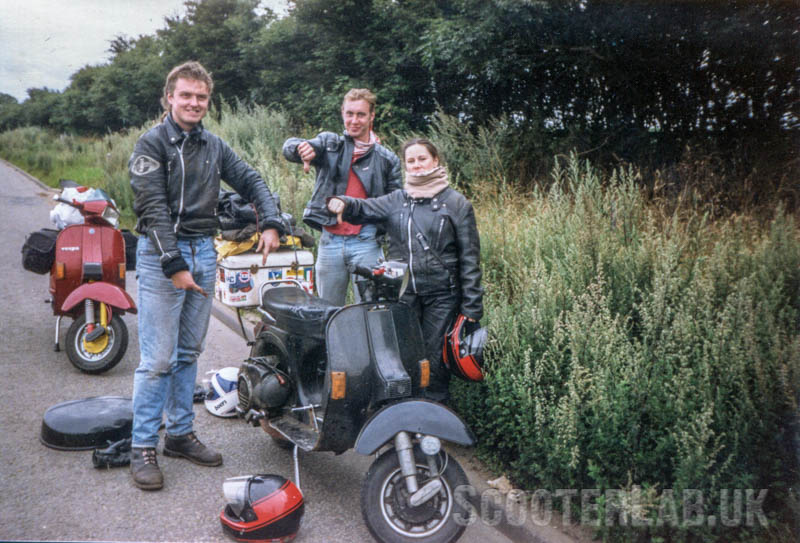
Intro Image: From Vince (Olympic SC) as featured in Sticky’s book Scooterboys – The Lost Tribe which is available here.
SLUK Shop – products made for polluting vehicles, no food crops harmed during their production










Here in France even new 4 stroke fuel injected scooters come with a warning not to use E10 petrol! Fortunately there’s usually a choice of E5 98 petrol at the pumps when the only 95 octane is E10. For the last few months all pumps carry stickers showing “E5” or “E10”.
Spot on Sticky – nice photo of Sniff and Co too
I must thank Vince for that picture. Holey piston moment if I recall!
Ah so that’s where you got the name!
Good little write up Sticky btw
And there was I thinking mixing two stroke was hassle. Can’t see many scooterist adopting the “ethanol filter trick” on the way to the IOW, mind you most scooterist’s on the way to the IOW these days are in vans ! Good video though.
An interesting read. I’m a bit dubious in how you link this as a direct result of groups such as ER actions. I don’t think many environmental pressure groups would be in favor as there is a lot of evidence as to why biofuels are bad for the environment – some of which you mention such as the bad science regarding carbon offsetting and how else the land that is used for growing these crops could be used. All the stuff about Industrial agricultural to produce things such as cheap meat and bio fuels etc leading to the fall off in bio diversity etc etc. I think your more on the target when pointing the finger at money and maybe some bad EU policies (I’m pro European btw so this not a brexit drum I’m trying to bash)
Anyway I agree with the conclusion it stinks and is a mess!
I mention Extinction Rebellion only in that their protests are being used as a cover to release and promote policies under a ‘green agenda’ when really the policies aren’t green at all if you look closely.
Thanks for the clarification
Well said that man, only one winner in this bulshitting world and that’s the governments lining their own pockets
As someone dealing with US Ethanol fuel for 20+ years, it is the evilest additive ever for anything two-stroke or anything with plastic fuel tanks. It kills lawnmowers, chainsaws etc. if used too much – you can be assured that a good percentage of tools won’t start next “mowing season” due to the carbs being “gummy” from the varnish it leaves behind.
I use only Ethanlol free fuel in my ’85 scooter, old Greeves, all petrol powered tools and even a 15 year old Triumph (sorry, its a motorbike 😉 – its plastic tank expanded when taken out of the frame for a day due to not being under pressure in the frame. 3 days in a chest freezer helped get it – somewhat – back in.
It is crap stuff. I hope back home you’ll still be able to get Ethanol free fuel – I can around here – for just a bit more cash – I hope that option presents itself also.
The Climate Change Brigade have become the new Puritans of the modern age: “We are right, you are wrong”, “We are enlightened, you are in the darkness of ignorance”, “We are helping you by forcing your hand” etc..
There is no conclusive evidence for any assertions that the activities of people is having a negative impact on global climate.
Don’t conflate climate with weather, they are two very different things. The weather changes all the time, often in cycles of ten or twenty years or more – fifty or one hundred.
Neither should we conflate environmental degradation (which is real and happening every day) with Climate Change
Who are the ‘International Panel on Climate Change’? who are they? On who’s authority? Their climate models are an excellent example of how statistics can be interpreted to give a desired result.
Problem, reaction, solution. Doomsday Climate change is the problem, the hysteria in the media generating fear is the reaction, carbon taxes and more government involvement in your private affairs is the solution.
Ethanol is just the start.
Ed Bailey says above: ‘I’m pro European’… so am I, but I’m anti-EU in it’s current undemocratic, coercive form.
Ask anyone who ‘survived’ Communism in Eastern Europe during the 70’s & 80’s to make comparisons between what they had then and what the EU has become now.
The UK is getting out in October and Ireland would do well to follow suit
I’ll put it to you this way; if man made climate change or CO2 based climate change is real and is happening, the first people to adjust would be international insurance corporations who underwrite for trans national corporations.
You would not be able to secure insurance for coastal properties or assets located on coastal areas if alleged CO2 based climate change were a real thing – but you can. Look at the Netherlands; You can get coverage going decades forward for even the most exposed endeavor, be it a giant wind farm or sea-dyke.
So what about all this sea level rise and cities being washed away and all the rest of the doomsday stuff the National Geographic love to show you ‘simulation’s’ of, in their publications. Well all I can say is that you are all big boys now and you must stop believing in Fairy Tales & scary-stories.
You have a politician over there, a Labour fellow, Corbyn right? I don’t know much about him but his brother is an actual Climatologist, a recognised expert on Climate; not a politician or a bureaucrat or EU-Yes-man. Give him a listen if you can find him on the Tube. Piers Corbyn I think. There are many others but they are given no platform in media.
I’m not a Leftie or a Rightie but I can see when I’m being sold a pup! It’s like that Ladybird book story for children where Chicken-Lickin & Henny Penny are off to tell the King that the sky is falling! Lol.
So you dont think climate change is real because its still possible to obtain insurance for properties next to the coast that could be subject to flooding from rising sea levels?
‘Interesting’ argument but I think i’ll go with what 99% of what the world’s scientists say
Some more info which might be useful to riders of older scooters. E0 or Ethanol free fuel will still be available after the introduction of E10 in 2020 in Standard Premium grade, from Esso. This is the latest statement on the situation on Exxon/Mobil’s UK website –
‘The majority of unleaded 95 Octane petrol sold in the UK contains up to 5% ethanol as required under the Government’s Renewable Transport Fuels Obligation (RTFO).
There is currently no requirement for renewable fuel (such as ethanol) to be present in super unleaded (97 grade petrol).
Esso super unleaded petrol (Synergy Supreme+ Unleaded 97) is ethanol free (except in Devon, Cornwall, the Teesside area and Scotland). We would therefore advise anyone who has concerns about the presence of ethanol in petrol to use Synergy Supreme+ – providing they do not fill up in Devon or Cornwall, the Teesside area or Scotland.’
I have contacted Esso who were very helpful and confirmed that they have no plans to change their policy. I also contacted the other majors who all, without exception, currently put E05 in their 97RON as well as 95RON standard fuels which will be increased to E10 next year. The only company who failed to reply were Shell, but as their petrol locally to me is at least 2p/litre more than Esso they won’t be getting my custom.
And now a completely useless fact from history. The very first car which Henry Ford made in 1896 whilst he was working for the Edison Co. ran on pure Ethanol. Ford introduced the Model t in 1908 and went on to make another 16,000,000 of them and that too could run on petrol or pure ethanol. Just thought you’d like to know!!
As much of a pain as it is, the ethanol removal process is relatively quick and simple, and if done 20L at a time or so, would reduce the tedium. Thats the way I will go when it increases in percentage.
It’s not really the sort of thing you can do in a garage forecourt on the way to a rally though.
A great piece of writing that explores the full picture. If any of you need to know why the politicians are so easily led down these mad paths of ” smash up what you’ve got and buy this new thing” pseudo environmentalism, consider that of our 600 plus MPs, only ONE is a scientist or engineer. Yes just one single technical competent amoungst the whole f*kin bunch….