midlife crisis
noun
noun: midlife crisis; plural noun: midlife crises
- A loss of self-confidence and feeling of anxiety or disappointment that can occur in early middle age.
- The desire to recapture ones youth through the pursuit of young girls whilst driving a hideous convertible sports car that even a hairdresser would shun.
- Going on a diet a POW would find meagre and building a race scooter.
 Shunned by ladies, hungry for snacks. Over the hill Barrie dreams of becoming leader of the pack again…
And so it is, dear reader, you find me bypassing the first two rules of a mid-life crisis and skipping straight to number three. Sitting back and contentedly eating pies washed down with a pint of lager most evenings, leads to a feeling of contentment somewhere around the Ten ‘O Clock news that anxiety or disappointment would need an extremely large hammer to put a dent into.
A loss of self-confidence didn’t flicker on the radar, and, seeing as how I never pulled any young girls when I did drive around in a hideous sports car 20 years ago that avenue of ridiculousness was a non-starter. No, of the three stages of crisis, the only option was the last one. But what leads to this least obvious of choices and the one most likely to end in traction? Well it all started back in 1979…
My dad raced a Lambretta until I was around three years old; then he stopped for reasons yet to be revealed. I suspect the fact that we used to wake up with ice on the inside of the windows and the invention of the Atari games console led to the money spent on racing being channelled into installing central heating and basking in the heat playing Pac Man, among other home improvements.
However, I can remember kneeling next to him while he stuck new numbers onto the panels, and standing in the legshields absolutely terrified at the noise this thing was making while he took me for a spin up the back lane.
Skipping forward a few years and he decided to start racing again when I was somewhere around 13. Only this time it was obvious that Atari’s were crap, double-glazing was keeping the heat in and wall-to-wall carpets had replaced the lino. In short, going racing was what we did from then on.
The minimum age for a race licence back then was 17, so in 1993, a week after my 17th birthday, I took to the track for the first time on a SS90 loaned to me by the legendary Norrie Kerr. His last words to me before I headed off to the start line were “If you fall off, get up and run because I’ll be right behind you ready to put my boot up your arse!” That’s the only time I ever knew Norrie not to be true to his word. After I fell off on the third lap he was quite concerned about me, but, he soon realised I was fine as I set off on foot to record the fastest lap of the day, fearful of the boot about to land in the seat of my leathers.
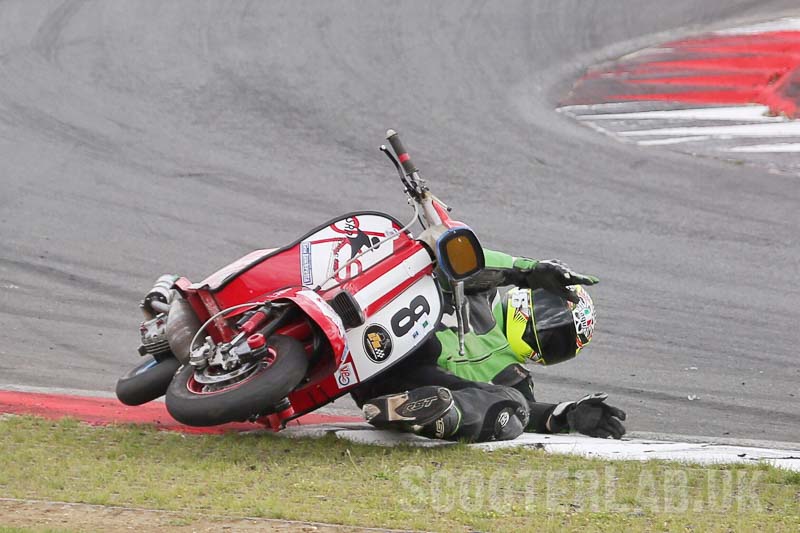
The following season riding my own Lambretta 150cc in Group 3, I managed to achieve what was reported as a first in scooter racing and a record which I think still stands. I fell off at every meeting. Sometimes more than once.
 Hungry for success, or just hungry? Our boy Barrie will eat the competition… or starve trying.
I stopped racing in the mid 2000’s. By that time I’d raced in a few different classes, won a few races, had a fantastic time and got to know some wonderful people. I didn’t miss racing, I just did different things.
Then, last season, while spectating at Croft I experienced an epiphany. The realisation that I was fat, approaching forty and had recently bought some carpet slippers hit me harder than Norrie’s boot ever would have. The last meeting of the season was at Cadwell Park. I got a licence, pumped the tyres up on my outdated Group 4 200cc Lambretta and went racing.
Proddie Racers
A new class has been introduced for this season which is aimed at keeping the costs down and having fun, Production Class. Basically it’s a race class using parts that anyone can buy off the shelf, without any tuning or modifications and go racing. It’s cheap, it’s fun and it suits me for one last hurrah before I hang up my leathers for good. Maybe…
If those who have expressed an intention to race LCGB Production Class for the 2016 season all make it to the grid this will be the biggest class on track with 24 riders. All will be on equal terms as far as power and top speed go, all heading into the first corner together. It might not be the fastest class on track, top speed will probably be somewhere a shade over 80mph, but it has the potential to be the closest and most exciting scooter race series ever seen.
Barrie Braithwaite #78
For the full calendar of events for this year visit the BSSO website.
 Andy Francis: The Godfather of the new LCGB backed Production Class
Lambretta Club of Great Britain Production Class rules
Although named and supported by the LCGB, Production Class is also open to Vespa large and smallframes. For full details visit the link at the end.
Regulations for Lambretta scooters
Any Series 3, GP, SX , LI model is allowed. Italian, Indian, or Spanish of origin.
Bodywork
Standard bodywork with no trimming of panels except for hole in the side panel for carburettor and small cut to rear of r/h running board for tailpipe of exhaust. Centre stand and splash plate must be removed. Metal or fibreglass panel work is allowed, fibreglass legshields are not allowed. No dropped handlebars allowed but any series 3 standard headset can be used. No light lenses (front or rear) and headlight opening must be blanked off. Rear light housing must be in position. 19mm Ball end brake and clutch levers must be fitted.
Suspension
Any Lambretta specific rear shock that is commercially available. Must be in standard position. e.g. no movement of original rear suspension fixing positions. Front forks as original internally sprung with uprated springs and bushes. Any commercially available external front dampers allowed. Steering dampers are not allowed.
Braking
Rear brake as original with commercially available shoes. Rear brake pedal in standard position. No foot pegs or rearsets allowed. Front brake as original drum or inboard disc. Conversion of inboard to hydraulically operated piston is allowed. Alternatively, an external single hydraulic disc type with drum style hub can be used. Single outboard only is permitted, no anti-dive allowed.
Engine
Standard 150 engine casing with standard mag flange. No welding to either and no pack plated between mag housing and engine casing. No material may be removed from the mag housing or engine casing. No matching of transfers allowed. Bump stop to remain intact. Rubber engine mounts may be uprated. Side casing with kickstart removed and welded up, or pedal removed and rubber cap secured over exposed kickstart shaft end. No packing plate allowed between side casing and engine. Type specific Raypeed RB20 performance kit and cylinder head in standard form with no polishing or tuning allowed. Only gaskets supplied with the kit can be used. No pack pieces. Standard Vertex or Wossner piston can be used. No machining or modifications to piston windows allowed. Standard inlet with standard reed block and petals. Any 58mm stroke crankshaft (not full circle) with 116mm con rod. Big end pin can be tig welded in position. Road stator plate for electrics with flywheel in use. Standard weight, intermediate or lightened flywheel may be used. No advance/retard mechanisms for ignition timing may be used. Ignition timing must be fixed. Original fan cowling and cylinder cowling must be in place for cooling, centre of fan cowling may be removed. No additional cooling scoops or ram cooling allowed. Filler and drain plugs to be lock wired.
Exhaust
Type specific Franspeed RB race pipe specially designed for this class
Carburettor
Carburettor used must be from approved specified list. Dellorto VHSH 30 round slide, Dellorto VHSA 30 flat slide or Dellorto 30PHBH round slide. No polishing, No power jet or modifications to standard carb. No force induction, or ram pipes to be fitted to carb. Only the use of standard Vetronite reed petals, as supplied with the kit is permitted.
Clutch
Any commercially available standard or Cassette clutch allowed, 4,5,6 or 7 plates with cable action as original. No chaincase packer or side casing modifications allowed.
Gearbox and drive
Must be as per original specification type, specific SIL GP200 front & rear sprockets – sizes may be altered to suit rider and circuit. Only commercially available sprockets may be used. Uprated chain tensioner is allowed
Tyres
Tyre brands must only be used on Lambretta split or tubeless rims. Sava/Mitasrace compound tyres; MC20(Wet), MC31/MC35 (Dry). Continental Race (Dry) and Continental Move (Wet).
Gauges
Only a rev counter is allowed, no other monitoring devices may be fitted
Fuel
Commercially available pumped fuel or Avgas with all taxes paid. Fuel tap must be clearly marked fuel on/off in relevant position.
Further information can be found at BSSO
midlife crisis
noun
noun: midlife crisis; plural noun: midlife crises
- A loss of self-confidence and feeling of anxiety or disappointment that can occur in early middle age.
- The desire to recapture ones youth through the pursuit of young girls whilst driving a hideous convertible sports car that even a hairdresser would shun.
- Going on a diet a POW would find meagre and building a race scooter.

And so it is, dear reader, you find me bypassing the first two rules of a mid-life crisis and skipping straight to number three. Sitting back and contentedly eating pies washed down with a pint of lager most evenings, leads to a feeling of contentment somewhere around the Ten ‘O Clock news that anxiety or disappointment would need an extremely large hammer to put a dent into.
A loss of self-confidence didn’t flicker on the radar, and, seeing as how I never pulled any young girls when I did drive around in a hideous sports car 20 years ago that avenue of ridiculousness was a non-starter. No, of the three stages of crisis, the only option was the last one. But what leads to this least obvious of choices and the one most likely to end in traction? Well it all started back in 1979…
My dad raced a Lambretta until I was around three years old; then he stopped for reasons yet to be revealed. I suspect the fact that we used to wake up with ice on the inside of the windows and the invention of the Atari games console led to the money spent on racing being channelled into installing central heating and basking in the heat playing Pac Man, among other home improvements.
However, I can remember kneeling next to him while he stuck new numbers onto the panels, and standing in the legshields absolutely terrified at the noise this thing was making while he took me for a spin up the back lane.
Skipping forward a few years and he decided to start racing again when I was somewhere around 13. Only this time it was obvious that Atari’s were crap, double-glazing was keeping the heat in and wall-to-wall carpets had replaced the lino. In short, going racing was what we did from then on.
The minimum age for a race licence back then was 17, so in 1993, a week after my 17th birthday, I took to the track for the first time on a SS90 loaned to me by the legendary Norrie Kerr. His last words to me before I headed off to the start line were “If you fall off, get up and run because I’ll be right behind you ready to put my boot up your arse!” That’s the only time I ever knew Norrie not to be true to his word. After I fell off on the third lap he was quite concerned about me, but, he soon realised I was fine as I set off on foot to record the fastest lap of the day, fearful of the boot about to land in the seat of my leathers.
The following season riding my own Lambretta 150cc in Group 3, I managed to achieve what was reported as a first in scooter racing and a record which I think still stands. I fell off at every meeting. Sometimes more than once.

I stopped racing in the mid 2000’s. By that time I’d raced in a few different classes, won a few races, had a fantastic time and got to know some wonderful people. I didn’t miss racing, I just did different things.
Then, last season, while spectating at Croft I experienced an epiphany. The realisation that I was fat, approaching forty and had recently bought some carpet slippers hit me harder than Norrie’s boot ever would have. The last meeting of the season was at Cadwell Park. I got a licence, pumped the tyres up on my outdated Group 4 200cc Lambretta and went racing.
Proddie Racers
A new class has been introduced for this season which is aimed at keeping the costs down and having fun, Production Class. Basically it’s a race class using parts that anyone can buy off the shelf, without any tuning or modifications and go racing. It’s cheap, it’s fun and it suits me for one last hurrah before I hang up my leathers for good. Maybe…
If those who have expressed an intention to race LCGB Production Class for the 2016 season all make it to the grid this will be the biggest class on track with 24 riders. All will be on equal terms as far as power and top speed go, all heading into the first corner together. It might not be the fastest class on track, top speed will probably be somewhere a shade over 80mph, but it has the potential to be the closest and most exciting scooter race series ever seen.
Barrie Braithwaite #78
For the full calendar of events for this year visit the BSSO website.

Lambretta Club of Great Britain Production Class rules
Although named and supported by the LCGB, Production Class is also open to Vespa large and smallframes. For full details visit the link at the end.
Regulations for Lambretta scooters
Any Series 3, GP, SX , LI model is allowed. Italian, Indian, or Spanish of origin.
Bodywork
Standard bodywork with no trimming of panels except for hole in the side panel for carburettor and small cut to rear of r/h running board for tailpipe of exhaust. Centre stand and splash plate must be removed. Metal or fibreglass panel work is allowed, fibreglass legshields are not allowed. No dropped handlebars allowed but any series 3 standard headset can be used. No light lenses (front or rear) and headlight opening must be blanked off. Rear light housing must be in position. 19mm Ball end brake and clutch levers must be fitted.
Suspension
Any Lambretta specific rear shock that is commercially available. Must be in standard position. e.g. no movement of original rear suspension fixing positions. Front forks as original internally sprung with uprated springs and bushes. Any commercially available external front dampers allowed. Steering dampers are not allowed.
Braking
Rear brake as original with commercially available shoes. Rear brake pedal in standard position. No foot pegs or rearsets allowed. Front brake as original drum or inboard disc. Conversion of inboard to hydraulically operated piston is allowed. Alternatively, an external single hydraulic disc type with drum style hub can be used. Single outboard only is permitted, no anti-dive allowed.
Engine
Standard 150 engine casing with standard mag flange. No welding to either and no pack plated between mag housing and engine casing. No material may be removed from the mag housing or engine casing. No matching of transfers allowed. Bump stop to remain intact. Rubber engine mounts may be uprated. Side casing with kickstart removed and welded up, or pedal removed and rubber cap secured over exposed kickstart shaft end. No packing plate allowed between side casing and engine. Type specific Raypeed RB20 performance kit and cylinder head in standard form with no polishing or tuning allowed. Only gaskets supplied with the kit can be used. No pack pieces. Standard Vertex or Wossner piston can be used. No machining or modifications to piston windows allowed. Standard inlet with standard reed block and petals. Any 58mm stroke crankshaft (not full circle) with 116mm con rod. Big end pin can be tig welded in position. Road stator plate for electrics with flywheel in use. Standard weight, intermediate or lightened flywheel may be used. No advance/retard mechanisms for ignition timing may be used. Ignition timing must be fixed. Original fan cowling and cylinder cowling must be in place for cooling, centre of fan cowling may be removed. No additional cooling scoops or ram cooling allowed. Filler and drain plugs to be lock wired.
Exhaust
Type specific Franspeed RB race pipe specially designed for this class
Carburettor
Carburettor used must be from approved specified list. Dellorto VHSH 30 round slide, Dellorto VHSA 30 flat slide or Dellorto 30PHBH round slide. No polishing, No power jet or modifications to standard carb. No force induction, or ram pipes to be fitted to carb. Only the use of standard Vetronite reed petals, as supplied with the kit is permitted.
Clutch
Any commercially available standard or Cassette clutch allowed, 4,5,6 or 7 plates with cable action as original. No chaincase packer or side casing modifications allowed.
Gearbox and drive
Must be as per original specification type, specific SIL GP200 front & rear sprockets – sizes may be altered to suit rider and circuit. Only commercially available sprockets may be used. Uprated chain tensioner is allowed
Tyres
Tyre brands must only be used on Lambretta split or tubeless rims. Sava/Mitasrace compound tyres; MC20(Wet), MC31/MC35 (Dry). Continental Race (Dry) and Continental Move (Wet).
Gauges
Only a rev counter is allowed, no other monitoring devices may be fitted
Fuel
Commercially available pumped fuel or Avgas with all taxes paid. Fuel tap must be clearly marked fuel on/off in relevant position.
Further information can be found at BSSO