

Egig has made his name producing ever more insane large capacity exotic engines for Vespa – like the 300cc smallframe you’ll see more of in part 2. For more info on Erich have a recap with our first Egig SLUK feature here.
2bece
Not forgetting our exclusive on his 407cc kit for PX and Lambretta here.
Now though, he’s planning to attack the main market with an affordable 170cc kit that bolts to standard casings…
“I made this kit for the guys who have never built an engine before.”
Hang on a minute Sunshine. So, for several decades 135cc was the biggest capacity kit you could buy for a smallframe Vespa and to build one that made over 20hp required a lot of extra work. Now you are saying that first-time engine builders can have a 170cc kit as a bolt-on and it’ll make around 25hp.

How is this magic possible?
The answer is surprisingly simple. The casing mouth of a smallframe Vespa (the hole that the cylinder spigot fits into) is 62mm diameter.
In order not to make the spigot too thin a typical 135cc kit had a 57mm piston.
More modern kits designed for 60mm pistons have over-sized spigots so you must bore the casing mouth to suit.
Egig – by the simple expedient of using a very long 115mm conrod – has made a kit that runs a 65mm piston. It’s bigger than the hole in the casing by 3mm but that doesn’t matter if the piston never comes down that far.

Then he went and made the kit out of cast iron…
Cast iron you say?
Yes the same stuff that Piaggio made their cylinders from. Functional but not usually considered sporting…
“The only reason iron can be a problem is if you make a mistake in carburation, then it can seize. I deliberately rode it with 20 or 30 sizes smaller on the main jet to make it seize but after a little time to cool the piston is free and you can ride again.”
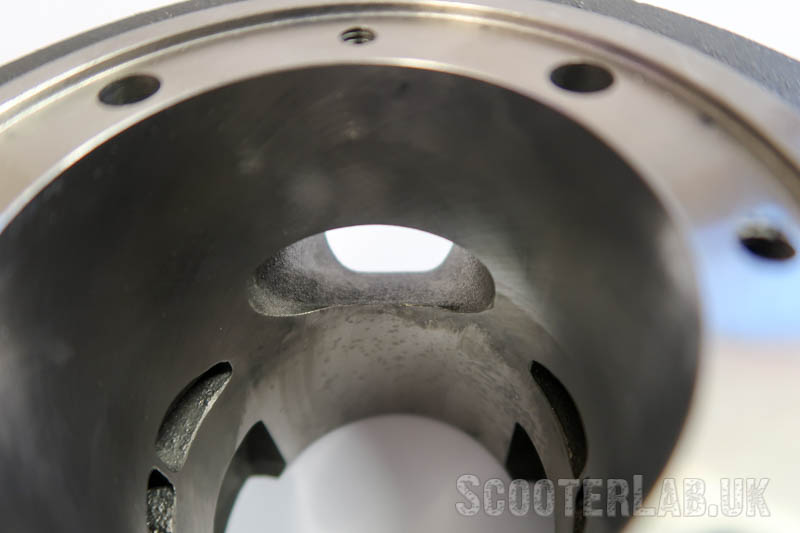
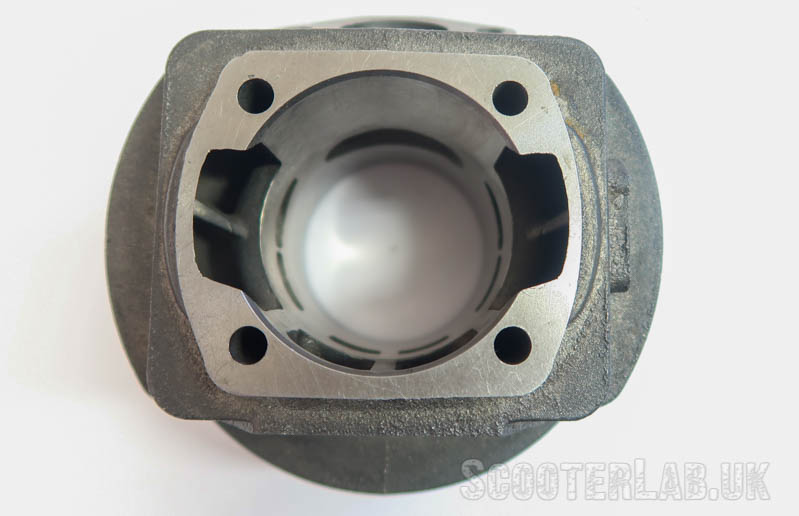
A little seize low on the skirt is not usually a problem but if a piston seizes in the ring-lands (the top section near the piston rings) then aluminium from the piston can get smeared and trap the piston rings. If that happens then it’s more serious and it may be impossible to re-start the bike.
With Egig’s strongly barrelled piston, this sort of seizure damage is unlikely, but not impossible.
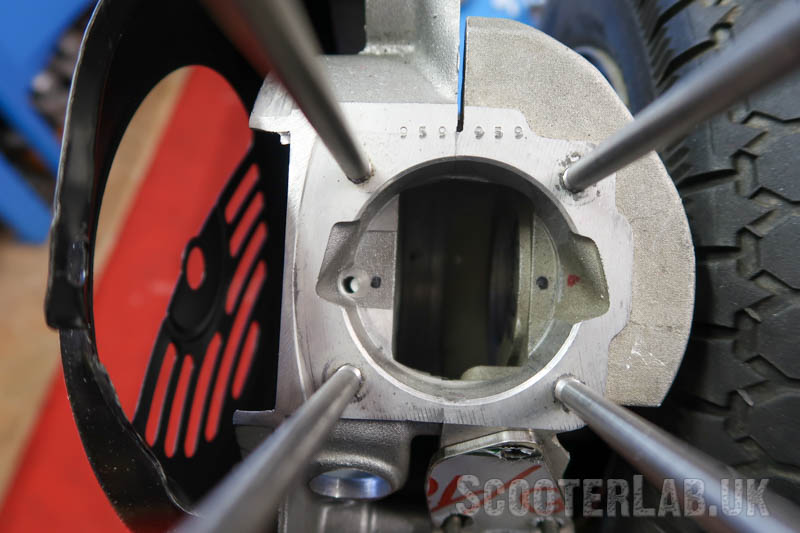
How can this be plug-and-play?
Surely you must need to do some Dremel-work to get 25hp out of this kit?
According to Egig, no you don’t. Along with several other distinguished tuners, he’s done the testing and he knows for certain that opening out the transfer area of the casings offers no discernable power advantage on this kit, or many others. Grinding away virgin metal does however weaken your engine casings. For that reason alone he says that this kit is better fitted to un-ported casings.
Using standard 51mm stroke cranks you absolutely don’t need to get them welded up or machined either. Just bolt the supplied blanking plate over the inlet port and you are good to go.
E.A.S.Y
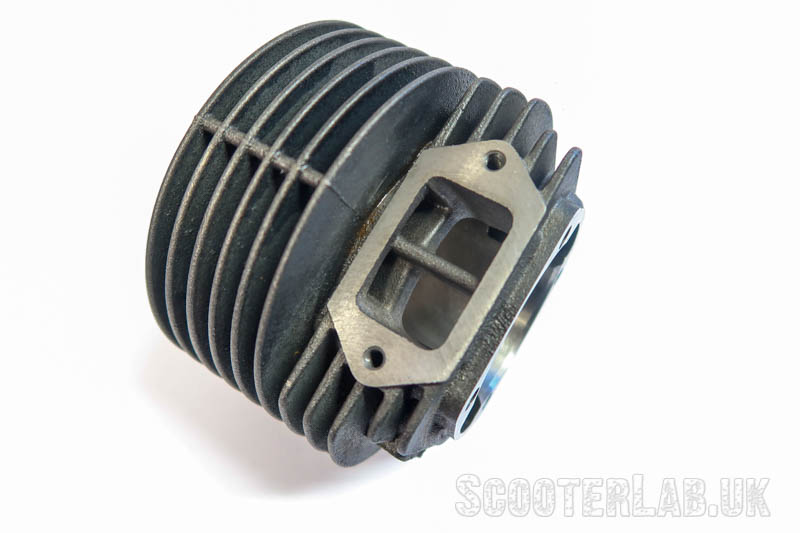
My casing is already converted for crankcase reed!
No worries, you can continue to use that and simply fit the supplied blanking plate for the cylinder inlet port. You can even run with rotary disc inlet if you prefer, and buy a suitable rotary induction crankshaft.
I would be surprised though, if either of those solutions made as much power as the 8-petal, double-apex reedvalve block that you can buy separately to bolt to the cylinder.
Egig has tried to make this reed kit as universal as possible. He says that the supplied inlet manifold should work with both smallframe and PK chassis without the carb banging on the floor of the frame.
The scooter I tried was fitted with a cheap-as-chips 30mm YSN copy of the PHBH Dellorto.

So far Egig has five prototypes running, two of which have covered 5,000km. Having checked the pistons Egig is confident that this kit is a good solution for road use. Certainly, if cast iron was good enough for Piaggio for many thousands of miles then…
The only bad part is that, unlike most other iron kits, Egig has no immediate plans to make oversize pistons for it. He is concerned that the head, which spigots inside the cylinder, will no longer centralise correctly with an oversized bore.
From my perspective, if there isn’t the advantage of oversizes on offer, making it a ‘kit-for-life’ then I’d prefer to have the improved cooling offered by an alloy-Nicasil kit, but he says that the iron used for this kit is very hard wearing.
The most important thing with all cast iron kits is correct jetting and cooling. With his fan for the SIP Vape ignition and correct jetting for the altitude in his area Egig maintains that he can hold 130 km/h (81 mph) on the motorway for 10km or more.
“This is a kit you could ride to Africa” he says, proudly.
In Egig’s experience, as long as the bearing seats are ok then yes, you can fit this kit to your standard engine, though he recommends the SIP casing as an affordable upgrade.
Special Crankshaft Essential
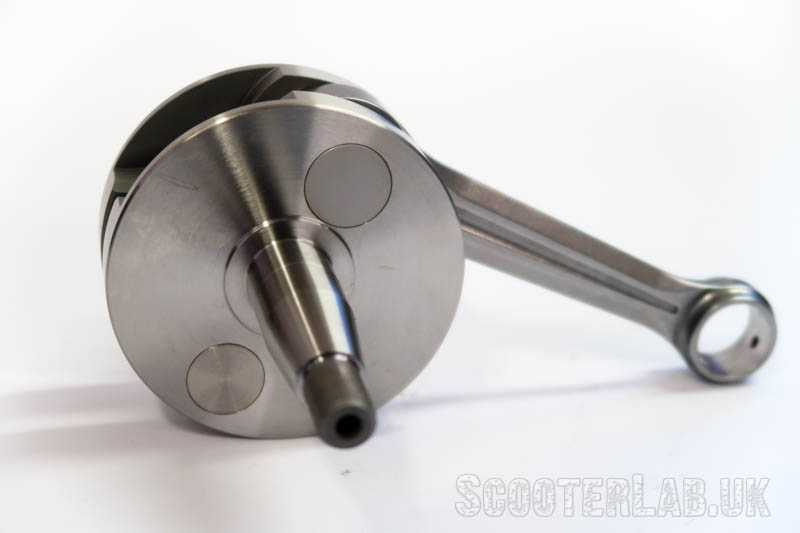
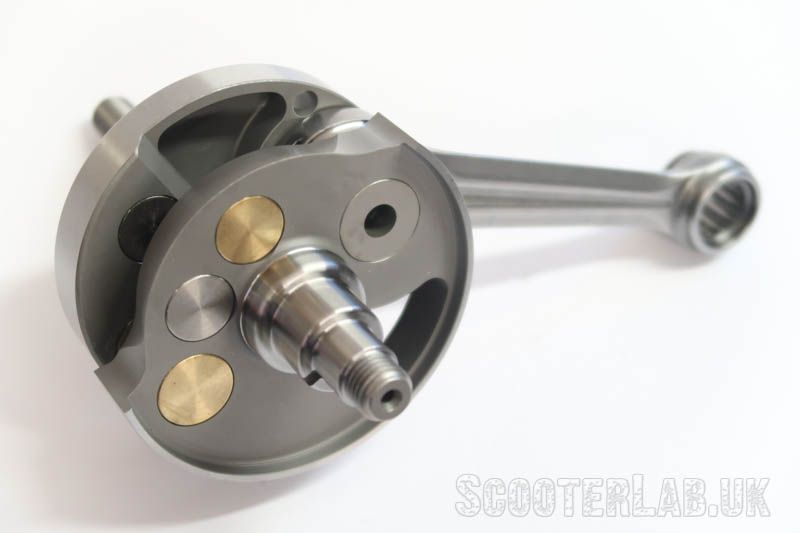
One of the only financial burdens in an otherwise easy and affordable engine conversion is that you MUST fit a dedicated crankshaft with a 115mm long rod.
Egig entrusts his crankshaft production to friend and collaborator, Fabbri, who makes correctly-balanced 51-stroke cranks both in full-web for cylinder reed and also rotary valve format. The cranks retail for around €400 which is not excessive for the quality you are getting, but it’s not cheap either.
The good news is that the kit itself isn’t too expensive at 280 Euros, though the cylinder reed inlet set-up costs an extra €140.
Compared to the opposition; that’s a lot of very accessible performance for a fair price.
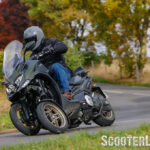
You’ll find out in part 2 tomorrow as Sticky follows Egig around the Italian mountains on the 170, whilst mr Egig plays on his 300cc smallie…
Words and photos: Sticky









Very interesting.. Good