
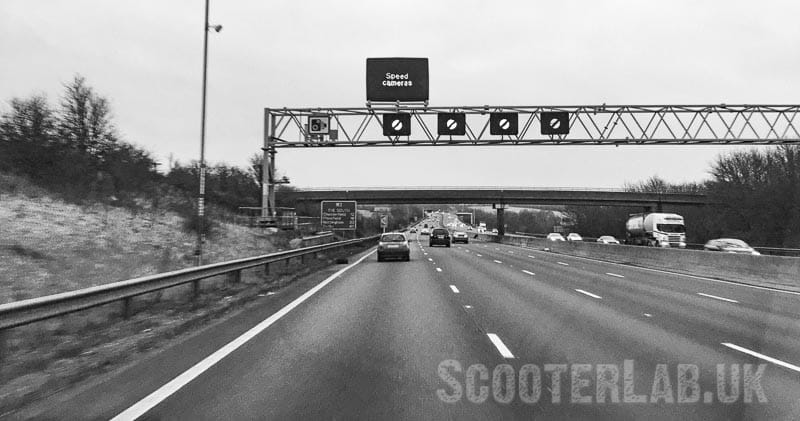
I’m sure many long-distance scooter riders will be pleased to hear that the rollout of more All lane Running (so-called ‘Smart’ motorways) has been paused until a full five years of safety data is available for schemes introduced before 2020.
Current stretches of the controversial ‘All Lane Running’ (ALR) Smart motorway schemes will be further upgraded with best-in-class technology to improve their safety. The Department for Transport is investing £900 million pounds to improve safety on existing ALR motorways. £390 million will be spent installing more than 150 extra emergency areas, giving drivers/riders 50% more places to stop in the event of an emergency (work to be completed by 2025). The remainder of the funding will be used to upgrade cameras to detect ‘Red X’ offences and also detect stopped vehicles.
Whilst further data is being collected, National Highways will continue finishing schemes currently under construction and they will open with the latest stopped vehicle technology in place. Design work on schemes already in the planning stage will continue so they’re ready to be rolled out depending on the outcome of the pause, although no preparatory construction will take place.
National Highways, in line with the Committee’s recommendations, will also pause the conversion of Dynamic Hard Shoulder (DHS) motorways – where the hard shoulder is used an additional lane at busy times whilst investigations are made into alternative ways of operating them in a way that will make it simpler for drivers. Additional stopped vehicle tech will also be used on these sections.
Transport Secretary Grant Shapps said:
“One of my first actions as Transport Secretary was to order a stocktake of smart motorways and since then, I have worked consistently to raise the bar on their safety. I am grateful to the Transport Committee and to all those who provided evidence for its work.
“While our initial data shows that smart motorways are among the safest roads in the UK, it’s crucial that we go further to ensure people feel safer using them.
“Pausing schemes yet to start construction and making multi-million-pound improvements to existing schemes will give drivers confidence and provide the data we need to inform our next steps. I want to thank safety campaigners, including those who have lost loved ones, for rightly striving for higher standards on our roads. I share their concerns.”
National Highways CEO Nick Harris said:
“We have listened to public concerns about smart motorways and we are fully committed to taking forward the additional measures the Transport Committee has recommended.
“While we pause those all lane running schemes yet to start construction we will complete the schemes currently in construction, we will make existing sections as safe as they can possibly be and we will step up our advice to drivers so they have all the information they need.
“We are doing this because safety is our absolute priority and we want drivers to not just be safer, but also to feel safe on our busiest roads.”
Despite data in the Highways England ‘Smart Motorways Stocktake’ suggesting that smart motorways are the safest roads in the country (by mile travelled) we all know that they’re essentially just a quick and easy way to add an extra lane to our existing motorway network. By using the hard shoulder as an extra lane thousands of miles of extra motorway space could be utilised with a relatively low-cost and on a small timescale. They’re pretty much an instant network extension.
If you’ve ever been unfortunate enough to break down on a smart motorway you know that you’re at the mercy of whoever is behind you. 38 people were killed on smart motorways between 2014-2019. What the data doesn’t reveal though is whether those deaths would have been prevented if there had been a hard shoulder available instead.
Let us know your thoughts and experiences of smart motorways in the comments below.