
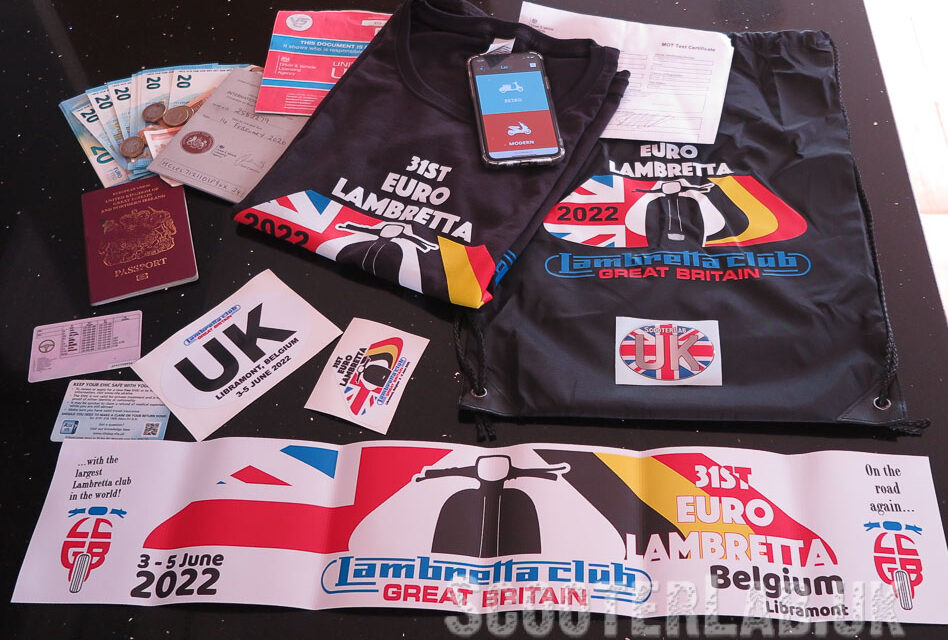
Euro Lambretta Belgium is coming up very soon and that’ll be followed by Vespa Days in Portugal, plus there are a fair few foreign events, like Wangerland in Germany.
Before you set off into the unknown (the European Union or Schengen Area as they call it) here’s our guide to help your trip go as smoothly as a ride on unsuitable vintage scooters is possible to go…
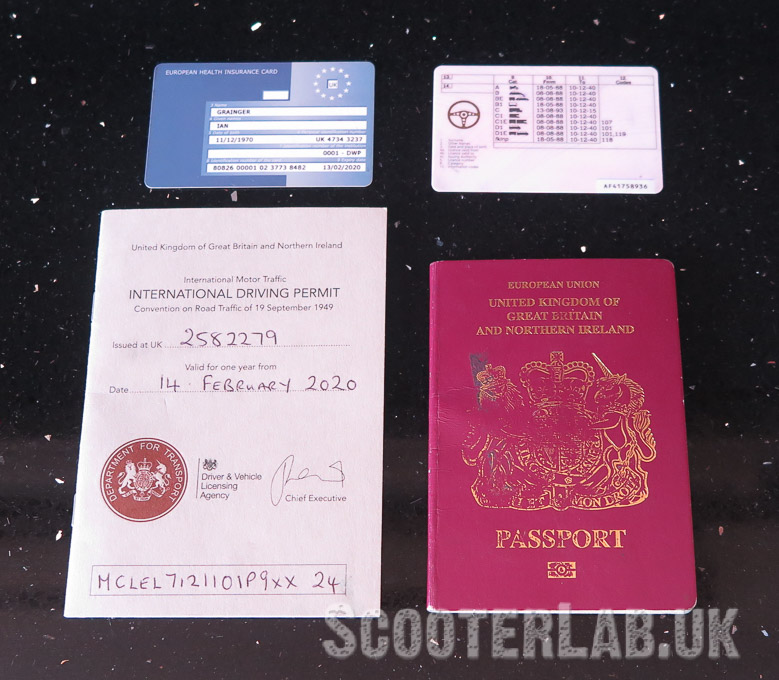
Back in the old days, a passport was valid up until its expiry date (as you’d expect). To travel, all you needed was a valid passport (or even an old one-year paper passport issued over the counter by the nice Post Office lady many years ago).
Aside from giving UK citizens a traditional blue passport, Brexit has made things a bit more complicated.
When you renewed a passport before September 2018 the UK Passport Office would add any ‘unspent’ time onto the new passport meaning you could have up to ten years and nine months on your new one. That rule has made things tricky for travellers who have a passport set to expire in the near future because most EU countries won’t accept the ‘added time.’ Your passport needs to have been issued within ten years of your entry into their country and have three months remaining when you return.
Check both the issue and expiry date of your passport before travelling or you may be refused travel.
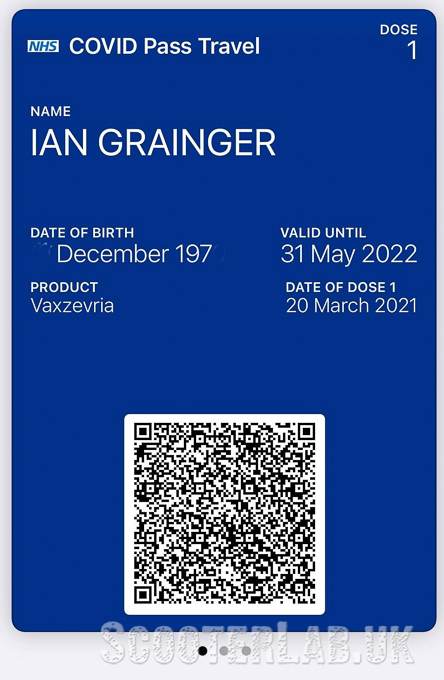
You’ll need to take your Covid passport if you have one and be warned, some countries don’t accept the paper version (Nigel, our plastics man was refused travel a week ago because him and his wife didn’t have theirs and they couldn’t download them at the airport).
It’s best to download the NHS app BEFORE YOU TRAVEL and save the Covid passports to your phone’s ‘wallet.’
• Covid passports only last for 30 days on the app so be sure to renew them before you travel
• It’s worth screenshotting them and sending them to somebody travelling with you just in case your phone dies
Depending on how many doses of the vaccine you’ve had, you may have three or four Covid passports and possibly a ‘recovery’ one if you’ve had Covid within 180 days of travel. You’ll need at least two doses or be able to show a positive recent PCR result.
Download the NHS app here
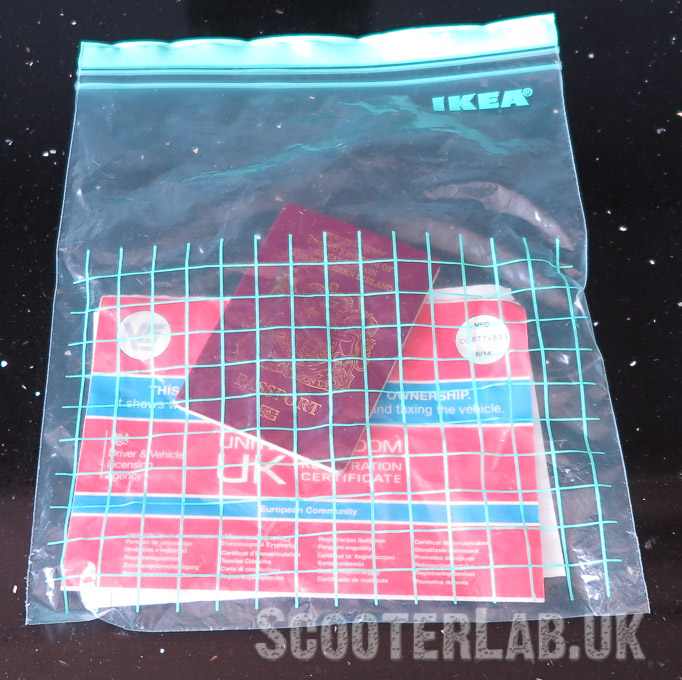
Licence
Providing you have a valid FULL UK photo card licence you don’t need to do anything differently. Just take your licence with you. If you’re riding on a CBT then you’d better pass your test quickly as it’s ILLEGAL to drive/ride abroad on L-plates!
If you still hold a paper licence, or your licence was issued in the Isle of Man, Gibraltar or the Channel Islands you’ll need to get yourself an International Driving Permit from the Post Office. If you’re from mainland UK you DON’T need an International Driving Permit.
Documents
Legally you need to carry your V5 (logbook) and MOT certificate (if applicable) when riding abroad and for most countries your insurance documents. It’s worth taking an extra photocopy of them as well just in case you need it. If your logbook states ‘Historic Vehicle’ you may be able to argue that you don’t need an MOT – providing your French/Spanish/German/Italian is good.
SLUK tip: Stick your documents in a zip-seal bag and put them somewhere where rain can’t get at them.
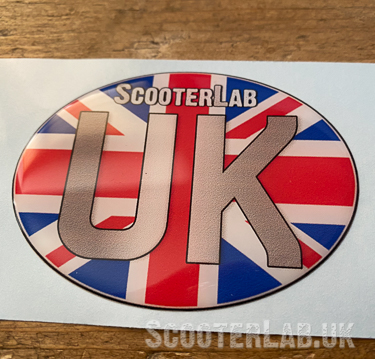
Your old GB sticker is no longer valid in the EU so you need to fit a UK one on the back of your vehicle, luckily Lambretta Euro riders will have received one with their goody bags. Or you could buy one of our SLUK UK gel stickers.
There’s not a lot of room on the back of most scooters so sticking it to the rear of your luggage is an option,
If your number plate already has a ‘UK’ symbol on it you don’t need to fit a sticker.
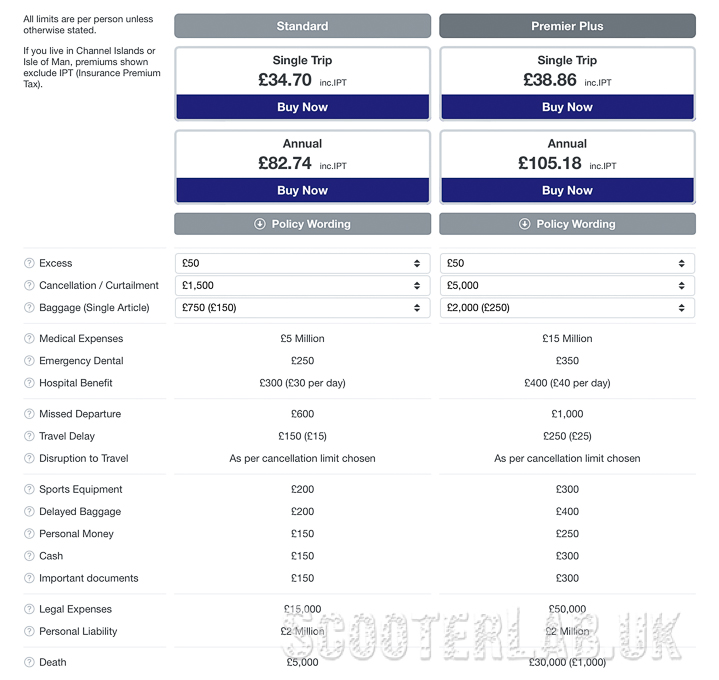
Never travel abroad without at least some basic travel insurance cover. Not many policies cover you for riding anything higher than 125cc abroad so it’s essential to check the small print and exclusions on any cover before you take a policy out. I’ve used Coverwise for my insurance for a good few years but even they have started to make it more difficult for certain ‘hazardous activities’, riding grannies shopping bikes across Europe is one of them…
Carole Nash WILL cover you for riding though, a quote for two people riding through the Netherlands and Belgium came to just £34.70 for eight days and gives peace of mind.
Breakdown cover
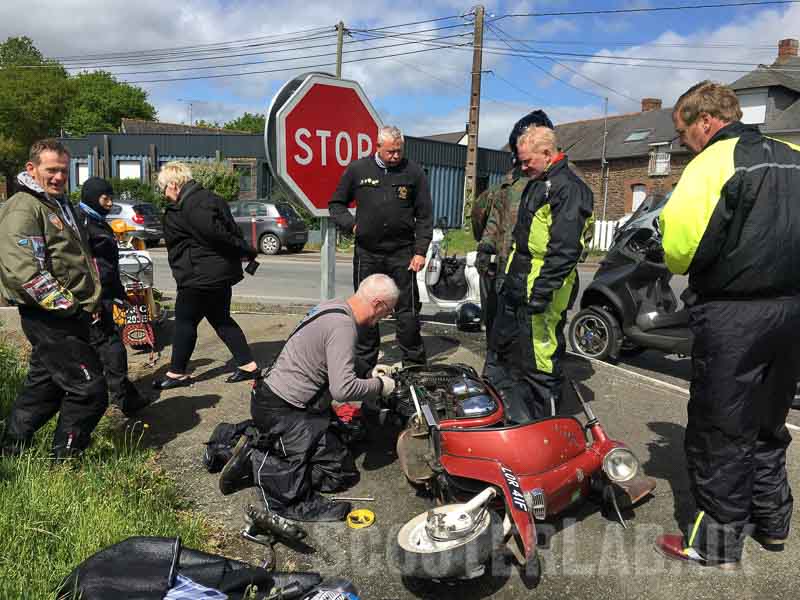
Unless you’re riding a scooter that is less than ten years old, or have European breakdown cover with your insurance company you’ll struggle to get decent cover for breaking down abroad. Most companies don’t cover older vehicles.
It’s also worth noting that even if you do have cover it isn’t unknown for your recovery company/insurance company NOT to take you and your scooter home if they deem the scooter to be worth less than it’ll cost them to repatriate you. There have also been quite a few cases of the scooter being stuck in Europe for a few weeks whilst the owner has been sent home, or of riders being dumped at a non-specialist garage on a Sunday afternoon.
Van hire
It can be more beneficial to hire a van one way if you breakdown to get you to the port, or your destination then the port on the way home. Although most ferry firms and the tunnel will refuse a scooter being pushed onto their vessel (try and blag that on the day). Remember if you’re hiring a vehicle abroad you’ll need a credit card to secure it.
Although the EHIC is no longer available it is still valid until the date of expiry. It’s been replaced now by the GHIC – Global Health Insurance Card. You can get yours for free here.

UPDATED May 24th
Passenger locator forms are no longer required for Belgium, more information available here.
This particular subject seems to change on a regular basis and depends on which country you’re travelling to, or through. We suggest you look up the latest information for the countries you’re visiting as close to your travel date as possible.
To give you an example of what you have to do, here’s a link to one for Belgium. It’s worth noting that if you’re staying less than 48-hours you may not need to fill one in. Also, you may struggle to fill in the form accurately if you’re stopping in multiple places during your trip so some artistic licence may be needed.
Check with Gov.uk, the foreign embassy, your ferry company, Euro Tunnel or airline for the latest recommendations before you travel.
Some UK mobile phone companies are starting to charge for data/mobile use in the EU again. Check with your service provider before travelling. Or alternatively, you should receive a text giving you details of the charges (if there are any) as soon as your phone finds a local network.
I’ve recently travelled to the Netherlands and Canary Islands and been able to use my EE phone as normal for no additional cost.

Fuel
In the UK we’re lucky enough to still be able to buy super unleaded fuel. In the EU you’ll struggle to find E5 and will no doubt have to use E10. It’s worth taking a fuel additive/ethanol protector with you. One small spoonful is enough to treat a tank. We sell the Millers protector at SLUK, it lasts for 100 tank fulls and costs £30 a bottle so share it with a few friends.
**There has been a bit of a rush on this product but we have some on order, it’s due in early next week 23rd May**


France
Always check with the country/countries you’re travelling in or through for the latest rules, they are subject to change and misinterpretation. As a rule, most countries require you to have a high-viz vest/jacket to put on if you break down or stop at the side of the road so it’s worth always taking one abroad, remember your pillion needs one too.
France is especially strict so here are some things to consider…
• High-viz jacket/gillet to be used in case of emergencies – you and your pillion can be fined for not having one and fined even more for not wearing one at the side of the road
• If you’ve bought ‘proper’ riding gear in the last three years it should be CE approved, in France you can be fined if you’re not wearing gloves, or not wearing CE approved gloves
• Despite what you may think, you do not need a breathalyser kit when riding through France. The law was overturned
• You also don’t need reflective helmet stickers

Belgium isn’t the most exciting place to ride through (especially if you take the motorways) and their roads can give the UK a run for their money when it comes to potholes. It is a place I’ve ridden through many times though and so far have never had any problems with the law.
Motorcyclists are obliged to wear protective kit including gloves and a long-sleeved jacket, as well as trousers with long legs and boots covering the ankle.
Netherlands
As you’d expect, life is quite relaxed in Holland but it’s still worth having a high-viz in case of breakdowns. Filtering is legal in the Netherlands as long as you don’t pass other vehicles at more than 6mph.
Germany
• Filtering is illegal in Germany unless the other traffic is stationary
• You’re meant to carry a warning triangle (Oxford Products sell a folding one)
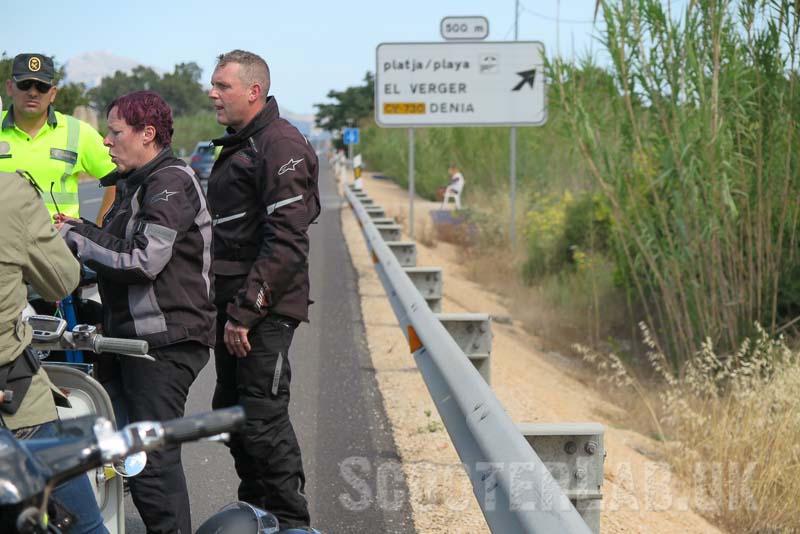
Spain is probably the friendliest place in Europe to ride, everybody is very courteous to riders (and drivers), they obey the rules and always like to see and chat about bikes and scooters.
Beware that you don’t fall foul of their driving rules and regulations though. For instance, make sure your lights are fully working at all times (you’ll be fined €100 for not having daytime headlights), don’t cross a solid white line, even if you are going to a garage on the opposite side of the road (you’ll be fined €100). Don’t exceed speed limits, especially in villages (you guessed it, €100 fine). Spanish police aren’t big fans of your expansion pipe either, no matter how nice it sounds but do like to receive €100! Regular and frequent police check points help prevent misbehaving! Oh, and if you wear glasses you should also carry a spare pair.
The wearing of in-ear headphones or connecting an intercom to your phone by Bluetooth IS illegal in Spain. Contrary to what you may read elsewhere it ISN’T illegal to use an intercom.
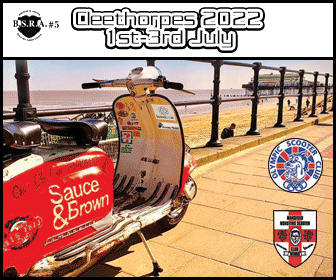
In the photo above a couple of friends are just getting a €100 fine for a defective headlight whilst a roadside prostitute sitting in a plastic patio chair (under the road sign) is allowed to go about her business unhindered.
Portugal
• One of the peculiar laws for Portugal is that dashcams/helmet/bike cameras are ILLEGAL. Personal privacy is taken very seriously. You can be fined €1500 if you’re caught using one
• Filtering is ILLEGAL in Portugal and you can be fined for doing it but many bikers ignore the rule. Just be warned
• Drink driving laws are stricter than in the UK, the Portuguese limit is 0.05% (in the UK it’s 0.08%). If you’ve had your licence for less than two years that drops down to 0.02% in Portugal. Obviously seasoned drivers are better at drink driving than newbies. Don’t do it though wherever you are
• It is ILLEGAL to carry fuel in cans so hide yours if you need to take one.
Italy
Italy isn’t a bad place at all to ride through and most of the usual EU rules apply (high-viz etc.). It’s worth noting that speed limits automatically decrease on Italian dual carriageways and motorways if it rains 68mph becomes 55mph and 80 mph drops to 68mph on the motorway.
It’s also worth bearing in mind that you can get more than one automatic fine on the same stretch of road so watch out for signs warning of bus lanes and speed cameras. I was ‘lucky’ enough to get three bus lane fines and a speeding ticket within a few minutes in Milan. They will and do pursue you back in the UK (as I know to my €450 cost).
Keep us posted
This article was written in May 2022 and is meant to give you some useful reminders before you head off into the EU but please check for the latest updates and advice (updates are in red boxes). We all know that Brexit and Covid have given the world a green light to change things at a moment’s notice and the freedom to travel can no longer be taken for granted.
If you have any updates, or advice to add please feel free to email us at editorial@scooterlab.uk
Iggy








Fuck all that, I’ll stay here ………………
Me too and I won’t comply with the “Covid Passport” digital Id either.