
Rare original footage of the Vespa competitors in the Paris-Dakar 1980.
Vespa PX Paris Dakar 1980
In 1980, not long after the founding of the world\’s most arduous desert race, four Frenchman entered on Vespa scooters…
The 1980 attempt was really driven by Vespa France more than by Piaggio Italy. The French importers fielded a team of four gallant riders, of which two actually completed the distance; though not quickly enough to register in the formal results.
This expedition was supported by Piaggio to the extent that they supplied and prepared Vespa PX200s both for practice and for the actual race. Piaggio also sent factory mechanics to take part in the rally as co-pilots in the Land Rovers which served as back-up for the scooters, and were entered into the race in their own right.
In the end only two of the four Vespas made it to Dakar and only one – that of Mark Simonot – crossed the line under its own steam. Bernard Tcherniavsky’s engine repeatedly seized on the final run along the beach in Dakar and was finally dragged over the line in one of the support Land Rovers.
The Vespa riders had endured a torrid time leading to some blatant rule-breaking en route. As night drew in whilst stuck in some of the worst stages some of the Vespa riders elected to load their scooters onto the Land Rovers simply to stay in the running. This did not go unnoticed by some of the other tail-end bike competitors who had been beaten to the finish of certain sections by the Vespas without ever being overtaken by them on the course!
De-brief
The truth of the 1980 campaign was that small problems with the scooters – which could have been solved by more testing and preparation – and subtle gaps in team leader Piot’s organisation made the trip a living hell: sufficient to crush the spirit of all but the most resolute man.
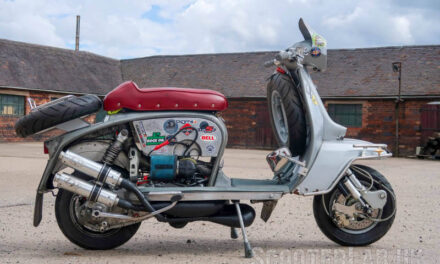
The Vespas PX200s used ‘appeared’ largely standard with the exception of knobbly tyres, enlarged fuel tanks, external air-filters, carrying handles and a special exhaust system. We’ll never know exactly what other changes were made to the engines, though I doubt very much if they were totally standard.
The most consistent area of failure was the rubber silent blocks used to attach the top of the rear shock absorber to the pressed steel frame of the Vespa. These are simply a large block of rubber bonded to two metal plates: one with a nut into which the shock screws and another with a stud which fits through a hole in the frame.
In the early ‘90s UK Scootercross scene these silent blocks were a relatively common failure point on Vespas. The first you’d normally know about it was when you’d go to pick up the back of a scooter. The frame would lift but the rear wheel would stay on the floor!
In normal riding these silent blocks are reliable because they are always sandwiched together in compression. It’s only when the scooter is being jumped that they tend to fail because then the bonded rubber is being asked to support the whole weight of the engine, often as it is being forced firmly away from the frame by the shock absorber. If one fails mid flight then there is nothing to stop the shock moving around and being jammed against the frame at an odd angle when the scooter lands. This is what happened with disturbing regularity to the Paris-Dakar riders, with the twisted shocks then rubbing against the tyres and puncturing them. Piot hurriedly ordered some uprated silent blocks from the Piaggio factory, but it was several more soul-destroying days before anything arrived.
The other notable problem – though only to the machine of hard-riding CRS riot policeman Bernard Neimer – was a complete failure of the frame. Bernard’s machine actually started to fracture at the floor. Despite hurried welded repairs by the Piaggio mechanics the cracks eventually became so severe that Neimer was forced to retire before his scooter snapped in two.

Fancy an adventure?
If you would like to ride your Vespa or Lambretta in the desert, then check out these scooter raids for later this year.
Are you missing out?
Did you know that you can get FREE Notifications of every SLUK story sent through to most devices. Simply follow the instructions in our Free SLUK Notifications article to get on board the ScooterLab Train.
If you dig this free new service, please tell your friends.