
 European fuel stations already use E10
It’s been announced that UK fuel stations will be moving over to E10 (petrol containing 10% Ethanol) fuel by September THIS YEAR! The move is effectively doubling the current ethanol content of pump fuel and bringing us in line with many parts of Europe.
The switch to E10 is said to remove 750,000 tonnes of CO2 emissions per year and have the same environmental impact as losing 350,000 cars from the road. As much as it’s good for the environment, it sends a cold shiver down the spine of classic vehicle owners. Ethanol and older engines aren’t a good combination, especially tuned 2-strokes. Sticky delved deep into biofuel a while back (if you get up close he still has an aroma of sugary plant-based petrol), you can read the full story here if you need educating about ethanol.
Even the government press release states:
A small number of older vehicles, including classic cars and some from the early 2000s, will continue to need E5 fuel, which is why supplies of E5 petrol will be maintained in the ‘Super’ grade.”
That means any of us running an older scooter will need to use more expensive super unleaded from September. If you cast your minds back to the time when leaded petrol was being phased out and replaced with unleaded, a certain percentage of fuel stations still had to offer leaded fuel (at inflated prices) to cater for older vehicles. That was slowly diminished and higher octane super unleaded became the norm for users of more fragile vehicles. The scenario with E10 is very similar, although this time super unleaded will be the more expensive alternative to E10.
Things are moving fast in the world of fossil fuels, Transport Secretary, Grant Shapps said:
We’re going further and faster than ever to cut emissions from our roads, cleaning up our air as we accelerate towards a zero-emission transport future.”
Sadly for us lovers of classic scooters (especially tuned ones) that future is zooming fast towards us. British manufacturer Jaguar Land Rover announced recently that the Jaguar brand will be 100% electric by 2025, just four years away. Whilst many other manufacturers are aiming for zero emissions by 2030. That’s not to say we’ll not be allowed to ride our two-stroke scooters by then but you can bet more and more ULEZ/clean air zones will be rolled out over the next few years restricting where, when and what we can ride.
Iggy
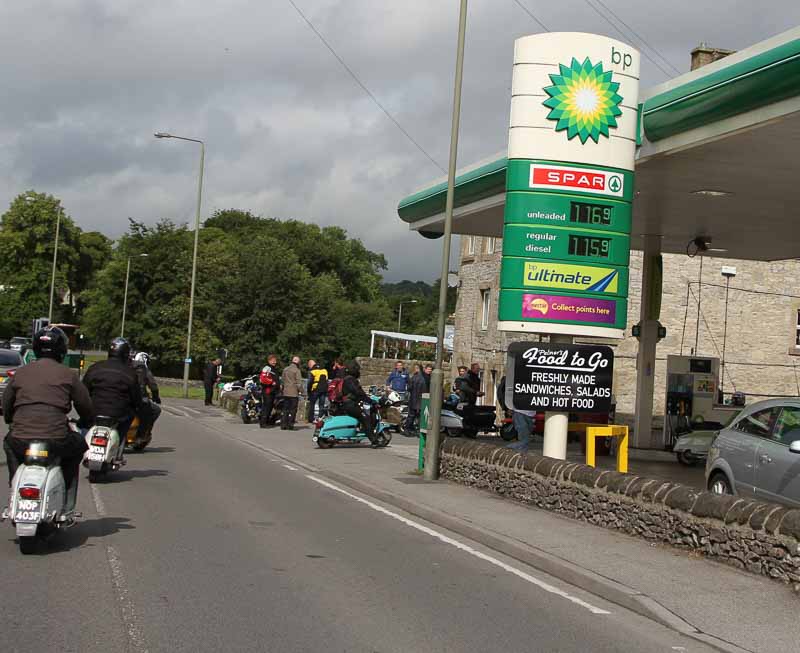 Racing to be first at the super unleaded may be the next big thing…
British industry
Aside from helping the environment and obvious health benefits, one other good thing about biofuels is that it helps local industry. The recent government announcement has lead to the Vivergo sugar plant reopening in the north east, creating 100 jobs. No doubt that number will increase as the fuel becomes more widely used… or at least until electric vehicles kill it off.
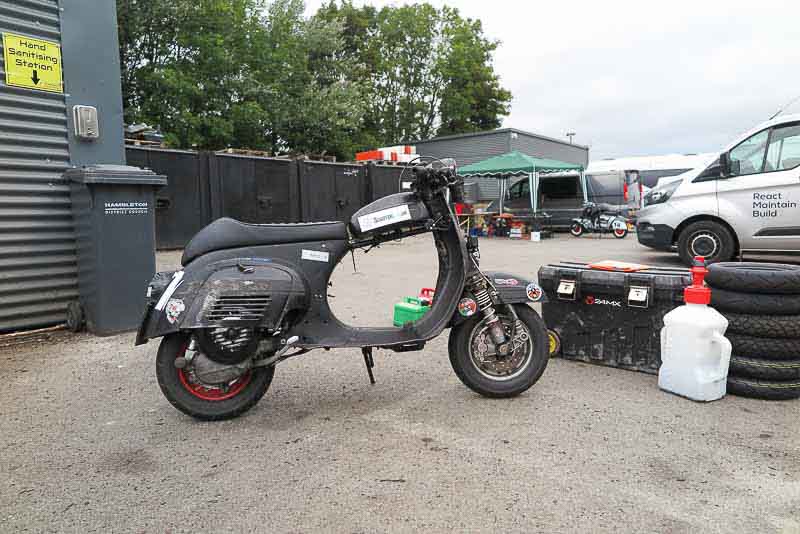 SLUK Racing – powered by 99 octane pump fuel
Limited fuel choice and what to do about it?
When E5 Super Unleaded gets deleted from the fuel pumps you have two options:
- Prepare your scooter to run on 10% ethanol fuel. Suggestions on what to do are included in this previous SLUK article. Riders in the US have been running on higher ethanol content fuel for years but a friend of mine from Serbia who was working in California as a mechanic basically had a full-time job cleaning out the fuel systems of various classic vehicles. The longer they stand unused the worse the contamination gets.
- Switch to using ‘Super Plus’ unleaded fuel. The governments have made a commitment that this higher octane fuel will remain on sale in the UK for another five years from September 2021. Super Plus fuel is rated E5 which means that it contains “up to 5%” ethanol which is the same or less than current Super Unleaded. The good news about that is that you won’t need to make any changes to your scooter. The bad news is that you’ll pay around 15p more per litre at the pumps than you did for normal E5 unleaded. Of course, competition and increased consumption may actually bring the prices down a bit in the future but not by a lot.
Is Super Plus E5 safe to use in my scooter?
Pretty much every long-distance rally going scooterist has a tale about someone filling up with ‘bad fuel’ and blowing up an engine, which was previously running fine, within a few miles.
There is a surprising commonality between these tales and the use of Super Plus unleaded fuel.
Some of these stories can be discounted as old wives tales and upon examination are coincidences with an imminent mechanical failure that was going to happen anyway.
However, a large number remain and I’ve encountered it myself riding to Holiday in Holland rally in the early 2000s. Super Plus grade from one motorway petrol station left my scooter engine pinking and running rough so I took it easy. Many of those who didn’t back-off ended up with holed pistons.
With the increased use of Exhaust Gas Temperature gauges people can be much more scientific about this issue. I’ve been told by several people that they can see EGT temperatures jump up after filling with ‘bad fuel’. As soon as they refill again somewhere else the temperatures drop back down to normal.
Degraded Fuel
My theory, and I must emphasise that this is only a theory, is that a lot of the ‘bad fuel’ problems people encounter with fuels seem to come from low-traffic pumps. By that I mean literally ‘low traffic’ because it’s a filling station in the middle of nowhere, or low traffic because you’ve chosen to use Super Plus unleaded when everyone else was using normal 95 octane.
What a lot of people don’t consider is that petrol is made up of lots of different hydrocarbon fractions that degrade or evaporate over time. Indeed, you can even see this happening if you fill up on a hot day and look over the top of your open petrol tank you can see a visual haze and distortion as the lighter elements of the fuel evaporate. Fractions such as Butane evaporate at anything over 0 degrees Centigrade.
When the 95 Super Unleaded fuel tank for the filling station is filled from the lorry, the fuel in it will be 95 octane, but the longer it sits in the tank the more it will degrade. If the filling station is busy then it will be topped up more frequently and the chances are that it is 95 grade all the time.
When it comes to Super Plus 97 unleaded, if you went to a petrol station where most people were using 95 octane then it might have been in the tank and degrading for a long time.
Essentially, I don’t think that there’s anything wrong with running on ‘fresh’ Super Plus unleaded fuel, apart from the cost.
My advice for running on Super Plus all the time is to try to fill up at busier high-traffic filling stations and avoid any so desolate that they look like a horror movie film set. Hopefully when the new legislation comes in from September many more drivers will switch to Super Plus and the ‘freshness’ of that grade of fuel in the petrol stations will improve.
SLUK Racing – powered by Tesco
For our Team SLUK endurance racing expeditions we’ve run on Tesco 99 octane Super Plus with no adverse effects, but typically Tesco filling stations are busy all the time…
Sticky

It’s been announced that UK fuel stations will be moving over to E10 (petrol containing 10% Ethanol) fuel by September THIS YEAR! The move is effectively doubling the current ethanol content of pump fuel and bringing us in line with many parts of Europe.
The switch to E10 is said to remove 750,000 tonnes of CO2 emissions per year and have the same environmental impact as losing 350,000 cars from the road. As much as it’s good for the environment, it sends a cold shiver down the spine of classic vehicle owners. Ethanol and older engines aren’t a good combination, especially tuned 2-strokes. Sticky delved deep into biofuel a while back (if you get up close he still has an aroma of sugary plant-based petrol), you can read the full story here if you need educating about ethanol.
Even the government press release states:
A small number of older vehicles, including classic cars and some from the early 2000s, will continue to need E5 fuel, which is why supplies of E5 petrol will be maintained in the ‘Super’ grade.”
That means any of us running an older scooter will need to use more expensive super unleaded from September. If you cast your minds back to the time when leaded petrol was being phased out and replaced with unleaded, a certain percentage of fuel stations still had to offer leaded fuel (at inflated prices) to cater for older vehicles. That was slowly diminished and higher octane super unleaded became the norm for users of more fragile vehicles. The scenario with E10 is very similar, although this time super unleaded will be the more expensive alternative to E10.
Things are moving fast in the world of fossil fuels, Transport Secretary, Grant Shapps said:
We’re going further and faster than ever to cut emissions from our roads, cleaning up our air as we accelerate towards a zero-emission transport future.”
Sadly for us lovers of classic scooters (especially tuned ones) that future is zooming fast towards us. British manufacturer Jaguar Land Rover announced recently that the Jaguar brand will be 100% electric by 2025, just four years away. Whilst many other manufacturers are aiming for zero emissions by 2030. That’s not to say we’ll not be allowed to ride our two-stroke scooters by then but you can bet more and more ULEZ/clean air zones will be rolled out over the next few years restricting where, when and what we can ride.
Iggy

British industry
Aside from helping the environment and obvious health benefits, one other good thing about biofuels is that it helps local industry. The recent government announcement has lead to the Vivergo sugar plant reopening in the north east, creating 100 jobs. No doubt that number will increase as the fuel becomes more widely used… or at least until electric vehicles kill it off.

Limited fuel choice and what to do about it?
When E5 Super Unleaded gets deleted from the fuel pumps you have two options:
- Prepare your scooter to run on 10% ethanol fuel. Suggestions on what to do are included in this previous SLUK article. Riders in the US have been running on higher ethanol content fuel for years but a friend of mine from Serbia who was working in California as a mechanic basically had a full-time job cleaning out the fuel systems of various classic vehicles. The longer they stand unused the worse the contamination gets.
- Switch to using ‘Super Plus’ unleaded fuel. The governments have made a commitment that this higher octane fuel will remain on sale in the UK for another five years from September 2021. Super Plus fuel is rated E5 which means that it contains “up to 5%” ethanol which is the same or less than current Super Unleaded. The good news about that is that you won’t need to make any changes to your scooter. The bad news is that you’ll pay around 15p more per litre at the pumps than you did for normal E5 unleaded. Of course, competition and increased consumption may actually bring the prices down a bit in the future but not by a lot.
Is Super Plus E5 safe to use in my scooter?
Pretty much every long-distance rally going scooterist has a tale about someone filling up with ‘bad fuel’ and blowing up an engine, which was previously running fine, within a few miles.
There is a surprising commonality between these tales and the use of Super Plus unleaded fuel.
Some of these stories can be discounted as old wives tales and upon examination are coincidences with an imminent mechanical failure that was going to happen anyway.
However, a large number remain and I’ve encountered it myself riding to Holiday in Holland rally in the early 2000s. Super Plus grade from one motorway petrol station left my scooter engine pinking and running rough so I took it easy. Many of those who didn’t back-off ended up with holed pistons.
With the increased use of Exhaust Gas Temperature gauges people can be much more scientific about this issue. I’ve been told by several people that they can see EGT temperatures jump up after filling with ‘bad fuel’. As soon as they refill again somewhere else the temperatures drop back down to normal.
Degraded Fuel
My theory, and I must emphasise that this is only a theory, is that a lot of the ‘bad fuel’ problems people encounter with fuels seem to come from low-traffic pumps. By that I mean literally ‘low traffic’ because it’s a filling station in the middle of nowhere, or low traffic because you’ve chosen to use Super Plus unleaded when everyone else was using normal 95 octane.
What a lot of people don’t consider is that petrol is made up of lots of different hydrocarbon fractions that degrade or evaporate over time. Indeed, you can even see this happening if you fill up on a hot day and look over the top of your open petrol tank you can see a visual haze and distortion as the lighter elements of the fuel evaporate. Fractions such as Butane evaporate at anything over 0 degrees Centigrade.
When the 95 Super Unleaded fuel tank for the filling station is filled from the lorry, the fuel in it will be 95 octane, but the longer it sits in the tank the more it will degrade. If the filling station is busy then it will be topped up more frequently and the chances are that it is 95 grade all the time.
When it comes to Super Plus 97 unleaded, if you went to a petrol station where most people were using 95 octane then it might have been in the tank and degrading for a long time.
Essentially, I don’t think that there’s anything wrong with running on ‘fresh’ Super Plus unleaded fuel, apart from the cost.
My advice for running on Super Plus all the time is to try to fill up at busier high-traffic filling stations and avoid any so desolate that they look like a horror movie film set. Hopefully when the new legislation comes in from September many more drivers will switch to Super Plus and the ‘freshness’ of that grade of fuel in the petrol stations will improve.
SLUK Racing – powered by Tesco
For our Team SLUK endurance racing expeditions we’ve run on Tesco 99 octane Super Plus with no adverse effects, but typically Tesco filling stations are busy all the time…
Sticky









can we not just bring back 4 star please?
The issue with ethanol & two stroke engines is not straight forward. There are many ‘papers’ on the subject & effects upon engine components & from my understanding, even nitrile seals should not yer be troubled. Unfortunately, there are those that market Viton seals as being essential when they are not…..yet. Two stroke engines have the advantage of oil. Not often you can say that.
However, the quality of fuel dispensed is another issue & difficult to prove when things go wrong. I had the fuel pump in a car fail years ago & believe it due to using the cheaper Supermarket fuels. My current drive uses only Shell Ultra, uses no oil between changes & has clocked nearly 250,000.
Personally, since leaded high octane petrol was being phased out, I have bought only Super Unleaded from BP, Shell or Tesco for any scooter. It costs more but my belief is that you get more for your money. Swings & roundabouts it may be, but buying quality fuel is to my mind some insurance toward peace of mind.
Ordinary unleaded petrol is best kept for lawn mowers & generators……
Think we all know writing is on the wall when it comes to 2 strokes on UK/EU roads , think maybe five to ten years and the government might start to offer a scrap-age roll out to owners. Reality is fossil fuel powered vehicles are history.
So basically we will be running our ve-hic-les on moonshine, d’yuk yuk!
I will not be buying any new machines with ICEs now. I expect my 2013 GTS and 2005 800cc motorsickle to be banned or silly taxed off the road within five years and then, even Euro 5 bikes to be ULEZ’d beyond that. What’s the point buying a new machine that will need to be scrapped or priced out of towns in ten years! That’s not environmentally friendly.
I will save my money until either Piaggio or Scomadi produce a beefy ‘leccy scoot that does at least 75mph and 100 mile range at top whack.
I guess Niall at Retrospective will be raking it in with all the classic conversions that will need to be done.
It’s a different world now folks. Better get with the programme or be left cycling to rallies in Lycra g-strings! God forbid!
There’s always someone different!
Unfortunately I don’t ride a scooter but used to but for many years have, and still do, drive a 2-stroke engined car. Yes, they exist and a number of manufacturers have made them.
I’ve therefore read your E10 comments with great interest, alarm and concur with them.
Running a water-cooled 2-stroke I have different oil requirements to air-cooled (have to stick to mineral oils, definitely avoid PIBs but that’s another story).
Already to cope with E5 I run a substantially altered carb – larger Venturi, main jet and idle jet culminating overall in a richer mixture and monitored with an EGT.
With a 2-stroke, more fuel equals more oil equals more smoke! Really an environmental improvement?
It’s fine saying use Super-unleaded but where on earth do you buy it out here in rural Wales? All the garages here only stock Unleaded95 and Diesel!
I’m not a scooter driver either, I am in rural Cumbria and have a 1998 Rover 800 which won’t run on E10. The nearest place that sells E5 is about 20 miles away in the opposite direction to where I usually drive, Grant Shapps staff reckon I should incorporate that into my travelling! So if I need to take my wife to her GP for an appointment I have to drive 20 miles to get petrol, then backtrack those 20 miles and drive another 20 miles to the doctors. The fact they sneaked E10 in under cover of Covid shows how vile they are
I feel your pain John. With classic scooters we’re often running tuned engines and need to stop for fuel at around 50 miles die to tank size. We travel all around the country and Europe to events and when you get to a fuel station on fumes and they haven’t got super unleaded it’s not a nice place to be.
I have a two stroke bike and an 1991 car neither will run on the new fuel but on top of that I have petrol fueled garden multi tool and that will not run on the new fuel either going to be an expensive time soon