
 New large-block 225 and smallblock 200 kits from Casa aimed at the daily riding include some novel technology.
Long Wait for a Largeblock
The Casa Lambretta X1 185cc piston-port kit launched in the early 2000s never set the kit market alight because its performance was relatively modest. It was however, very well made by Gilardoni and has proved to be very reliable.
What the world has been waiting for is a 225 version, but apart from a false-start with a the Casa 210 kit, which was soon deleted, the Lambretta largeblock piston-port engine has been left largely abandoned by Casa Lambretta.
At the end of 2020, that changed with the launch of the new X2 225 kit. The X2 follows a similar format but with completely overhauled porting layout and timings.
Casa Lambretta not Casa Performance
These cylinder kits are the product of Vittorio Tessera’s Casa Lambretta business and developed together with Italian cylinder casting and plating specialists Gilardoni.
His company is not to be confused with Casa Performance; which is the sport arm of Rimini Lambretta Centre. While the two businesses are similarly named, and collaborate on some products such as the Casatronic Ducati ignitions, the two firms remain independent.
Construction
Both the X2 225 and X1-Sport (smallbock 200) use Gilardoni’s protected process for chamfering above and below the exhaust port.
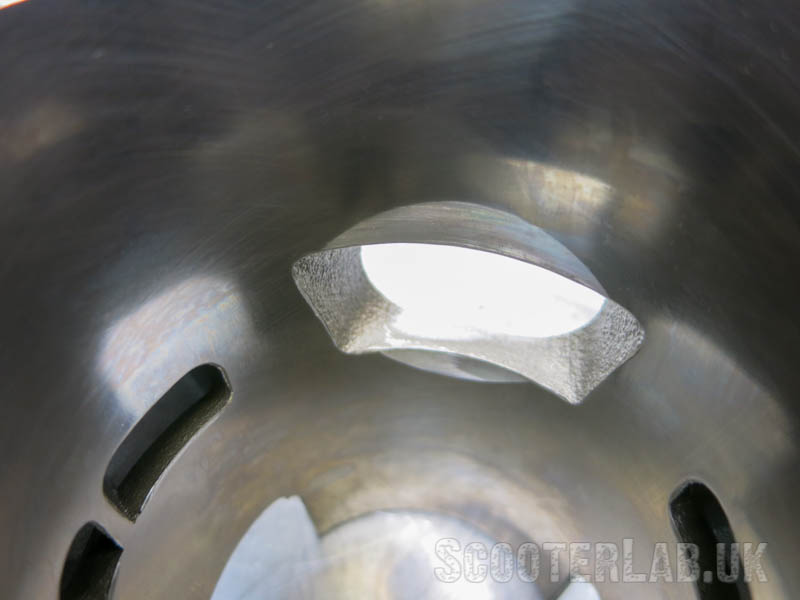 Chamferings above and below the port should aid ring life.

These chamferings are made by a proprietary process which machines a very gentle moon-shaped chamfer into the bore, but not through the Nicasil. The idea is that the chamfer gently eases the ring back into the piston groove after it has passed the port.
The exhaust port itself is trapezium-shaped with quite square corners which would normally be hard on piston rings without Gilardoni’s process.
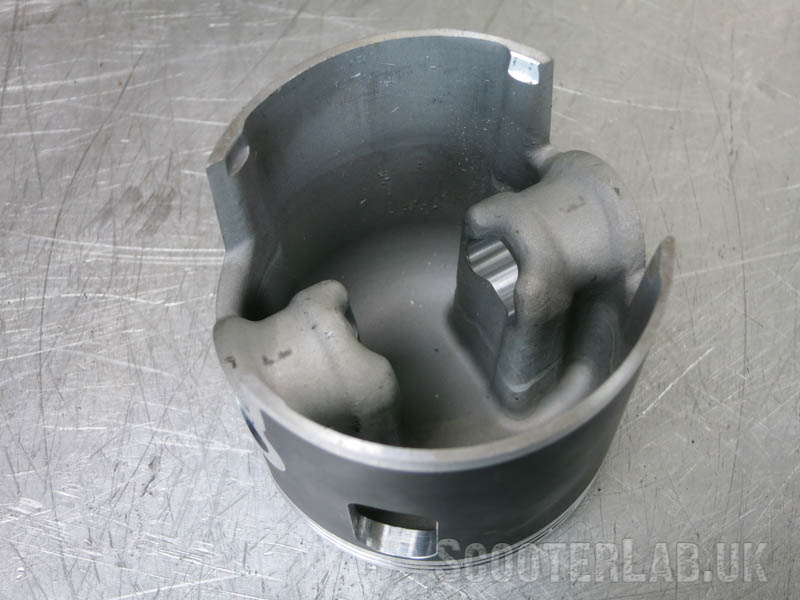 Unique forged piston for the 225 version with machining by Vertex.
The chief difference between 200 and 225 is the choice of piston supplier. Where the smallbock uses a cast Meteor piston, the 225 uses a forged piston made especially for Casa Lambretta.
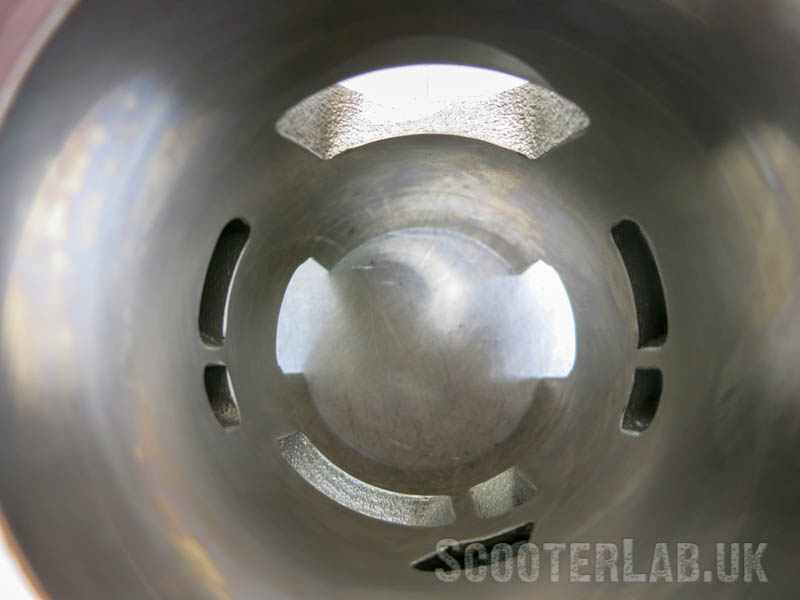
The 225 kit has a single exhaust port with four transfer ports and a slotted rear boost transfer port carved in a zigzag around the outside of the inlet port. Unlike the 186, this port has been reshaped to position the feed in the cylinder more centrally with respect to the main transfers.
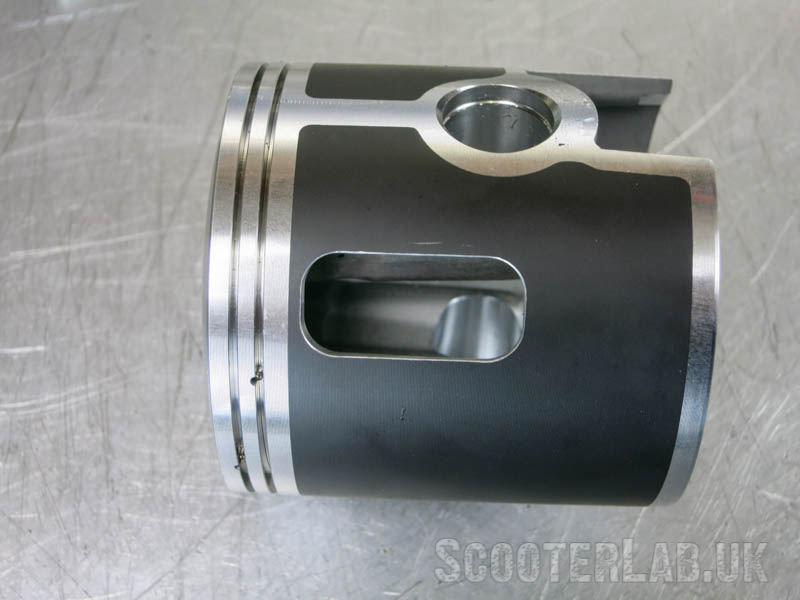 The boost port is fed by a slot in the piston.
The cylinder head still only uses the four main barrel studs but it has a recessed gasket face which locates over a raised ring at the top of the barrel to ensure perfect centralisation. No head gasket is required.
The kit is supplied with inlet and exhaust studs and a small set of gaskets.
 The inlet port is produced using a 3D-printed core which leaves quite a rough surface.
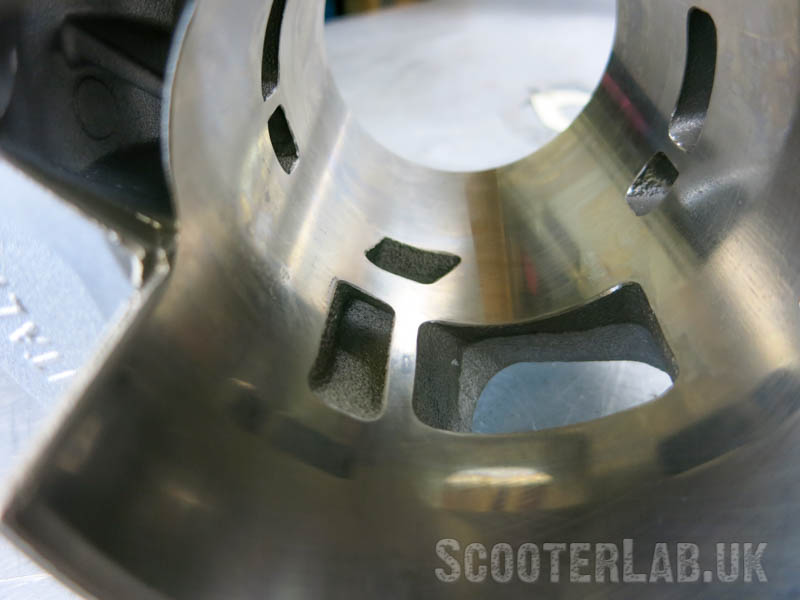 The inlet port is bigger and squarer and features a redesigned boost port.
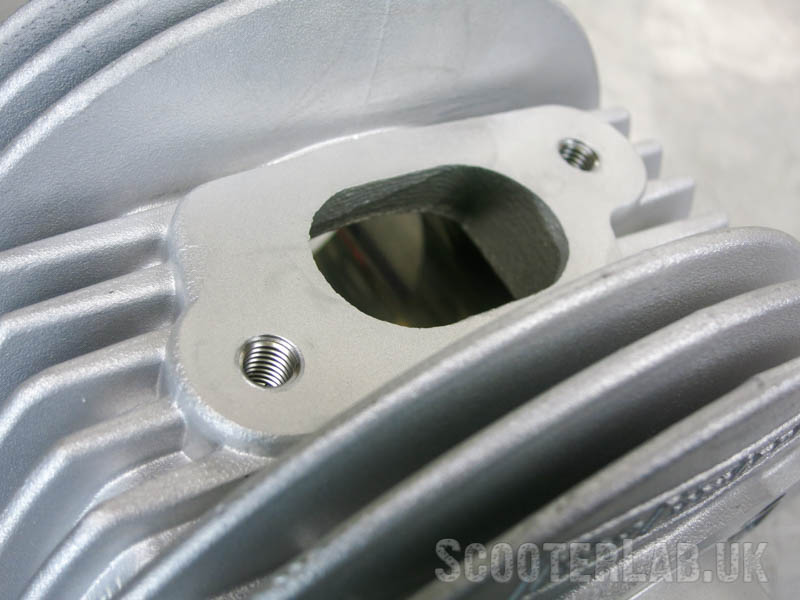 The exhaust studs holes in the aluminium cylinder are fitted with steel thread inserts to reinforce them. This is a good idea when the threads are so shallow.
Point of the Kit
The thinking behind the X2 and X1-S kits is to offer easy, bolt-on conversions for both small and largeblock engines which hide nicely under cowlings and may use standard-looking carbs and exhausts if tuning in your country is not strictly legal.
What these two new submissions offer over the old 186 is some additional performance to justify the fitting of a kit.
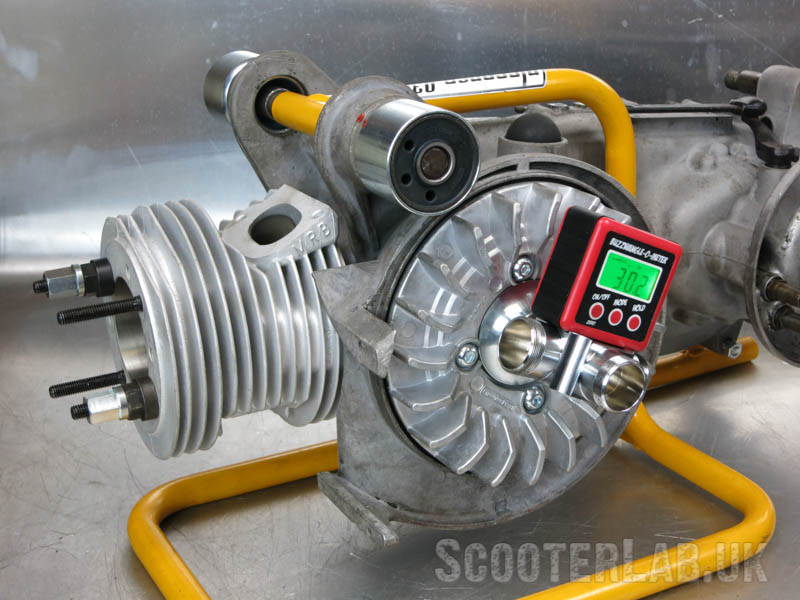 The Buzzwangle method was used to measure all the port timings quickly and accurately.
Performance
For the forthcoming Complete Spanners Lambretta Kit Book that I’m working on I’ve fitted and dyno tested all of the current Lambretta kits using standardised components for all of the tests.
In the case of the graphs below the specs are:
- Unmatched Italian 200 cases.
- SIP crankshaft.
- Ducati Casatronic ignition with special fixed CDI at 18 degrees advance.
- Dellorto 30mm PHBH carb – open mouthed.
- EXHAUSTS: BGM Bigbox V4 and Franspeed Race.
When assembled with the single supplied 1mm base gasket the X2 225 had a 1.7mm squish. We measured the following timings using a Buzzwangle:
- Inlet timing degrees: 143.5 degrees
- Main transfer timing degrees: 130
- Secondary transfer timing degrees: 130 – 130.5
- Boost port timing degrees: 134
- Main exhaust port timing: 175.5
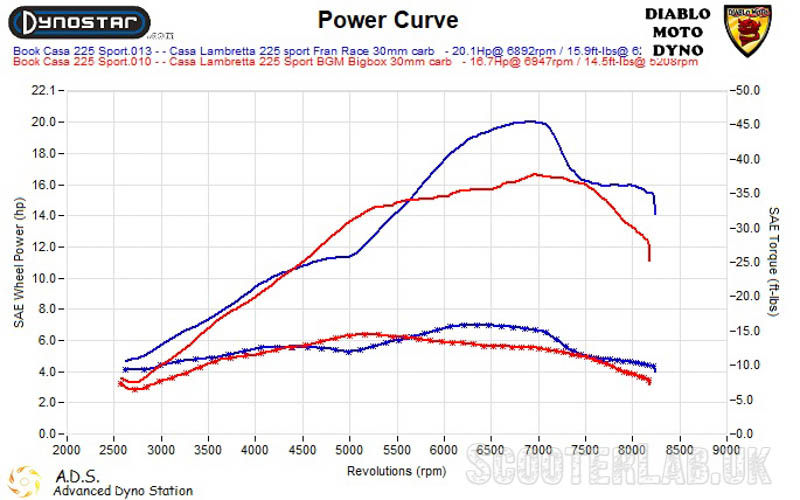
This graph depicts both exhausts on the Casa 225 Sport kit. It actually suits the Franspeed Race quite well; making more peak power, torque and even low rpm potential than the BGM. The only obvious deficit is between 4,500 and 5,500rpm where the BGM is at its strongest in terms of torque.
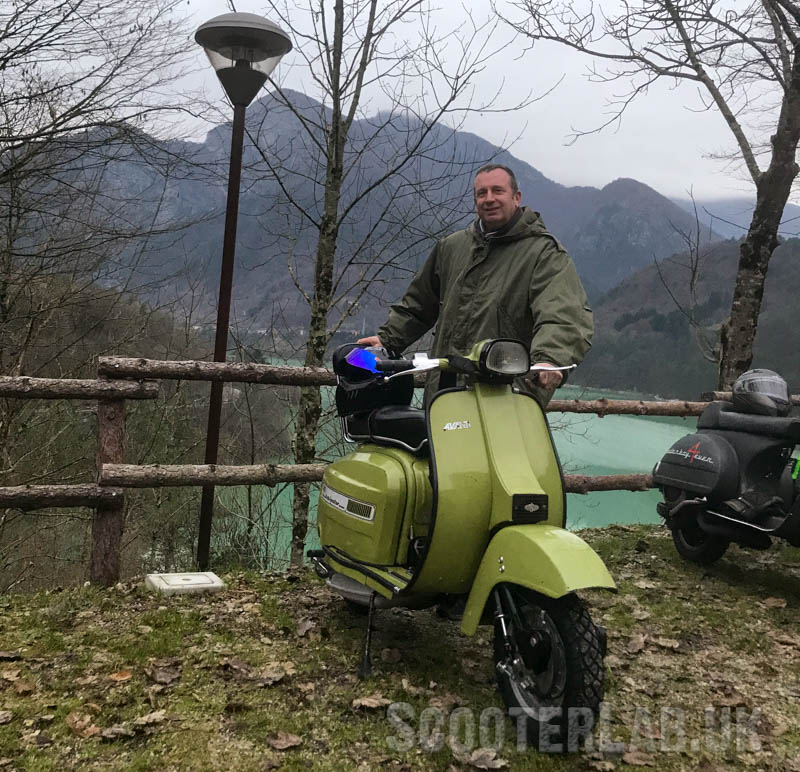 Dean Orton’s first time out on the X2-fitted Kelvinator in December 2019 on a run in the Dolomites.
Quick Spin
I’m fortunate to have tried one of the Casa Lambretta X2 225’s in pretty much the spec shown in the red curve (apart from an air-hose and filter set-up on the 30mm carb).
This was fitted to Dean Orton’s Kelvinator Avanti which is a rare Indian derivative of the Lambretta built by a company more adept at making refrigerators. It’s styled kinda like that too.
Dean used a prototype of the X2 kit on the Kelvinator to ride from Italy to Germany for 2020’s Scooterist Meltdown event. His motor also benefits from a Cyclone 5 Pro gearbox.
With a BGM Bigbox the X2 225 offers quite a wide torque curve, pulling seamlessly from 4,000rpm to 7,500. The low RPM power is similar to a standard scooter but the mid-range and over-rev are greatly enhanced.
In practical terms that makes for a massively practical ride that will get to 70mph and sit there. As such it felt perfect for touring and day-to-day riding but lacks the thrill and ‘kick’ of a higher-end reedvalve kit.
These days I get the impression that there is an increasing shift towards standard-engine like power delivery (but more of it) and crisp carburetion throughout the rev range. If that sounds like what you want then this is the sort of kit for you.
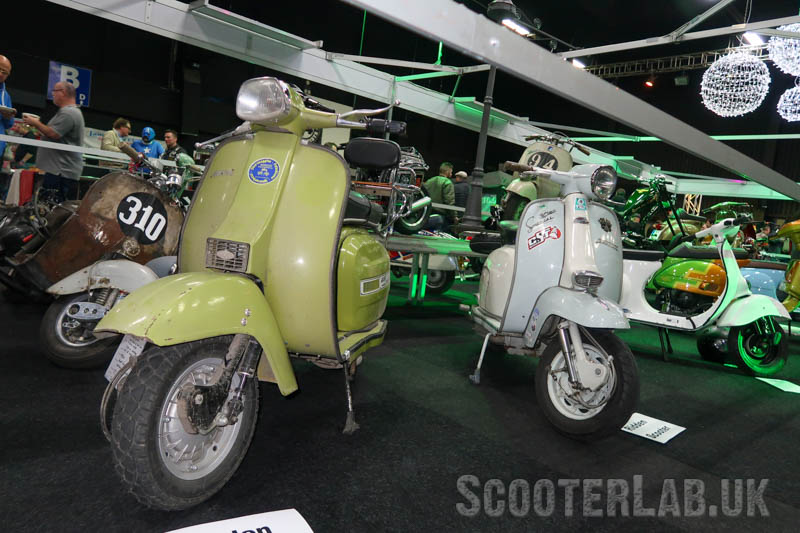 Who knew in February that it would be the only big European scooter gathering in the calendar for 2020?
Getting a Casa X2 or X1-Sport
Prices for the new kits are as follows:
- X2 225 – €460
- X1 – Sport – €450
- matching flange rubber inlet manifolds – €60
These should be in stock shortly at all Casa Lambretta dealers worldwide.
 The X1-Sport has the same layout but uses a Meteor cast piston.
Pros
- Gilardoni-produced cylinder.
- Steel thread inserts used for exhaust studs.
- Self-centralising cylinder head design.
- Funky exhaust port design should offer improved longevity.
Cons
- No set-up instructions supplied as yet – still working on it.
- Design for the raised ‘ring’ in the cylinder gasket face means that long stroke conversions using head gaskets will be more difficult.
- Test cylinder needed fettling to sit flush onto casing due to being tight on the cylinder studs.
- If the liner gets damaged it may be impossible for anyone other than Gilardoni to replate the cylinder to the same specification.
Words and Images: Sticky
Additional Images: Dean Orton
Dyno tested at Diablo Moto

Forthcoming Kit Book
If you want more details on the Casa X2 and X1-Sport then you will find it along with data on its many competitors in the Complete Spanners Lambretta Kit Book
Included in the book there will be tons of additional data, fitting tips, dyno comparisons, user reviews and road tests; including all of the latest replacement engines.
I’d hoped to have it done by now but Covid and the constant launch of new kits made that difficult. The latest target for release is spring this year…
We make and sell various touring products and accessories

Long Wait for a Largeblock
The Casa Lambretta X1 185cc piston-port kit launched in the early 2000s never set the kit market alight because its performance was relatively modest. It was however, very well made by Gilardoni and has proved to be very reliable.
What the world has been waiting for is a 225 version, but apart from a false-start with a the Casa 210 kit, which was soon deleted, the Lambretta largeblock piston-port engine has been left largely abandoned by Casa Lambretta.
At the end of 2020, that changed with the launch of the new X2 225 kit. The X2 follows a similar format but with completely overhauled porting layout and timings.
Casa Lambretta not Casa Performance
These cylinder kits are the product of Vittorio Tessera’s Casa Lambretta business and developed together with Italian cylinder casting and plating specialists Gilardoni.
His company is not to be confused with Casa Performance; which is the sport arm of Rimini Lambretta Centre. While the two businesses are similarly named, and collaborate on some products such as the Casatronic Ducati ignitions, the two firms remain independent.
Construction
Both the X2 225 and X1-Sport (smallbock 200) use Gilardoni’s protected process for chamfering above and below the exhaust port.


These chamferings are made by a proprietary process which machines a very gentle moon-shaped chamfer into the bore, but not through the Nicasil. The idea is that the chamfer gently eases the ring back into the piston groove after it has passed the port.
The exhaust port itself is trapezium-shaped with quite square corners which would normally be hard on piston rings without Gilardoni’s process.

The chief difference between 200 and 225 is the choice of piston supplier. Where the smallbock uses a cast Meteor piston, the 225 uses a forged piston made especially for Casa Lambretta.

The 225 kit has a single exhaust port with four transfer ports and a slotted rear boost transfer port carved in a zigzag around the outside of the inlet port. Unlike the 186, this port has been reshaped to position the feed in the cylinder more centrally with respect to the main transfers.

The cylinder head still only uses the four main barrel studs but it has a recessed gasket face which locates over a raised ring at the top of the barrel to ensure perfect centralisation. No head gasket is required.
The kit is supplied with inlet and exhaust studs and a small set of gaskets.


Point of the Kit
The thinking behind the X2 and X1-S kits is to offer easy, bolt-on conversions for both small and largeblock engines which hide nicely under cowlings and may use standard-looking carbs and exhausts if tuning in your country is not strictly legal.
What these two new submissions offer over the old 186 is some additional performance to justify the fitting of a kit.

Performance
For the forthcoming Complete Spanners Lambretta Kit Book that I’m working on I’ve fitted and dyno tested all of the current Lambretta kits using standardised components for all of the tests.
In the case of the graphs below the specs are:
- Unmatched Italian 200 cases.
- SIP crankshaft.
- Ducati Casatronic ignition with special fixed CDI at 18 degrees advance.
- Dellorto 30mm PHBH carb – open mouthed.
- EXHAUSTS: BGM Bigbox V4 and Franspeed Race.
When assembled with the single supplied 1mm base gasket the X2 225 had a 1.7mm squish. We measured the following timings using a Buzzwangle:
- Inlet timing degrees: 143.5 degrees
- Main transfer timing degrees: 130
- Secondary transfer timing degrees: 130 – 130.5
- Boost port timing degrees: 134
- Main exhaust port timing: 175.5

This graph depicts both exhausts on the Casa 225 Sport kit. It actually suits the Franspeed Race quite well; making more peak power, torque and even low rpm potential than the BGM. The only obvious deficit is between 4,500 and 5,500rpm where the BGM is at its strongest in terms of torque.

Quick Spin
I’m fortunate to have tried one of the Casa Lambretta X2 225’s in pretty much the spec shown in the red curve (apart from an air-hose and filter set-up on the 30mm carb).
This was fitted to Dean Orton’s Kelvinator Avanti which is a rare Indian derivative of the Lambretta built by a company more adept at making refrigerators. It’s styled kinda like that too.
Dean used a prototype of the X2 kit on the Kelvinator to ride from Italy to Germany for 2020’s Scooterist Meltdown event. His motor also benefits from a Cyclone 5 Pro gearbox.
With a BGM Bigbox the X2 225 offers quite a wide torque curve, pulling seamlessly from 4,000rpm to 7,500. The low RPM power is similar to a standard scooter but the mid-range and over-rev are greatly enhanced.
In practical terms that makes for a massively practical ride that will get to 70mph and sit there. As such it felt perfect for touring and day-to-day riding but lacks the thrill and ‘kick’ of a higher-end reedvalve kit.
These days I get the impression that there is an increasing shift towards standard-engine like power delivery (but more of it) and crisp carburetion throughout the rev range. If that sounds like what you want then this is the sort of kit for you.

Getting a Casa X2 or X1-Sport
Prices for the new kits are as follows:
- X2 225 – €460
- X1 – Sport – €450
- matching flange rubber inlet manifolds – €60
These should be in stock shortly at all Casa Lambretta dealers worldwide.

Pros
- Gilardoni-produced cylinder.
- Steel thread inserts used for exhaust studs.
- Self-centralising cylinder head design.
- Funky exhaust port design should offer improved longevity.
Cons
- No set-up instructions supplied as yet – still working on it.
- Design for the raised ‘ring’ in the cylinder gasket face means that long stroke conversions using head gaskets will be more difficult.
- Test cylinder needed fettling to sit flush onto casing due to being tight on the cylinder studs.
- If the liner gets damaged it may be impossible for anyone other than Gilardoni to replate the cylinder to the same specification.
Words and Images: Sticky
Additional Images: Dean Orton
Dyno tested at Diablo Moto

Forthcoming Kit Book
If you want more details on the Casa X2 and X1-Sport then you will find it along with data on its many competitors in the Complete Spanners Lambretta Kit Book
Included in the book there will be tons of additional data, fitting tips, dyno comparisons, user reviews and road tests; including all of the latest replacement engines.
I’d hoped to have it done by now but Covid and the constant launch of new kits made that difficult. The latest target for release is spring this year…
We make and sell various touring products and accessories









I recently bought the X1 200 Sport but now I see there’s virtually no mention of these kits anywhere, have you heard anything about these kits since your article? Were only a handful made? And if so why? I was torn between the X1 and the BGM RT195. I only ordered it yesterday so I can still change! It’s so strange that NO ONE has this kit! Please let me know!
Until recently there was not a lot of data on that kit because it is such a crowded market and it was only launched recently. That kit is reviewed and dyno tested in here though if you’d like to read about it: https://archive.scooterlab.uk/product/complete-spanners-lambretta-kit-book/