
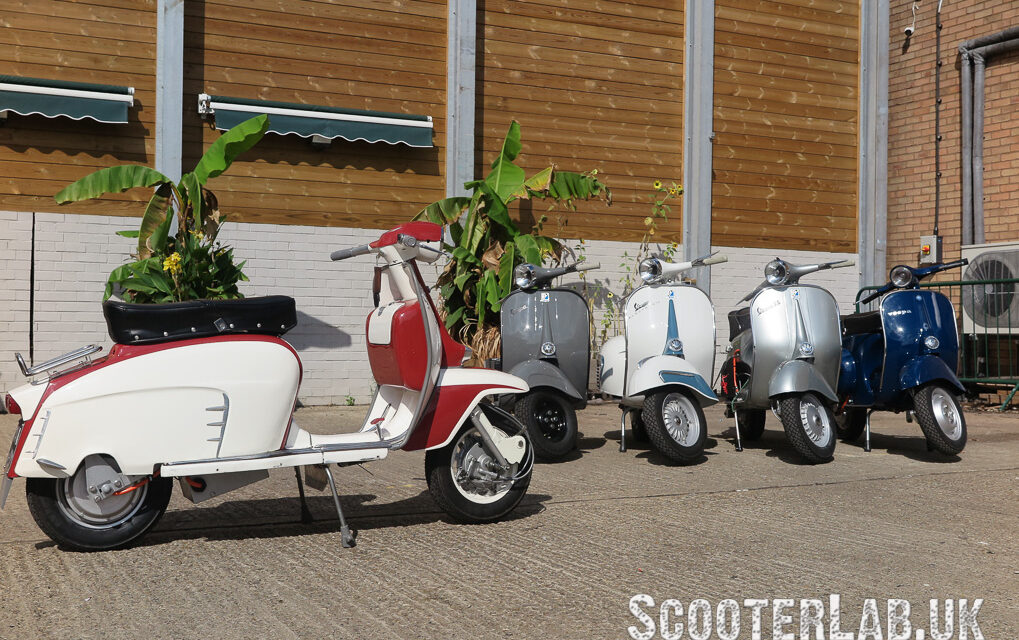
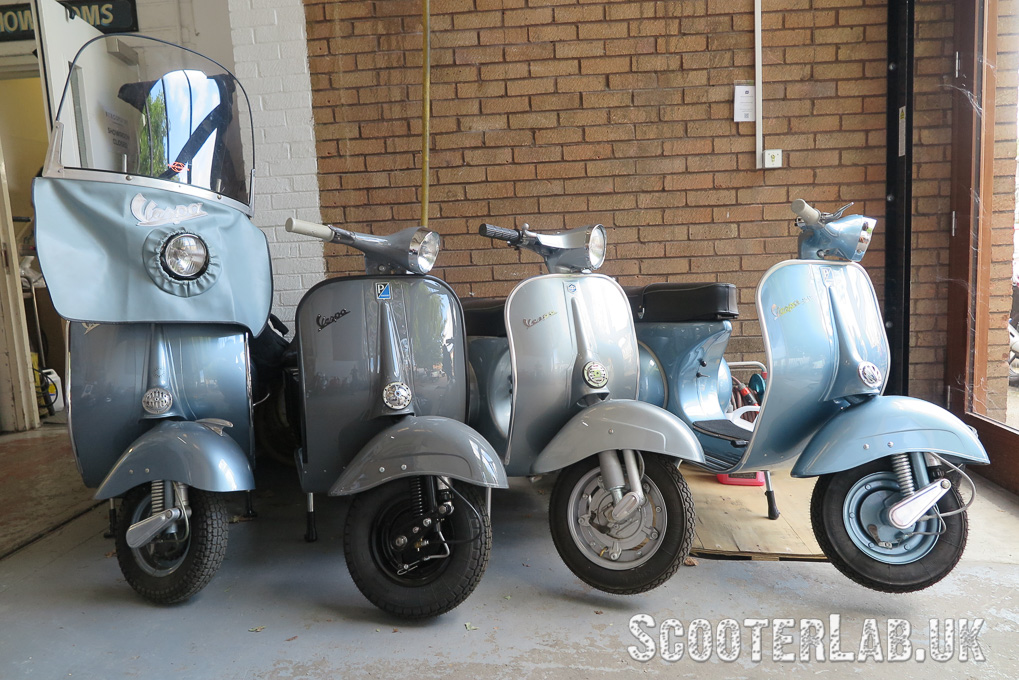
You’ve got to admire the fine looking collection of classic scooters pictured above. Look a bit closer and you’ll spot the (not quite finished) Lambretta isn’t quite as ‘Innocenti’ as the Italians envisaged it back in the day and those four Vespas weren’t how they left Pontedera either.
All these scooters (and many more besides) are the work of Retrospective Scooters in London. Their original two stroke petrol engines have been replaced with a Retrospective designed and built DIY electric conversion kit. Making them useable in any city around the world where emissions regulations have stopped the use of polluting vehicles. Or of course they can be used as a simple alternative to a conventional classic scooter. You get the style without the maintenance.
Rocket science
Regular SLUK readers will have seen a few articles about these Retrospective conversions, we first started following the story back in 2016 and have ridden various scooters and versions of the kit. The idea was originally conceived by rocket scientist (and friend of shop owner, Niall) John Chubb, so although it may not look over complicated to the naked eye, these conversions really are rocket science and there’s a hell of a lot of development work gone into perfecting them.
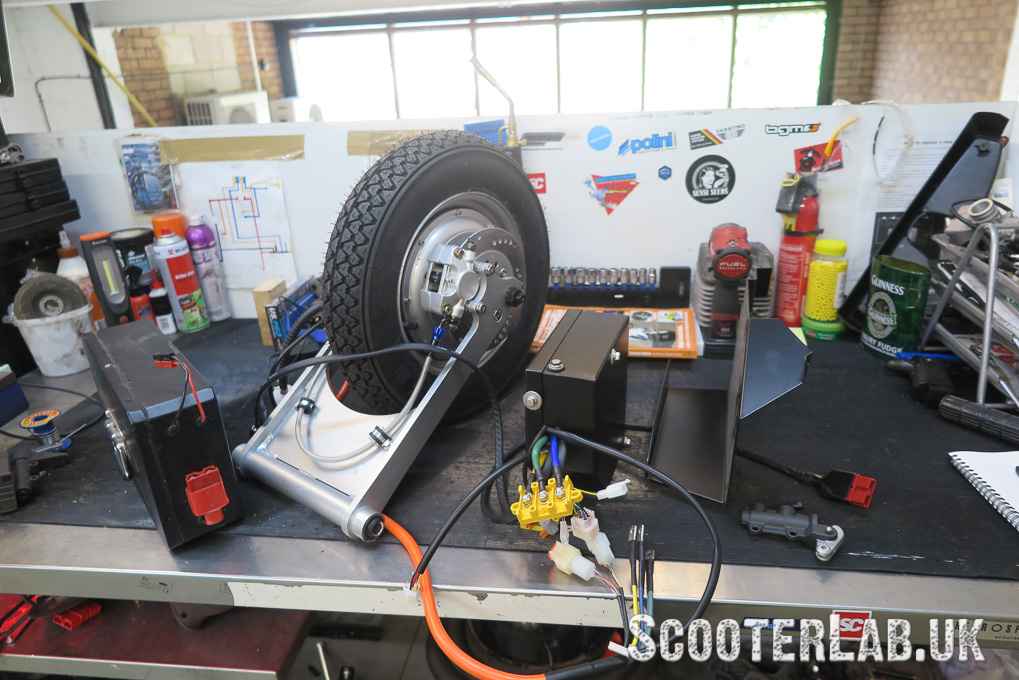
Retrospective have developed John’s ideas into a working small-scale production ready kit that can be fitted to pretty much any classic scooter by the average home mechanic – without the need for any complicated electrical knowledge. The image above shows the latest version of the complete ready to fit kit, which is assembled by hand at the shop in Walthamstow using top quality components. The kit costs around £2995 without a battery.
Fuel choice?
Then you need to add your choice of ‘fuel’ in the shape of a battery, or batteries depending on the scooter you plan to convert and the range you’re likely to need. The LG battery cells are housed in the custom made battery boxes which fit under the side panels of most scooters, or in the space where the tank was on a Vespa smallframe. Using one battery either side on a Lambretta, PX or large frame Vespa gives good weight distribution and a good range. If you’re using more than one battery they run in tandem so will swap over automatically when one battery runs out.
Shop owner and developer, Niall McCart talks us through the latest incarnation of their conversions in the video above. There are a few noticeable differences from the kit fitted to the modified PX we rode three years ago.
Rear disc brake (was drum)
Keyless ignition/remote
Connected by app
Now plugs into standard wiring loom
Latest generation controller
Choice of three batteries
One of the biggest changes to help people when fitting these at home is that there’s now no need to remove your standard wiring loom, it now simply plugs in to your existing loom.
Retrospective can remove a standard engine and fuel tank, clean the frame to get rid of those years of messy oil and petrol, fit the conversion using the specific swinging arm for your model of scooter (Vespa smallframe, Vespa large frame, Vespa wideframe, Lambretta series 1,2, 3, J Range, and many other classics) and get it all plugged in, add the battery/batteries using the specially made battery trays and have it running in the space of a morning or so. For a home mechanic doing one for the first time it’ll probably take them a weekend.
The kit includes
DC brushless electric motor
Sinusoidal motor controller
Custom made swing arm
battery tray and a single removable LG lithium-ion battery
battery chargerKeyless ignition
Battery gauge
All cables
LED headlight conversion
Option to add extra batteries
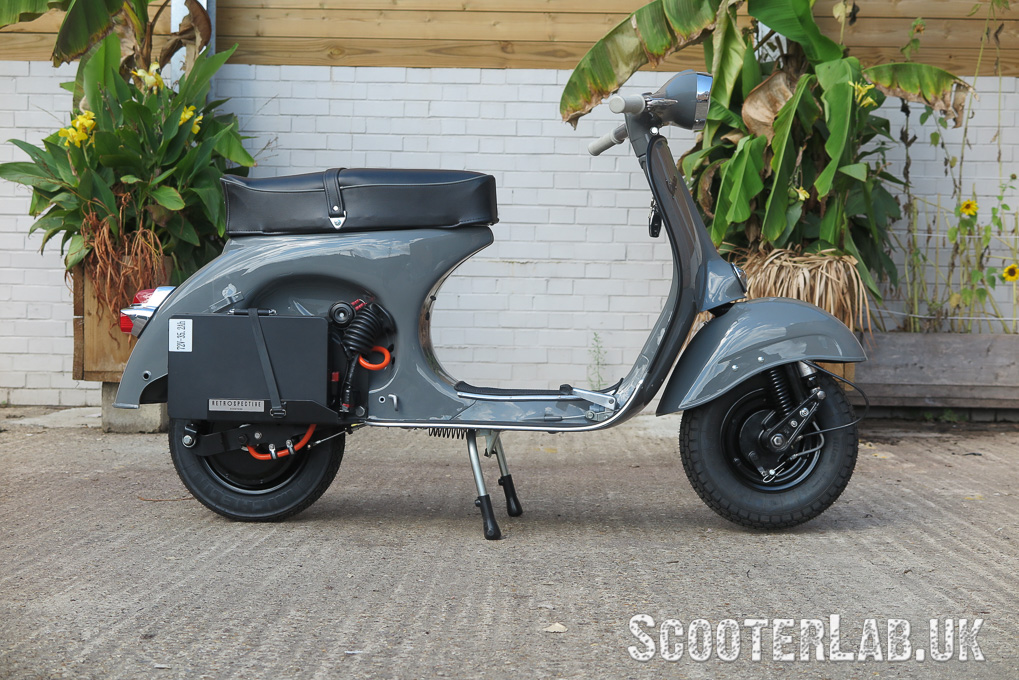
Of course, Retrospective have been restoring and building classic (petrol) scooters to a very high standard for years. They do all work in house, including bodywork and spraying. This Vespa was commissioned by a customer and looks stunning. The owner has gone for a twin battery set up and I think you’ll agree it’s a very neat and discreet job. With the panels on you see very little out of the ordinary and at first glance it just looks like a beautiful Vespa.
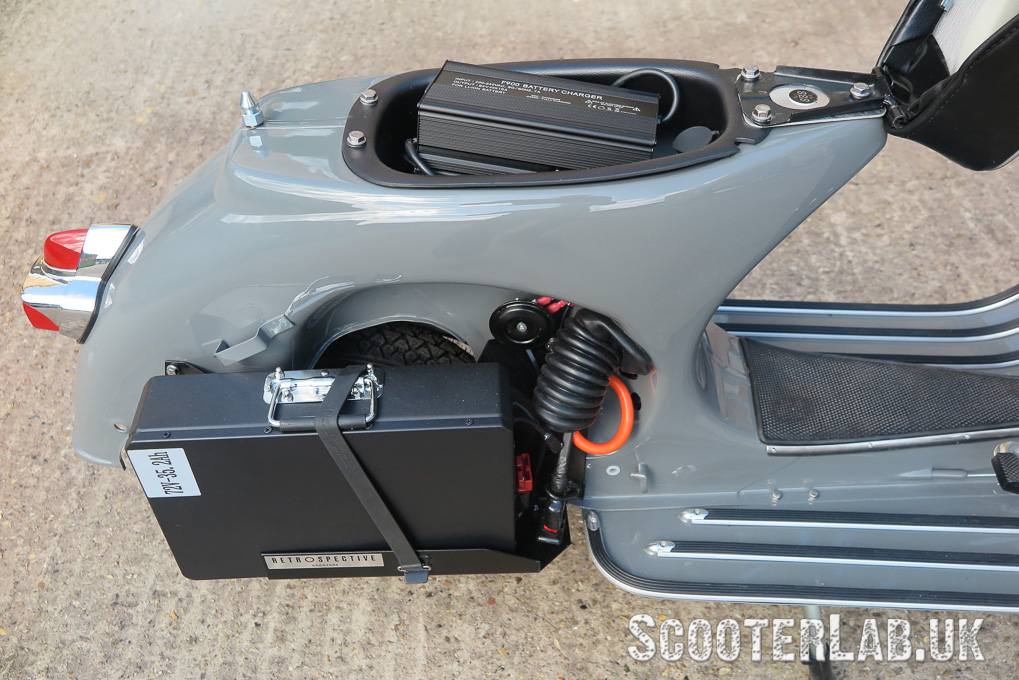
The orange cabling you can see is the high-voltage cable, legislation means it now has to be that colour for electric vehicles.
No classics were harmed
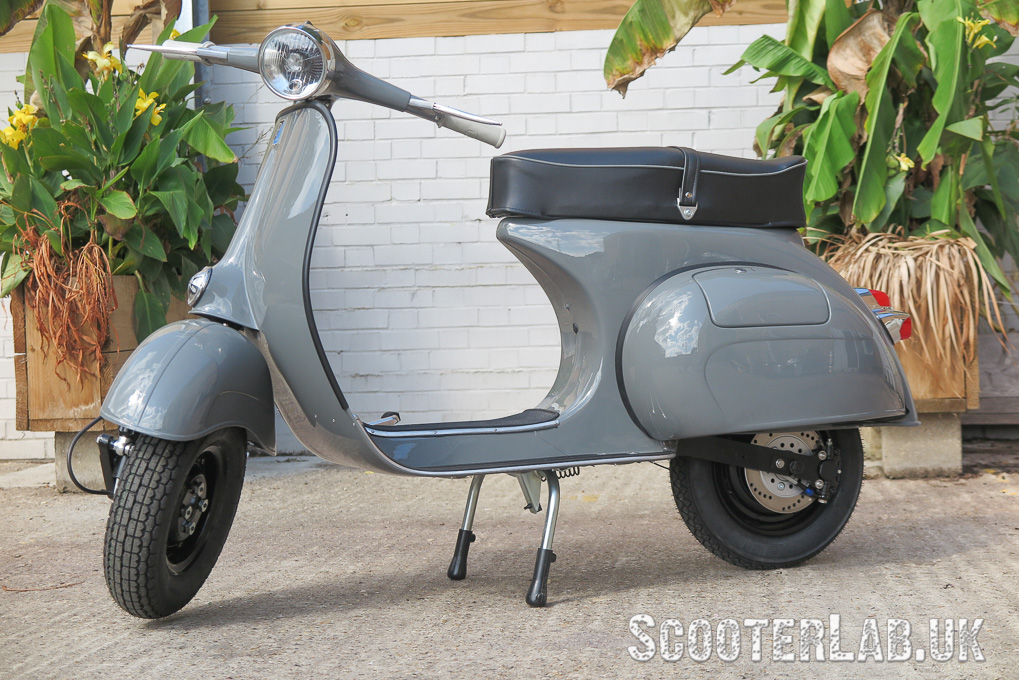
From the other side of the scooter you can see the new disc brake and the swinging arm but it blends in quite nicely with the black wheel, which also contains the 4kw hub motor. The good thing about the conversions is that everything is reversible, there’s no cutting, drilling or welding needed to your original frame. Your vintage machine will really be unharmed.
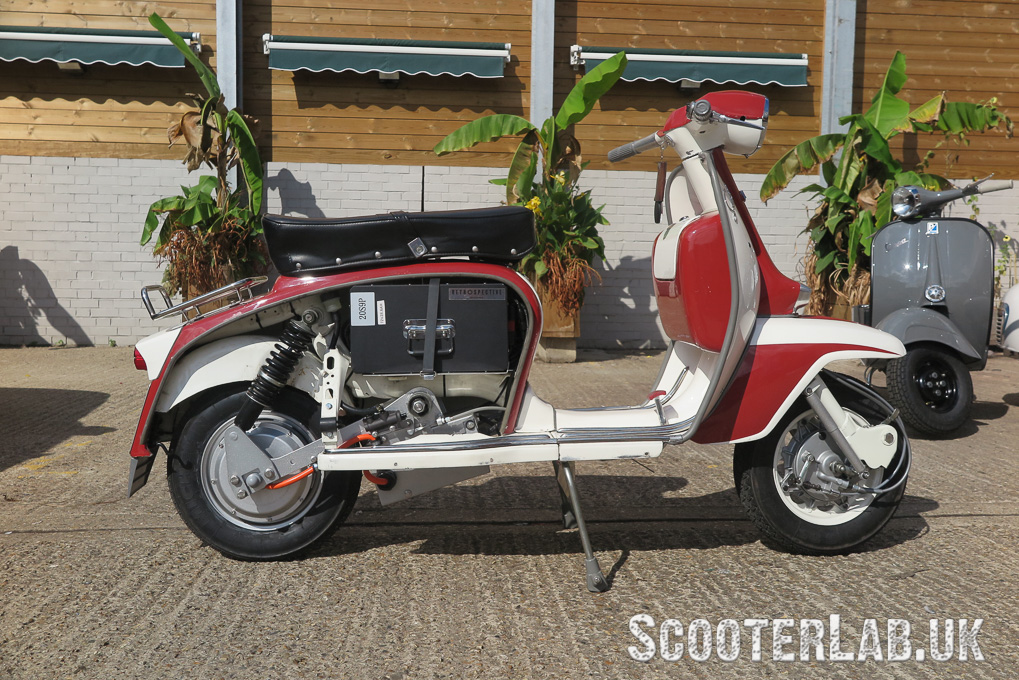
Previously I’ve ridden the earlier Retrospective demo smallframe, then the Vespa PX and Lambretta GP. This time I took their latest build, a Series 3 Li out for a spin. The scooter itself hasn’t been restored by the shop, this is how it came from the customer.
Well known London scooterist, Jerry works at the shop and was just finishing the electric conversion whilst I was there.
Despite the obvious weight of the batteries the Lambretta still felt like an Li when you take it off the stand. It’s also well balanced thanks to the evenly distributed batteries (one either side of the frame tube) and the centrally mounted ‘brains’ or control box. Everything is self contained and keeps the scooter looking as natural as possible.
Throttle response
For the Modern side of ScooterLab (and previously for other publications) I’ve ridden a lot of electric scooters and bikes. On most of the production machines I’ve ridden they’re let down by one thing in particular. Low speed throttle control. On scooters with this issue it’s really hard to turn the scooter around smoothly at slow speeds, or perform slow manoeuvres because the way the electronics work is more like an on/off switch than a throttle.
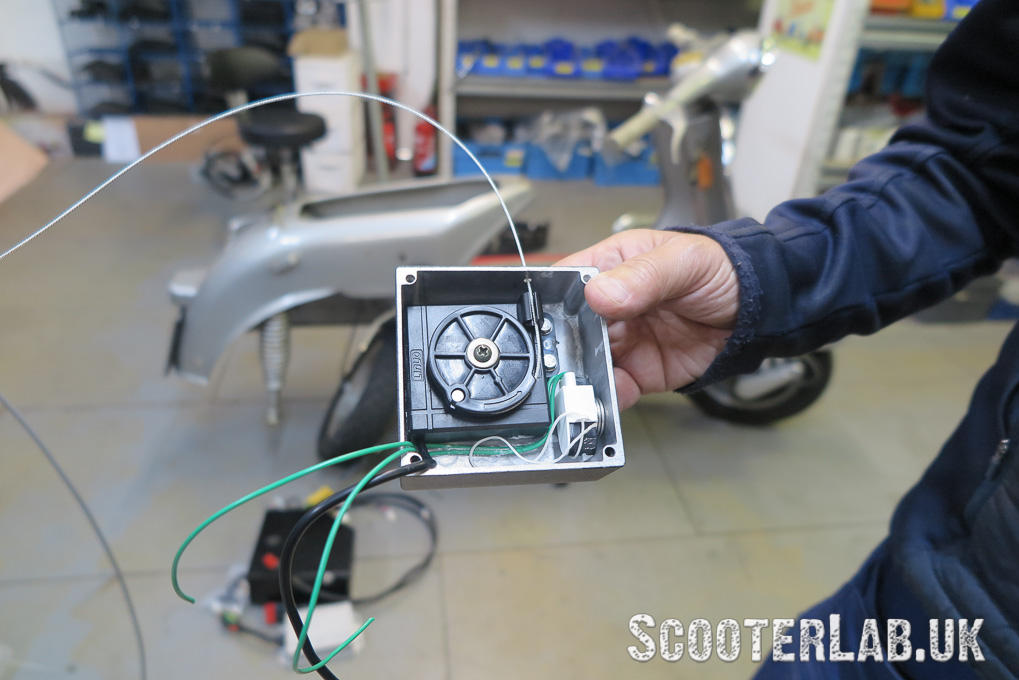
I’m pleased to say that Retrospective have cured this by using high-spec controllers for their conversions and by use of a neat cable operated throttle which is housed in its own box. This single item really makes their conversions stand out and allows you to ride with the finesse of a conventional scooter.
65mph top speed
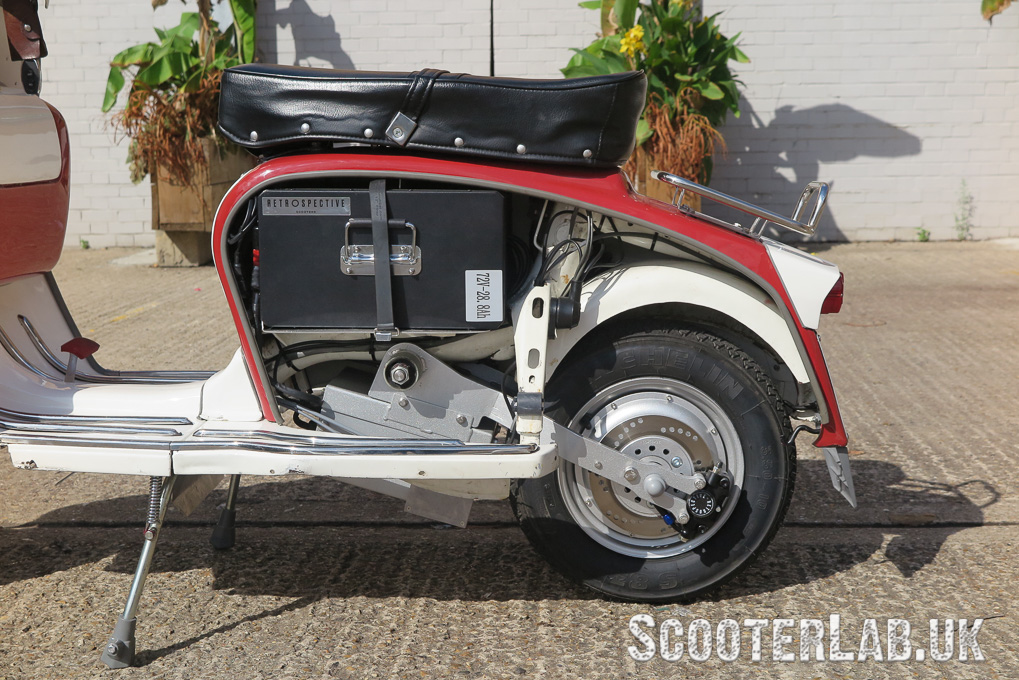
The rear disc brake is a useful addition to a scooter that will accelerate from 0-60 faster than most kitted scooters can manage. Acceleration is one thing an electric scooter is very good at. The latest 4kw hub motors used by Retrospective means they’re capable of 65mph and the speed can be restricted or de-restricted easily enough to satisfy the needs of the rider to suit their licence requirements. Power can be adjusted using the app.
Petrol head
I’m an out and out petrol head and classic scooter lover. I’ve ridden two stroke scooters since 1986 and plan to do so for as long as I’m allowed – as will the majority of SLUK readers. I’m not blinkered though, I can appreciate that changes are already happening and if you’re going to go electric (by choice or force) you may as well at least retain some credibility.
The way these kits are able to transform an environmental time bomb into a carbon zero mode of transport, whilst retaining the look and feel of one of our beloved classics is nothing short of amazing. Upcycling a 60 year old scooter is even more ethical than buying a brand new electric scooter (no doubt made and shipped from China).
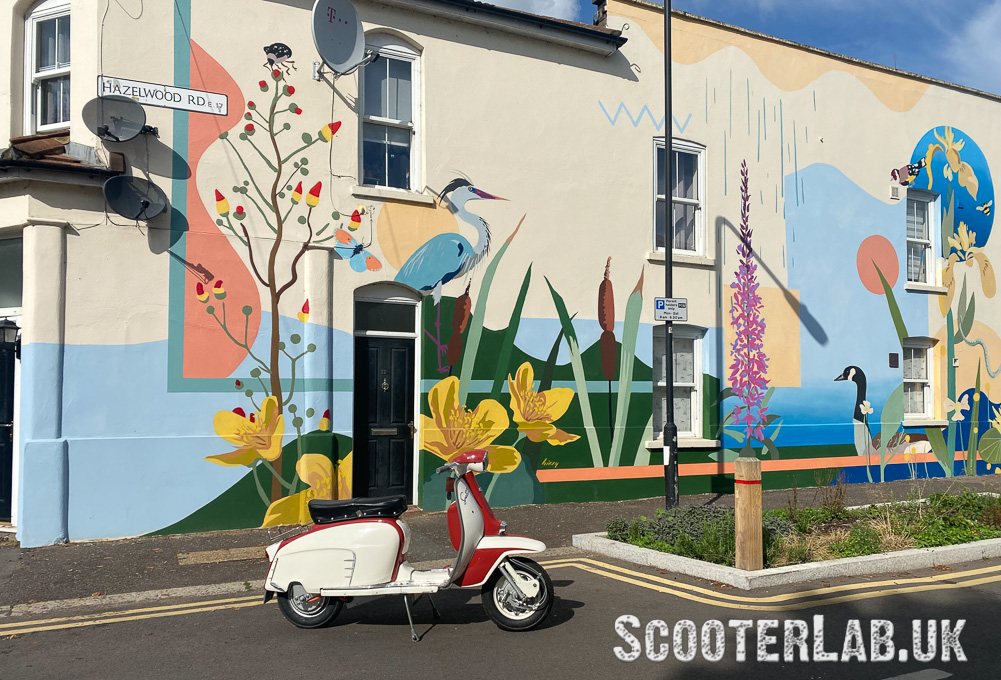
Remote start
The previous incarnations of this conversion used a traditional ignition key to power the scooter but the latest generation uses a remote key fob, press it and the scooter is ready to ride. It’s less of a faff than an ignition key, or most keyless ignition systems found on new bikes/scooters.
There’s also a motor cutout switch incorporated into what would have been the clutch lever, pull that in and the motor cuts out. It’s a useful safety feature, all traditional scooter riders are used to pulling a clutch in if there’s a problem. Push it back out again and the motor is ready to ride again. Niall says it’s not yet a legal requirement but he can foresee that it will be before long.
Of course, there’s no sound to let you know an electric scooter is ‘running’ but once you’ve pressed the ‘on’ button you’re good to go.
As part of the conversion the lights are swapped over to LEDs.
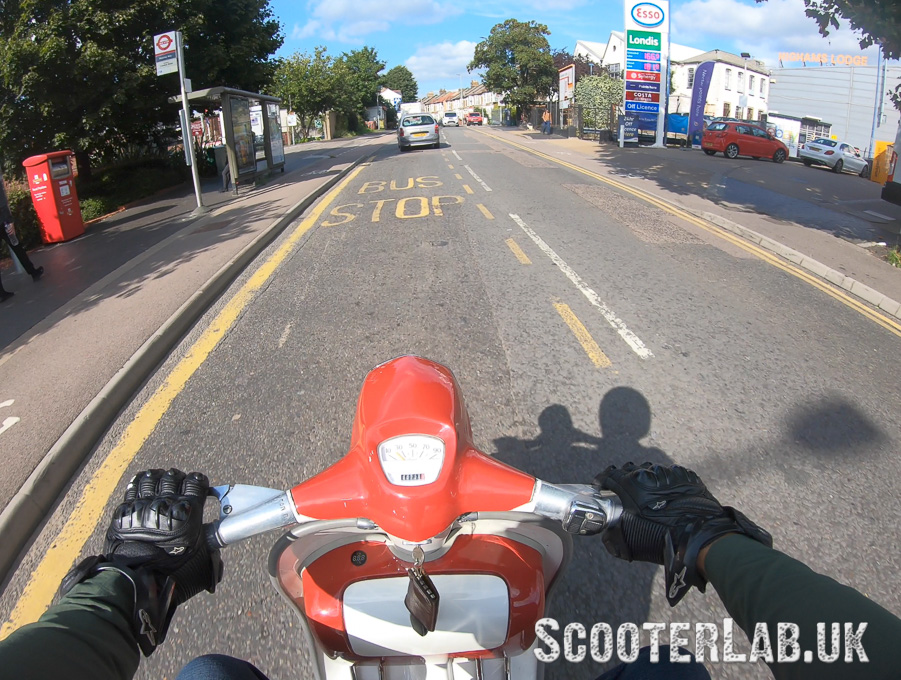
It feels kind of surreal at first when you ride a Lambretta (or Vespa) with no sound other than the subdued whirr of an electric motor. It’s also quite amusing at times, like when a biker pulled up next to me at a set of lights and had to do a double take when he realised this classic scooter wasn’t churning out fumes or making a noise. He was also surprised when I out accelerated him! That’s the other thing about electric, it’s just so instantly in the power – a proper twist and go.
With the new motor this scooter will top out at around 65mph.
As well as being responsive and quick, the throttle control is perfect, just like the real thing. Controllable, progressive and precise. Riding this scooter around the London suburbs was its natural environment. Fuss free city riding.
Battery and charging?
Of course charging a battery needs to be as easy as possible and you currently can’t use car charge points for a scooter battery. The Retrospective batteries can be charged in situ (around 3 hours for a full charge) if you can get close enough to a domestic powerpoint to plug the charger in (seen here under the seat). You can also remove the battery if you need to carry it into a building to charge it.
The battery cells are 72v 29 Ah made by LG, as with anything electronic with battery cells you get what you pay for and these are high-spec. There are three battery sizes available depending on scooter model used. For instance, the Vespa smallframe uses the 64v 26 Ah battery. Most customers opt for two batteries but Niall suggests getting one to start with and buying an additional one if you’re running close to empty once you start using the scooter.
Small 64v 26 Ah battery = 25-30 mile range £995
Medium 72v 29 Ah battery = 30-35 mile range £1195
Large 72v 35 Ah battery = 40 mile range £1395
Of course, recent energy price rises have lessened the gap between fossil fuel and electricity but recharging an electric scooter is still way cheaper than running a two stroke.
Who’s buying them?
Interestingly, whilst I was at the shop an Australian dad and daughter came to visit. Dad was in London visiting daughter when they had a conversation about a work colleague buying a classic Fiat 500. This lead to dad talking about having owned a Vespa SS 180 back in the day. A quick internet search found Retrospective across town and the next day they arrived to have a look around.
To say dad was blown away when Niall showed him the electric conversions would be an understatement. Both dad and daughter loved them and I’ll be very surprised if he doesn’t place an order as soon as he gets back to Oz. It also rekindled his passion for scooters and he vowed to hunt down the local scooter club once he got back to Adelaide.
The country buying most of these kits though is America, that’s followed by the UK. The legislation in Europe means they’ve not really taken off there just yet. Retrospective were at the recent Scooter Center weekender giving demo rides and they’re working on sorting out the legislation for Europe with the help of a couple of well known scooterists in Germany and Austria who are helping to wade through the TUV red tape. Once that’s sorted things really will begin to pay off for this forward-thinking e project.
Shipping batteries abroad is a problem though so customers in certain regions are advised to source their own, although of course advice will be given and the empty battery boxes can still be bought with the kit.
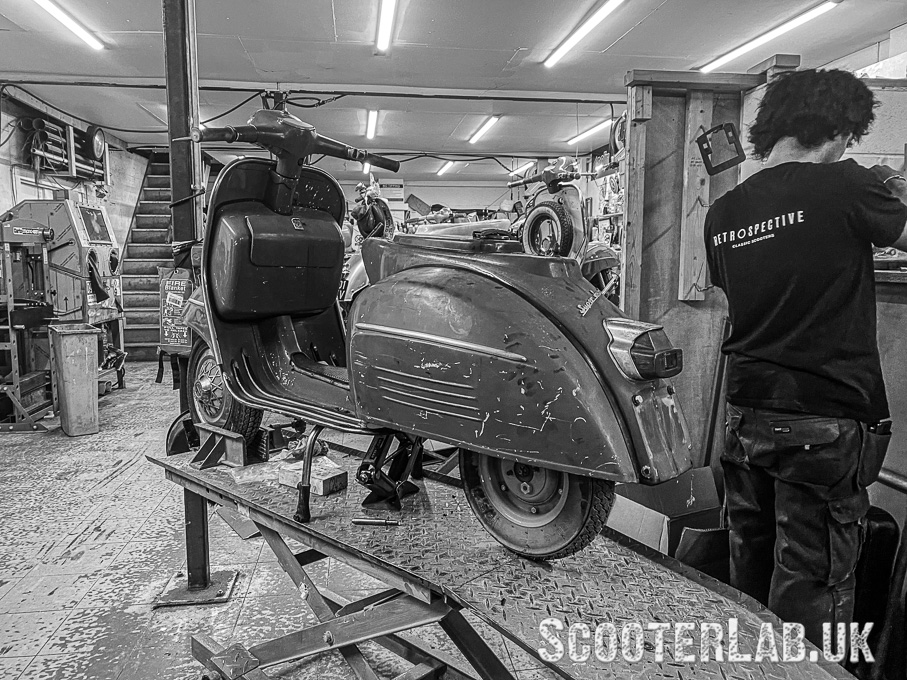
Conclusion
One thing is certain, these conversions will become more mainstream in the future as more and more ULEZ/Clean Air zones are rolled out and the restrictions tighten. Electric may not be the first choice for most of us when it comes to scooter riding and we’re certainly a long way off being able to use an e scooter for the kind of long-distance journeys many of us like to do but if that’s our only choice I’d prefer to convert one of my classics rather than leave it as a museum piece.
Words, photos and video: Iggy
Want to know more?
You can get in touch with Retrospective Scooters here. Remember to mention you read about it on SLUK!






great article and really cool work!
How are these conversion kits doing? What a great idea but are people really wanting to convert?
They are actually doing pretty well, not so much in the UK but certainly for overseas customers.