

December 1987 saw me literally riding away from Norrie Kerr on the back wheel of a new Vespa T5. It was my 17th Birthday. I was on board a brand-new red, E reg, squaretail mark 1. I also had a large direct debit set up every month to pay the hire purchase and it was worth every penny.
I can still remember that feeling of the extra power (hence the unintentional wheelies) and the sound of that distinctive T5 exhaust note. Having spent a full year on a 30mph Vespa 50 Special, the T5 was going to change my life. It was going to take me to seaside places around the country and abroad, as well as being my daily transport to get me to work. I passed my test on that scooter in May 1988. The T5 engine was such a lovely powerplant that there was no point in trading up for a PX 200, it matched and beat most of them on the road.
VIDEO | This early SLUK teaser gives you a taste of what 3 (or 4) wheels can offer
After I’d used and abused that scooter for three years I traded it in for a new white G reg Mark 2 T5 (analogue rev counter instead of digital) and a new HP agreement. I was never happy with the colour though and soon had a street racer paintjob done by Mirage to match the quick and reliable MRB 170 tuned engine. I kept that scooter until 1998, sold it for £800 and bought a shiny black R reg T5 Classic.
The original T5 had been dropped by Piaggio but (sorry T5 anoraks) I actually preferred the style of the Classic, it was a mixture of both PX and T5, with the best bits of each. Sadly, when I wanted another new Vespa in 2002, the Classic had also become extinct – RIP Vespa T5 1999.
I ended up buying one of the last new PX 200 Disc models in British Racing Green, a scooter I still own to this day. It’s now in street racer spec and we’ll be using that for a new SLUK project this spring.
Fast forward to 2021, after a few years of 2-stroke production and development being left out in the environmentally-led wilderness, things have turned a corner. New aftermarket tuning parts and equipment are being released all the time. New engines and casings were getting harder and harder to obtain but they are also being remade by tuning houses like Pinasco, Malossi, BFA and Quattrini. It’s now possible to build brand new T5 and PX engines into new casings, using new parts.
VIDEO | A view from the rider’s seat
Barnsley 2020
I’m sat outside Ron Daley Scooters, Barnsley’s infamous gun and scooter emporium. The only scooter shop I’ve ever been to with such an eclectic mixture of goods for sale. Also sat outside the shop is a (to all intents and purposes) brand new Vespa T5. Its engine is built using new Pinasco T5 casings and cylinder kit. It’s fitted into one of the last few new (pre-registered) PX’s in the world. It’s also been treated to a selection of fine parts, including Pinasco split tubeless rims, sportier rubber and Pinasco suspension. Being a Disc model gives the advantage of better braking up front, a SIP caliper replaces the Piaggio item to further improve both the look and stopping power. It’s a bit like choosing to spec up your new scooter. If you wanted this to be custom painted then that’s an option you can also choose.
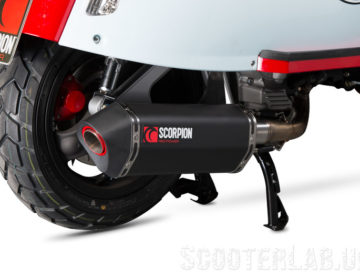
I turn the key on the demo scooter, prod the kickstarter and I’m transformed back into a teenager again. The muffled exhaust note of a T5 is different to any other Vespa. I’ve spent many thousands of miles listening to it in the past, it was the soundtrack to my youth. As were various expansion pipes. My aftermarket T5 exhaust of choice was always the Miceck but there’s something special about a standard (or in this case BGM) T5 box exhaust.
As I short shift up through the gears on this very low mileage engine everything just feels like it should on a new scooter. It’s smooth, responsive and everything is just right. The T5 was always quite a revvy motor, it accelerated well – ideal for most situations, although the jump from third to fourth meant a well-timed change was needed to keep the revs up. Headwinds and hills zap a bit of power and with lorries restricted to 56mph these days, the old slipstreaming trick on the motorway no longer works. Sitting in ‘clean’air in the danger zone right behind a lorry was a great way to gain a few mph, if not a little dangerous.
Back in the day I always believed the speedo reading but now with the benefit of GPS I know our scooters were never going as fast as we thought they were. Mid-sixties is much closer to the truth than close to 80mph on an old T5 speedo. Even so, for a 125cc scooter the T5 is nippy and powerful enough for motorways. It can easily cope with a blast to a rally, full thrash all day long.



Lexham insurance have supported ScooterLab since day one, click the banner above and get a quote for insurance on your current or next scooter.

My T5s took me everywhere around the country and to the South of France. Riding around Yorkshire on a bright winter’s day I’m not quite so far away from home but the memories keep flooding back. It was always a fight to get a weekend off work and I always had to ride through the night to get to rallies. 250 miles to places like Margate. I remember riding straight over an unseen roundabout in Kent at about 4am – that woke my pillion up. Heading to Aberystwyth and running out of fuel up a mountain in the middle of the night, there were no 24-hour fuel stations back then. The fear as we were ‘buzzed’ by some young lads in a Mark 1 Ford Escort heading towards us on our side of a pitch-black road in Hampshire as we headed for the Isle of Wight ferry. It was just a normal Friday back then. Arriving in strange places at dawn to set up an old ridge tent on a smoky patch of waste ground. Seventeen years old, mobile phones and sat nav hadn’t been invented then. Just a load of scooters and a bunch of mates off for a weekend of mayhem. Who would have thought that 33 years later I’d still be doing the same thing (Covid permitting of course), albeit with the benefit of being able to have Friday’s off now.
Back to Yorkshire. I thought I’d never get the chance to ride a new T5 again after the model was culled but modern technology and developments mean I can still relive my misspent youth. The T5 engine is still as sublime as it ever was, it sounds the same, feels the same and has the same performance. It’s a beautiful motor, one that really should have been developed further by Piaggio and used in the larger capacity PX. That’s all irrelevant now though. You can still own one, either by building it yourself or by buying one ready-built as a complete engine, or a complete new scooter like this one. The engine alone will cost you more than my new T5 did back in 1987 but you can’t put a price on the happiness it can restore. If you want one, give Ron Daley a bell, or buy the parts and build your own.
How much?
Like with any scooter, you can start with an empty cheque book when building something. If you already have a scooter then you can have an engine built for around £2500. If you want to own a ‘brand new’ complete T5 you’ll not get much change from £7,000.
Ron Daley T5 gallery
Check out the latest offerings from the SLUK Shop

December 1987 saw me literally riding away from Norrie Kerr on the back wheel of a new Vespa T5. It was my 17th Birthday. I was on board a brand-new red, E reg, squaretail mark 1. I also had a large direct debit set up every month to pay the hire purchase and it was worth every penny.
I can still remember that feeling of the extra power (hence the unintentional wheelies) and the sound of that distinctive T5 exhaust note. Having spent a full year on a 30mph Vespa 50 Special, the T5 was going to change my life. It was going to take me to seaside places around the country and abroad, as well as being my daily transport to get me to work. I passed my test on that scooter in May 1988. The T5 engine was such a lovely powerplant that there was no point in trading up for a PX 200, it matched and beat most of them on the road.
VIDEO | This early SLUK teaser gives you a taste of what 3 (or 4) wheels can offer
After I’d used and abused that scooter for three years I traded it in for a new white G reg Mark 2 T5 (analogue rev counter instead of digital) and a new HP agreement. I was never happy with the colour though and soon had a street racer paintjob done by Mirage to match the quick and reliable MRB 170 tuned engine. I kept that scooter until 1998, sold it for £800 and bought a shiny black R reg T5 Classic.
The original T5 had been dropped by Piaggio but (sorry T5 anoraks) I actually preferred the style of the Classic, it was a mixture of both PX and T5, with the best bits of each. Sadly, when I wanted another new Vespa in 2002, the Classic had also become extinct – RIP Vespa T5 1999.
I ended up buying one of the last new PX 200 Disc models in British Racing Green, a scooter I still own to this day. It’s now in street racer spec and we’ll be using that for a new SLUK project this spring.
Fast forward to 2021, after a few years of 2-stroke production and development being left out in the environmentally-led wilderness, things have turned a corner. New aftermarket tuning parts and equipment are being released all the time. New engines and casings were getting harder and harder to obtain but they are also being remade by tuning houses like Pinasco, Malossi, BFA and Quattrini. It’s now possible to build brand new T5 and PX engines into new casings, using new parts.
VIDEO | A view from the rider's seat
Barnsley 2020
I’m sat outside Ron Daley Scooters, Barnsley’s infamous gun and scooter emporium. The only scooter shop I’ve ever been to with such an eclectic mixture of goods for sale. Also sat outside the shop is a (to all intents and purposes) brand new Vespa T5. Its engine is built using new Pinasco T5 casings and cylinder kit. It’s fitted into one of the last few new (pre-registered) PX’s in the world. It’s also been treated to a selection of fine parts, including Pinasco split tubeless rims, sportier rubber and Pinasco suspension. Being a Disc model gives the advantage of better braking up front, a SIP caliper replaces the Piaggio item to further improve both the look and stopping power. It’s a bit like choosing to spec up your new scooter. If you wanted this to be custom painted then that’s an option you can also choose.
I turn the key on the demo scooter, prod the kickstarter and I’m transformed back into a teenager again. The muffled exhaust note of a T5 is different to any other Vespa. I’ve spent many thousands of miles listening to it in the past, it was the soundtrack to my youth. As were various expansion pipes. My aftermarket T5 exhaust of choice was always the Miceck but there’s something special about a standard (or in this case BGM) T5 box exhaust.
As I short shift up through the gears on this very low mileage engine everything just feels like it should on a new scooter. It’s smooth, responsive and everything is just right. The T5 was always quite a revvy motor, it accelerated well – ideal for most situations, although the jump from third to fourth meant a well-timed change was needed to keep the revs up. Headwinds and hills zap a bit of power and with lorries restricted to 56mph these days, the old slipstreaming trick on the motorway no longer works. Sitting in ‘clean’air in the danger zone right behind a lorry was a great way to gain a few mph, if not a little dangerous.
Back in the day I always believed the speedo reading but now with the benefit of GPS I know our scooters were never going as fast as we thought they were. Mid-sixties is much closer to the truth than close to 80mph on an old T5 speedo. Even so, for a 125cc scooter the T5 is nippy and powerful enough for motorways. It can easily cope with a blast to a rally, full thrash all day long.


Lexham insurance have supported ScooterLab since day one, click the banner above and get a quote for insurance on your current or next scooter.

My T5s took me everywhere around the country and to the South of France. Riding around Yorkshire on a bright winter’s day I’m not quite so far away from home but the memories keep flooding back. It was always a fight to get a weekend off work and I always had to ride through the night to get to rallies. 250 miles to places like Margate. I remember riding straight over an unseen roundabout in Kent at about 4am – that woke my pillion up. Heading to Aberystwyth and running out of fuel up a mountain in the middle of the night, there were no 24-hour fuel stations back then. The fear as we were ‘buzzed’ by some young lads in a Mark 1 Ford Escort heading towards us on our side of a pitch-black road in Hampshire as we headed for the Isle of Wight ferry. It was just a normal Friday back then. Arriving in strange places at dawn to set up an old ridge tent on a smoky patch of waste ground. Seventeen years old, mobile phones and sat nav hadn’t been invented then. Just a load of scooters and a bunch of mates off for a weekend of mayhem. Who would have thought that 33 years later I’d still be doing the same thing (Covid permitting of course), albeit with the benefit of being able to have Friday’s off now.
Back to Yorkshire. I thought I’d never get the chance to ride a new T5 again after the model was culled but modern technology and developments mean I can still relive my misspent youth. The T5 engine is still as sublime as it ever was, it sounds the same, feels the same and has the same performance. It’s a beautiful motor, one that really should have been developed further by Piaggio and used in the larger capacity PX. That’s all irrelevant now though. You can still own one, either by building it yourself or by buying one ready-built as a complete engine, or a complete new scooter like this one. The engine alone will cost you more than my new T5 did back in 1987 but you can’t put a price on the happiness it can restore. If you want one, give Ron Daley a bell, or buy the parts and build your own.
How much?
Like with any scooter, you can start with an empty cheque book when building something. If you already have a scooter then you can have an engine built for around £2500. If you want to own a ‘brand new’ complete T5 you’ll not get much change from £7,000.
Ron Daley T5 gallery
Check out the latest offerings from the SLUK Shop