
Pinasco ‘Wideframe’ 161cc Vespa kit
We caught up with Andreas Nagy in Venlo who has been helping Pinasco to develop their range of parts for the earliest Vespas.
He is a specialist in getting more performance out of pre-57 Vespa models and we featured his Hoffmann here.
These early motors use an inlet direct into the cylinder with the carburettor on a long manifold below the seat. The cylinders are only secured with 3 studs. While many people love these old machines, they are simply too slow to be used over much distance in modern traffic.
The other problem is the use of a 3-speed gearbox with a wide gap between the ratios. If you produce a kit with long port timings then there is not enough power at low rpm to bridge the gap between one gear and the next.
Pinasco’s solution to this is an alloy Nicasil kit with really low port timings 112 degrees transfer and 142 degrees exhaust.
The kit has an additional two fixing bolts for the cylinder head, and the head centralises inside the cylinder bore.
Andreas leant me a Vespa to try with this kit and the following components:
- Pinasco 161cc kit
- Nagy-Blechroller inlet manifold for 23mm Polini CP carb
- Modified PX SIP Road 2.0 exhaust
- Pinasco primary gear kit
- Pinasco Flytech ignition
- Pinasco 57 corsa crankshaft
VIDEO: Pinasco Wideframe kit road test


Andreas tests his Vespa at Scooter Center
Results
As you can see from the video above, the Vespa is much faster and more useable than in standard format:
The most important aspects according to Andreas are:
- Incredibly tractable – peak torque produced at 3,600 rpm.
- Rides fine even with 3-speed gearbox – no need for 4-speed conversion
- Will pull cleanly from 15kmh (10mph) to 100kmh (62mph) in top gear.
- No mess or spit-back in the carb area
- Excellent fuel economy (3.5 litres for 100km)
- Reduced oil ratio (2% instead of 5% with uprated crank)
- No problem with riding at full throttle
Not only has Andreas been testing the kit but so has Vittorio (‘Turbo’) from Pinasco Italy who recently rode his Faro Basso to the North Cape (Nordkapp) in Scandinavia with a friend from Vespa Club Piacenza. That’s a journey made much easier by a 60mph engine.
Future
Andreas is working with Pinasco on an updated version for launch sometime in the future but at the moment his test scooter rides so nicely it’s difficult to see how it could be improved much.
So far the best performance seen is 12hp in a test at Scooter Center, who are now offering the Pinasco kit here.
SIP have recently released a direct-fit version of their Road 2.0 exhaust for these models and Stoffi is offering a manifold for the CP carb. Pinasco are currently working on their own versions of both of these items as well.
Verdict
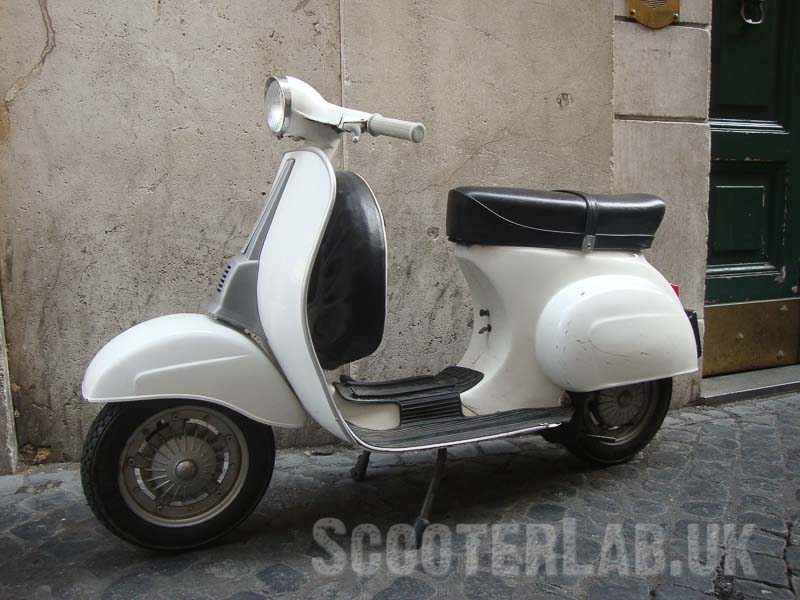
Italians refer to this style of Vespa as the Nonna (Grandmother) models. The Pinasco conversion really turns them into a granny you’d like to grab for a ride rather than one you’d leave at home in favour of a younger model.
Sticky
Thanks to Scooter Centre for the dyno chart. Andreas offers all sorts of early Vespa engine work from his shop Nagy Blechroller.








Hi. After seeing this video im going to go with this set up on my 55.
Question, where can i get the pinasco 64 tooth gear kit as im struggling.
Cheers nick
For all the specialist wide-frame parts and information, try Andreas direct https://www.nagy-blechroller.de/impressum.html
really wondering why nobody in this “review” points out that price/power relation is really really bad?
only 10,4hp for nearlly 500,- out of 160ccm is good?
its not & absolutely not state of the art in the year 2017
even the quattrini M1x/ M172 is cheaper with 172ccm
the price is unbelievable high as we were always used to when it comes to pinasco hardware, u pay the name and u cant expect highend power/technique (best example: the oldschool 80ies was renamed to “SUPER SPORT” but it still has only 1 real port as it is only a copy of the original piaggio 200ccm cylinder designed for pnp only)
back to that funny new 160ccm pinasco kit:
a) u only get 10,4hp for impressive 490,-
b) 160ccm and only 10,4hp ?
both is bad.
simple comparison:
a plug and play DR 177 for only euro 160,- (!) gains 11-12hp (sure, its a different engine type, doesnt matter.)
just be aware of that, if u are fine with that, go for it ;o)
its also for sure that the timings do have potential
(not to say: typical for pinasco timings are usually bad ;o) )
so it should be able to get more out of this 160ccm
its 2stroke guys! so easy pimp able.
I Agree Lukas, it sounds like a rip off. Plus carb plus exhaust plus flywheel.
But what are the better cheaper options?
A px engine conversion? It’s a shame to go that way?
What would you suggest?
I have taken the plunge. Its a very expensive option. but the PX convertion was not looking good and had to shave off finns off of the cylinder. I had managed to shave the carb down with reeds and the carb box so that I would not have to cut the frame, It did work. But I like the idea of having the original engine.