
We at SLUK have been trusted with info about Richard Taylor’s plans for the Lambretta GT engine for a while, but now he’s permitted us to reveal the next step of development.
One of the things that Richard is very conscious of is the cost of all these new fancy engine components for what is supposed to be a cheap and humble commuter scooter.
With that in mind he has done his best to not reinvent the wheel and instead take advantage, as much as possible, of the engineering developments and product quality of major companies. In that way it is possible for people to pick up used or cheap pattern/original components to use as donor parts for Lambretta engine builds.
In that respect he has:

Ignition:
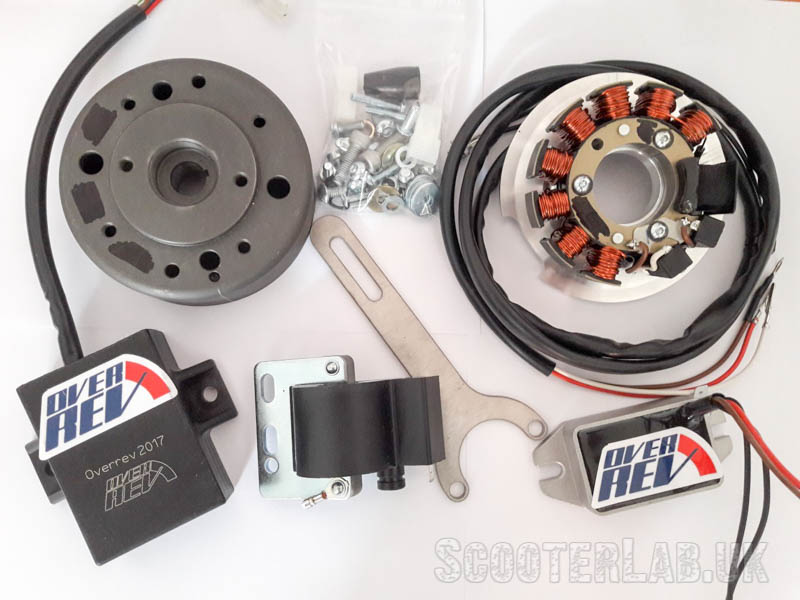
Rich has for several years produced an Aprilia RS125 ignition conversion for Lambretta engines.
The advantages are:
- that the stator is of quality manufacture, produces good electrical output (180 Watts)
- a CDI with advance/retard map built in
The chief disadvantage is:
- the external ignition pick-up requires machining a large hole in a Lambretta mag flange, however Richard is planning his own mag flange to include room for the Aprilia pick-up.

Cylinder:
The conversion you see before you is actually from a Seadoo watercraft. Richard chose the Seadoo because second-hand cylinders are readily available from the USA offering a cheap and potentially powerful water-cooled conversion.
The Seadoo 580/583/587 is a Bombarier/Rotax twin. With 76mm bore and a 64mm stroke the engine will have a capacity of 290cc. Richard estimates the output to be in excess of 40hp at 7,000rpm!
The chief advantage of this cylinder is:
- budget availability second-hand
- a reboreable iron liner.
- Water-cooling for temperature stablility
The main disadvantages of this cylinder are:
- its size (the crankcase mouth has to be inclined downwards to clear the frame as per the DAC specials)
- being crankcase reed it requires a reed-valve inlet being made into the casings and specific manifold/carb/tank arrangement
- a completely new head must be produced
- you need to fit all the usual water-cooling kit and caboodle to your scooter (radiators, pumps, hoses and gauges)

Entry Level?
Richard calls this the ‘entry-level’ version of the engine because it continues to use oversized-web ‘Plus’ Lambretta cranks from the likes of Harry Barlow in order to produce a 64-mm stroke crank with good torsional stability.
Richard is currently working on a crankcase reedvalve conversion for the casing and a new manifold to suit the largest DellOrto VHSB carbs.
He expects this sort of engine to appeal to advanced engine builders only, who have a good technical knowledge and their own solutions for exhausts and water-cooling. That said, Richard is planning to develop his own exhaust and electric water-pump solution.
When
Richard is planning to offer crankcases modified to suit from January onwards with a more complete kit of parts available around March next year.
Prices are yet to be established
Sticky