


As a classic scooter enthusiast, I can’t help but thinking that Piaggio have really missed out by not capitalising on their rich back catalogue of timeless Vespa designs. Retro scooters sell by the container load – if it looks faintly like a 1960s classic but has modern running gear and somewhere to plug your hair straighteners in people will buy it.
Classic Lambretta designs of yesteryear have been used by the likes of Scomadi and Royal Alloy to great effect. Dozens of mostly Chinese manufacturers have copied the Vespa silhouette and built cheap, (often disposable) rip off clones. None of them quite getting it right but still selling plenty of plastic scooters to punters. So why have Piaggio never brought back one of their classic designs as a modern retro, with all the benefits of both worlds? A Vespa design recreated for the 21st century. Done properly without being overpriced it would sell around the world.

Hybrid success
The Vespa GTS has become the 21st-century workhorse for many rally going scooter riders. A modern equivalent to the outlawed, out of production Vespa PX. The GTS has a fairly powerful engine, good brakes, decent handling and the all-metal monocoque body we all expect from a Vespa. It still hasn’t got that old Vespa shape though.
Scooterists are a determined bunch and if they can’t buy what they want they’ll build one themselves. Scooter enthusiasts are never satisfied with a simple production scooter. Things are never fast enough so we feel the need to tinker, improve, alter or in this case transplant.
As far as we’re aware, this is the first Vespa GTS engine that has been successfully transplanted into a PX-style chassis. If there are others I’d be surprised if they were done half as well.
VIDEO | Up close and on-board the GTX 300
Who built it?
The owner/builder, Mick Maidment lives in Leicestershire and has just spent 10 months building what he calls a GTX 300. He’s in his mid-70s and is the retired owner of a structural metalwork fabrication company. Mick still rides scooters most days, still builds engines, does a bit of tuning and fixes problems for local scooterists. He’s also just about to start teaching a keen 19-year-old PX riding girl how to look after and service her scooter, and she also wants him to teach her how to weld. Although Mick recently stopped taking on work at his home workshop he’s happy to help nurture the next generation.
 The panels are still quick and easy to remove, just one bolt holds the front end on
Hand built by an English craftsman
As mentioned, Mick has spent his life messing about with metal fabrication, both for work and pleasure. Having just ridden this recently completed, perfectly road-legal hybrid scooter and seen the intricate details up close I’m amazed by his ingenuity, the neat touches and clever solutions he’s crafted into this very special one-off scooter. Watch the video above as Mick talks us through most of the details.

How did the project start?
Mick kept hearing friends trying to decide whether to go to certain events on the PX or GTS and it gave him an idea. It’s something hundreds of scooter riders will have thought up but not had the talents to create the fusion. Talent is one thing that isn’t lacking here. Getting a big four-stroke lump into a PX style chassis and more importantly making it sit well and look in proportion isn’t by any stretch of the imagination easy. It requires skill and determination.
LML meets GTS
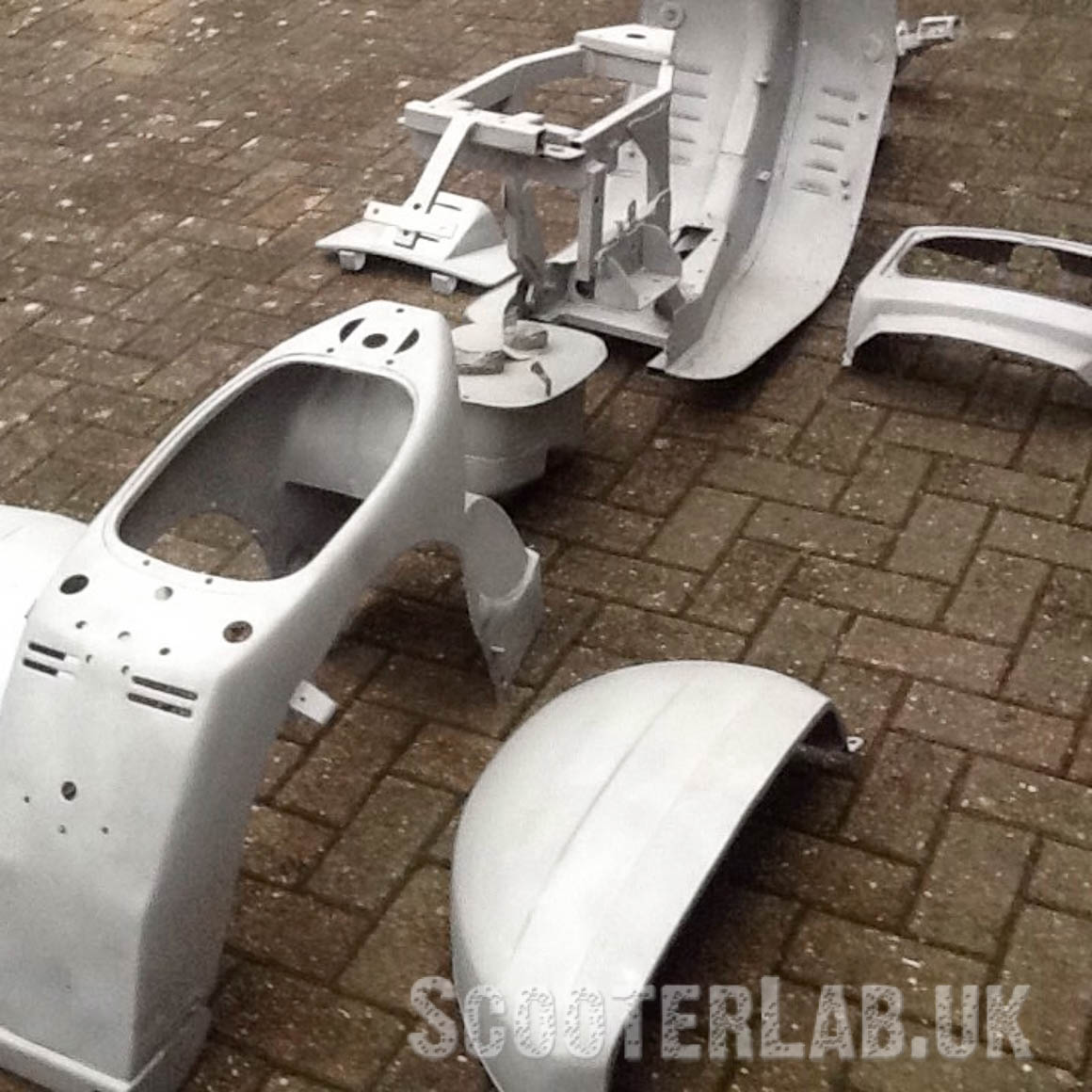
Before starting the project Mick managed to find himself a stolen/recovered GTS 300 from an insurance recovery place. He needed more than just an engine and got the complete damaged scooter for just £700. He collected it after seeing it running and brought it home to his workshop. He also found himself an LML auto with V5 and logbook for just £100. The choice of using an LML was a clever one, the rear is detachable for starters, it’s also stronger (according to the owner) than a ‘real’ PX frame. Seeing as this one was going to be very heavily modified strength was a bonus and surely it’s better to cut and chop an Indian clone rather than an Italian original?

Outstanding
I’d seen a couple of photos of the GTX 300 before I paid Mick a visit but was blown away by just how much work has gone into this and how well the scooter now sits on 12″ GTS wheels. It’s not too high, or out of proportion and although there’s a protrusion in the frame loop for the cylinder head, and a bit of an ugly carbuncle on the toolbox door for the header tank, the fabrication is unbelievable, a testament to Mick’s outstanding skills. It looks ‘factory’ rather than built in a shed.
Clever details are in abundance. Stuff like the brackets he made for the GTS master cylinders, the ‘ladder’ frame beneath the scooter to give extra strength, the way he’s cut two PX tanks up and been able to accommodate the fuel pump in a much better place than Piaggio put the GTS one – whilst still having the capacity for 8.5 litres of fuel. He’s widened the frame, widened the tank, built a new subframe, created a wider central tunnel to house the CDI and allow easy access to pipes and electrics. The PX side panels have been lengthened, strengthened and can be easily removed to get to the battery, oil filler etc. Everything is well thought out and finished perfectly. Even the wiring looks neater than an original LML.
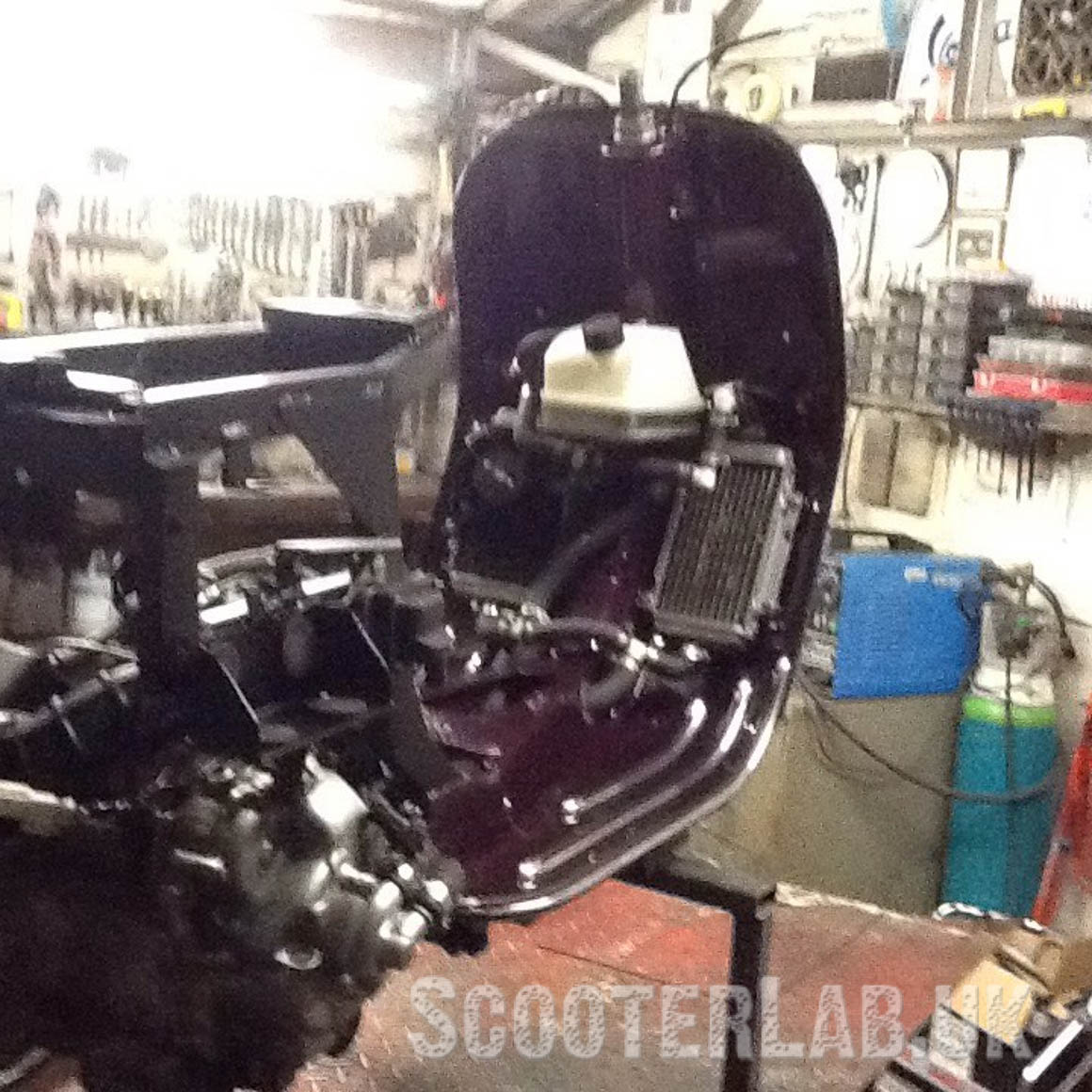
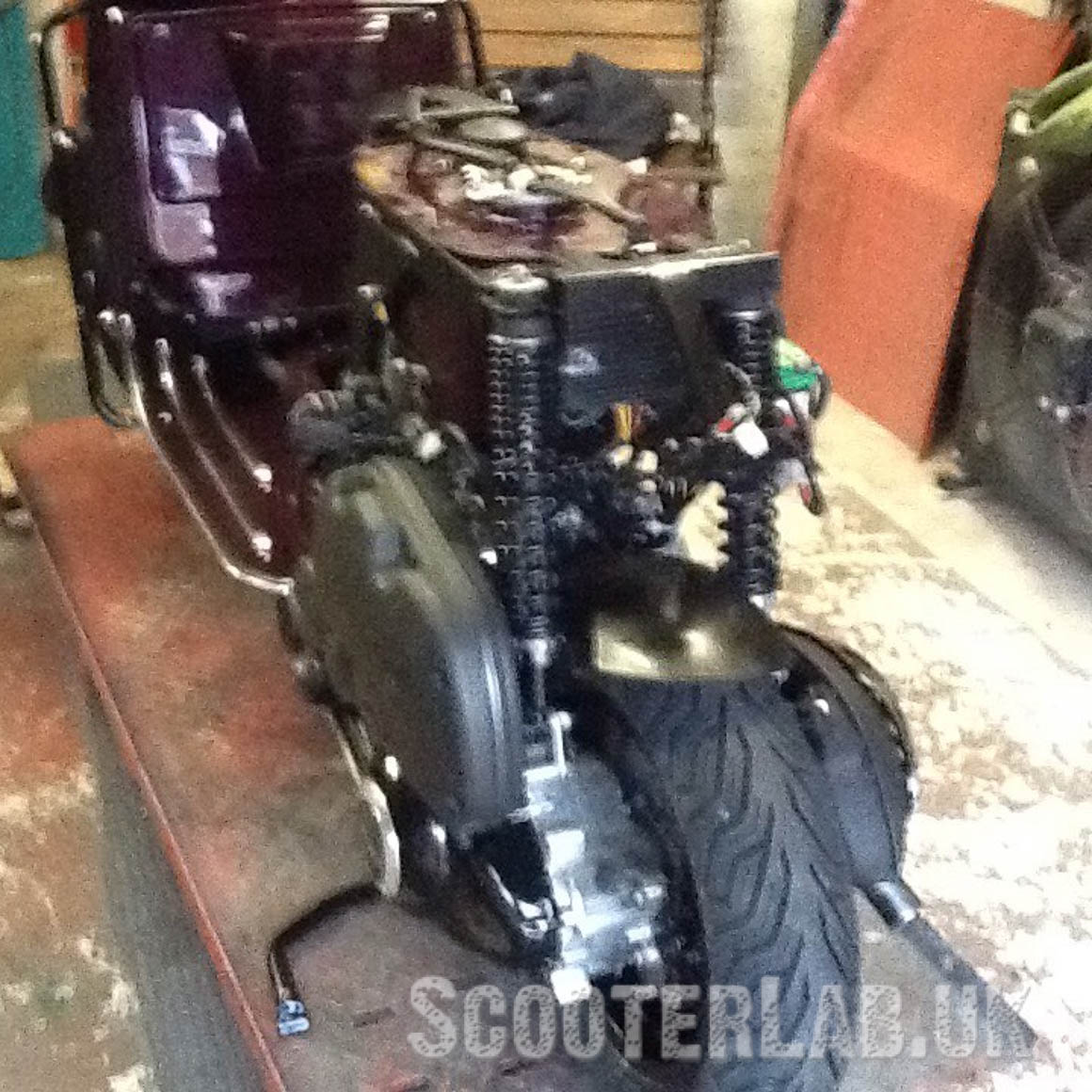
As mentioned earlier, the whole rear section of the frame can be unbolted and lifted off, a process that takes about 10 minutes but gives great access to the whole engine. It means adjusting the valves is a doddle in comparison to the engine-out job on a real GTS.
We didn’t get a chance to see the rear lifted off but Mick sent us a couple of blurry images taken on his i-Pad. Thankfully his metalwork skills are much better than his photography!
GTS forks
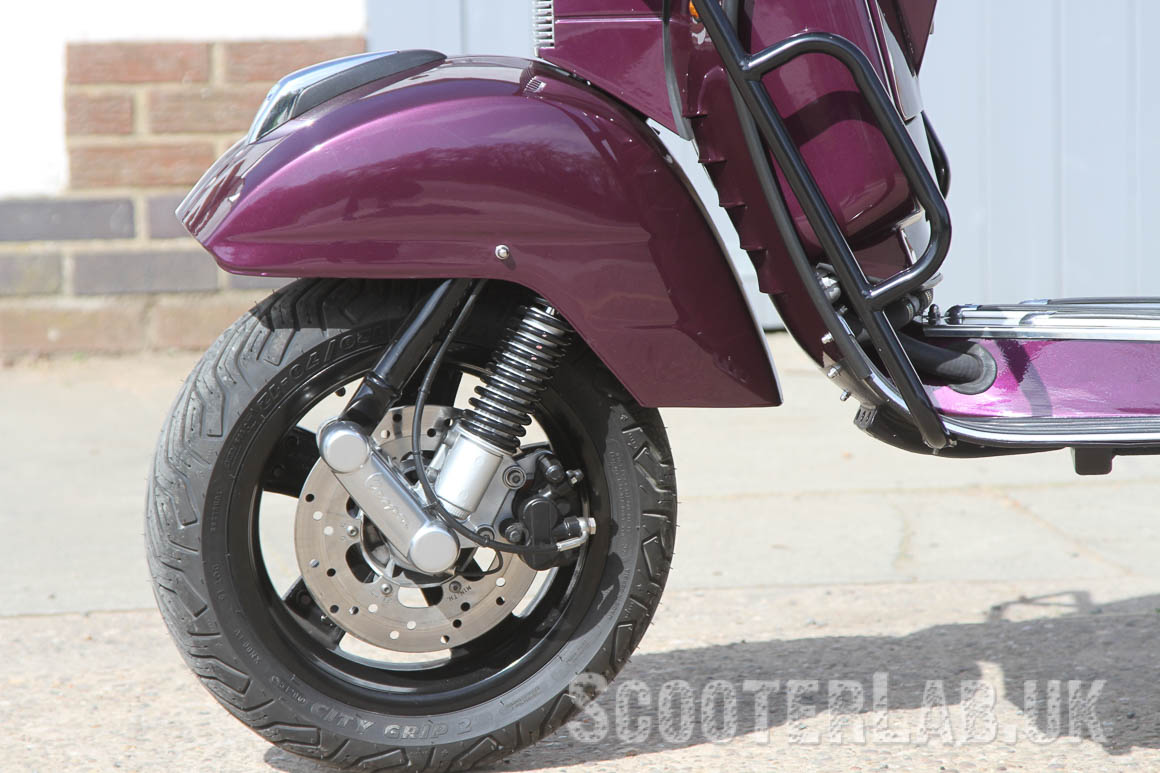
The forks sit so well in the scooter that it looks like they were made for the job. As it happens these were a two-week labour of love. A brief version of events is that they’ve been cut, machined and welded. The mudguard is a rolled and pressed item that Mick says will never suffer from the old PX rusty seam issue. To get things to look and work right he had to weld up the original fork hole in the mudguard, reposition it and spend a lot of time and plenty of trial and error to get it to work with the GTS forks. It also had to look like it was meant to be a part of the scooter and have enough clearance for the frame, as well as the horncast and have enough room for suspension travel and the 2″ larger front wheel. He absolutely nailed it. Although ever the perfectionist, Mick isn’t happy that the re-cut steering lock isn’t 100% right yet, he’ll be sorting that when he gets the chance.

Squeezing the engine in
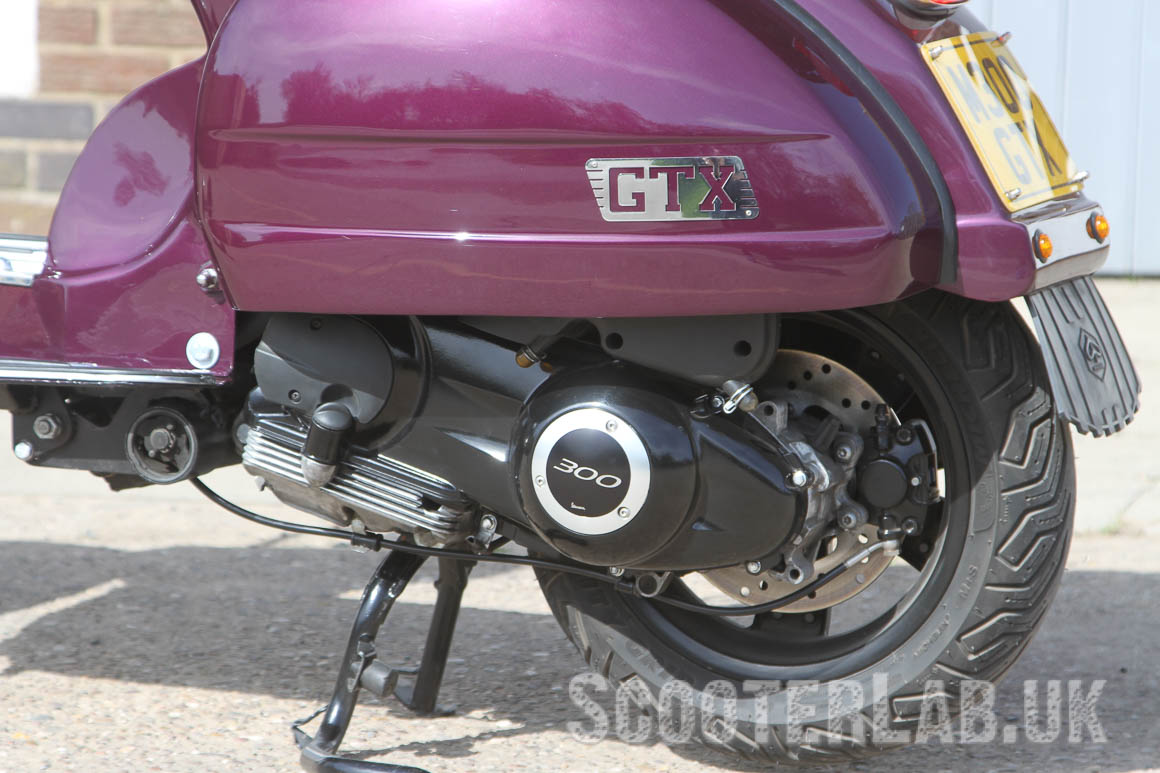
Getting the much larger GTS engine in the frame didn’t seem to phase him and aside from having the head protruding into the seat loop area is sits very nicely, at the correct angle and works with twin GTS shocks. He stressed to point out though that it is imperative that you use the original GTS silent block when building your own GTX, it eliminates vibration very well and was built-in by Piaggio for a reason.
Mick also got rid of the original plastic rear spoiler and made himself a new one as part of the frame. It also serves to house the mini-LED indicators, because obviously standard indicators weren’t going to fit the bill!
Cool running?
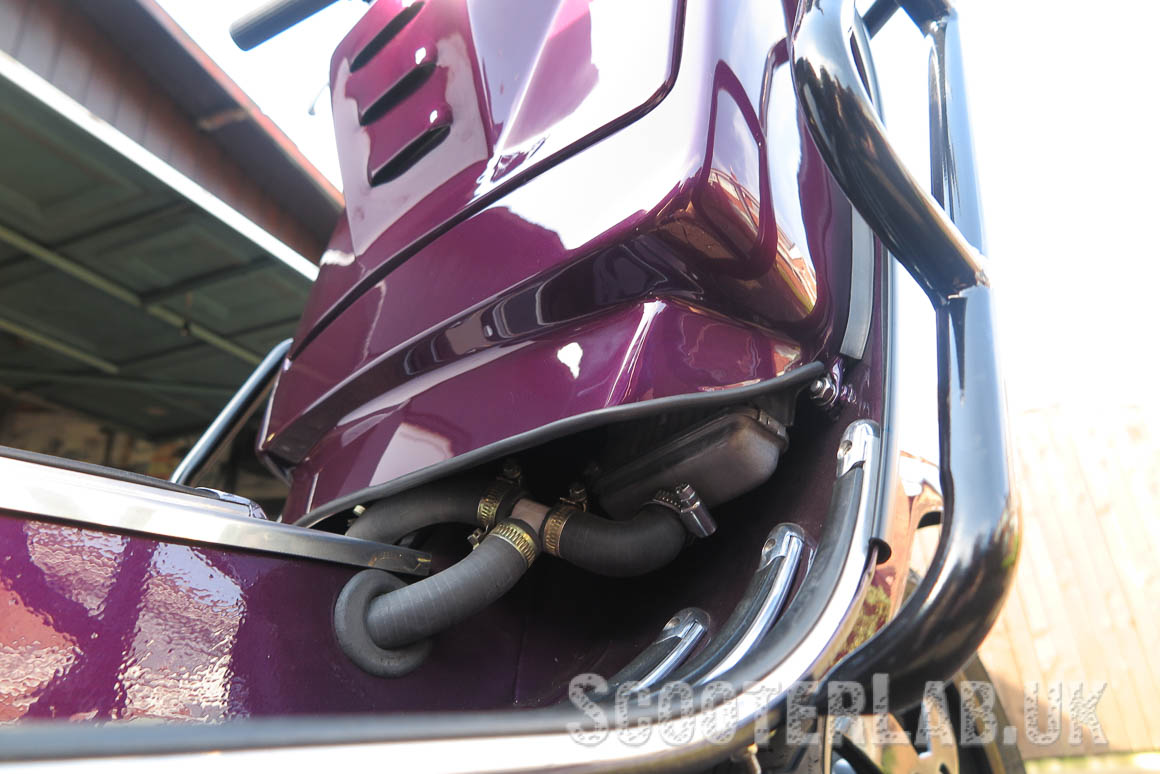
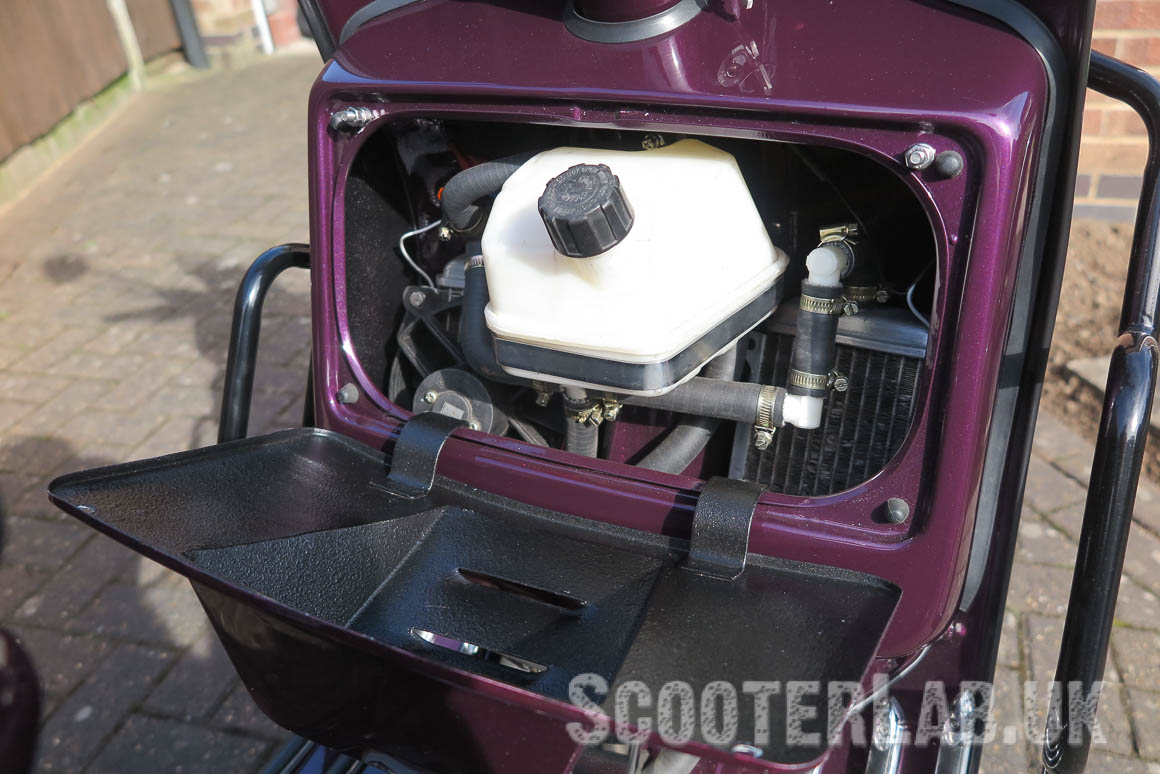
Liquid-cooling is one area that complicates a hybrid build, especially a GTS based one. With large twin rads, a fan and chunky header tank, plus the pipework to the engine it’s a squeeze to hide things. Luckily the modified glovebox was just about big enough for the job. Mick also louvred the front legshields and bottom of the glovebox to allow cool air to hit the radiators and hot air to exit.
Even so, the cooling still needs some more work. The fan comes on more than it should do, either when riding fast, or in traffic. There will be some additional venting added to try and lower the temp. As I left, Mick was measuring up for some side vents (similar to the ones on a GTS) and had a few other ideas in his head to overcome the potential problem. Having said that though, when I rode the scooter it was the hottest March day in England for 50 years.
Easy start
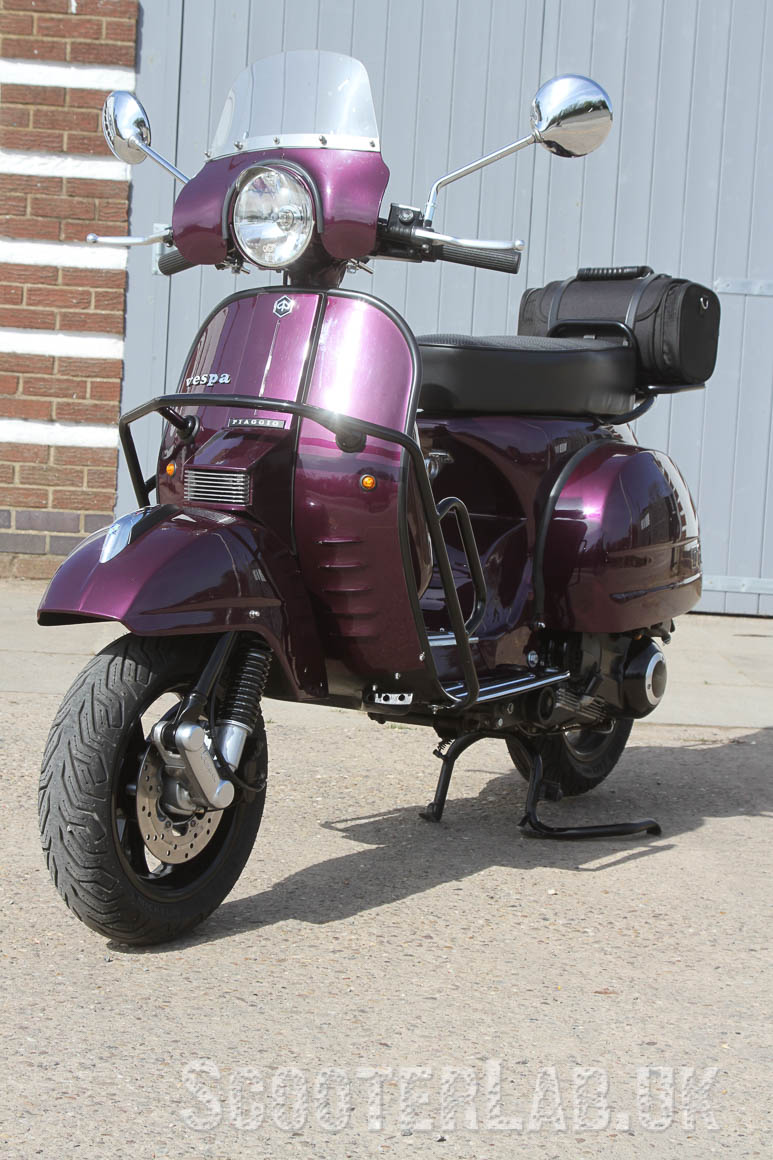
Starting the GTX is exactly the same as starting either an electric start PX or GTS. It uses a standard red PX start button grafted on to the early PX headset (the owner prefers that style to the later PX) and to start it you simply turn the key, hold a brake lever in and press the button. It fires up and sounds exactly like a GTS – just as you’d expect.
Messing with my mind
I remember when I first started riding autos. A Gilera Runner took my cherry and it felt kind of weird, no rear brake pedal, no gear change. It was a bit odd. You soon get used to things though and I’ve ridden lots of autos for both work and pleasure since. Getting on the GTX messes with your mind like a night on magic mushrooms.
It still feels like a PX, all the proportions are the same, although the seat sits a bit higher. Take it off the stand and it feels like a GTS, the weight is similar. Sit on the scooter, start it up and it feels like a GTS but before pulling away for the first time I tried to twist the imaginary gearshift into first whilst pulling in the rear brake. That’s because your head goes into PX riding autopilot again.
Readjust your brain, twist the throttle and it pulls away smoothly on the throttle. For the first few metres it feels a little bit wobbly, that’s because it’s neither PX or GTS, this is GTX. There’s more weight on the front end thanks to the heavier forks, larger wheel and cooling system and radiators. There’s also more lard at the rear. You soon get used to the different weight distribution though.
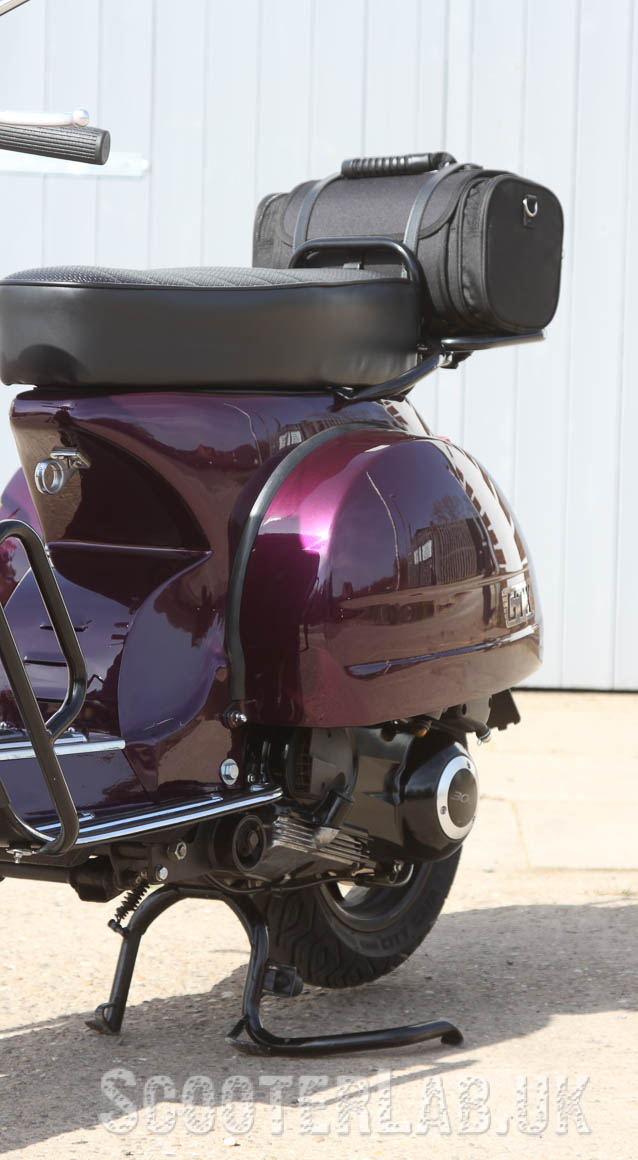
Fast enough?
As you’d expect, once you open the scooter up it’s as quick and useable as a GTS. It’s like riding a fast PX without the benefit of a nice-sounding 2-stroke motor. You’re more aware of the wind noise hitting you from the screen, although I ride a PX without a screen so the air probably hits me below my helmet on that.
The scooter feels very stable, straight and holds the road well. Those 12″ wheels make a difference to the skittish handling of a PX, as does the extra weight over the front end. It seems to keep the front planted. You can hold the scooter pretty much flat out whilst taking fast corners and it’ll hold a line. Having fantastic brakes is also a bonus. I felt the suspension needed a bit of work for faster riding but luckily the twin rear shocks are preload adjustable and there are plenty of aftermarket options if you want to dial them in properly. It takes a few stops and starts before your head stops you dabbing a foot for the imaginary rear brake pedal, or putting it into ‘first’ to pull away. Like a GTS it’ll make a great long-distance scooter.
Would you buy one?
Although there are still a few cooling issues to sort out this is probably the closest to what could be a production hybrid I’ve ridden. The GTX looks like it could have rolled out of the factory when you see it up close. It’s very well crafted, neat, subtle and built to perfection.
Would you buy one if there was a classic Vespa with modern running gear? Something like a Rally 300, GS 278, or original style automatic Primavera 125. I’m confident they’d sell like hot cakes.
Words, photos and video: Iggy
Visit the SLUK Shop

As a classic scooter enthusiast, I can’t help but thinking that Piaggio have really missed out by not capitalising on their rich back catalogue of timeless Vespa designs. Retro scooters sell by the container load – if it looks faintly like a 1960s classic but has modern running gear and somewhere to plug your hair straighteners in people will buy it.
Classic Lambretta designs of yesteryear have been used by the likes of Scomadi and Royal Alloy to great effect. Dozens of mostly Chinese manufacturers have copied the Vespa silhouette and built cheap, (often disposable) rip off clones. None of them quite getting it right but still selling plenty of plastic scooters to punters. So why have Piaggio never brought back one of their classic designs as a modern retro, with all the benefits of both worlds? A Vespa design recreated for the 21st century. Done properly without being overpriced it would sell around the world.

Hybrid success
The Vespa GTS has become the 21st-century workhorse for many rally going scooter riders. A modern equivalent to the outlawed, out of production Vespa PX. The GTS has a fairly powerful engine, good brakes, decent handling and the all-metal monocoque body we all expect from a Vespa. It still hasn’t got that old Vespa shape though.
Scooterists are a determined bunch and if they can’t buy what they want they’ll build one themselves. Scooter enthusiasts are never satisfied with a simple production scooter. Things are never fast enough so we feel the need to tinker, improve, alter or in this case transplant.
As far as we’re aware, this is the first Vespa GTS engine that has been successfully transplanted into a PX-style chassis. If there are others I’d be surprised if they were done half as well.
VIDEO | Up close and on-board the GTX 300
Who built it?
The owner/builder, Mick Maidment lives in Leicestershire and has just spent 10 months building what he calls a GTX 300. He’s in his mid-70s and is the retired owner of a structural metalwork fabrication company. Mick still rides scooters most days, still builds engines, does a bit of tuning and fixes problems for local scooterists. He’s also just about to start teaching a keen 19-year-old PX riding girl how to look after and service her scooter, and she also wants him to teach her how to weld. Although Mick recently stopped taking on work at his home workshop he’s happy to help nurture the next generation.

Hand built by an English craftsman
As mentioned, Mick has spent his life messing about with metal fabrication, both for work and pleasure. Having just ridden this recently completed, perfectly road-legal hybrid scooter and seen the intricate details up close I’m amazed by his ingenuity, the neat touches and clever solutions he’s crafted into this very special one-off scooter. Watch the video above as Mick talks us through most of the details.


How did the project start?
Mick kept hearing friends trying to decide whether to go to certain events on the PX or GTS and it gave him an idea. It’s something hundreds of scooter riders will have thought up but not had the talents to create the fusion. Talent is one thing that isn’t lacking here. Getting a big four-stroke lump into a PX style chassis and more importantly making it sit well and look in proportion isn’t by any stretch of the imagination easy. It requires skill and determination.
LML meets GTS
Before starting the project Mick managed to find himself a stolen/recovered GTS 300 from an insurance recovery place. He needed more than just an engine and got the complete damaged scooter for just £700. He collected it after seeing it running and brought it home to his workshop. He also found himself an LML auto with V5 and logbook for just £100. The choice of using an LML was a clever one, the rear is detachable for starters, it’s also stronger (according to the owner) than a ‘real’ PX frame. Seeing as this one was going to be very heavily modified strength was a bonus and surely it’s better to cut and chop an Indian clone rather than an Italian original?

Outstanding
I’d seen a couple of photos of the GTX 300 before I paid Mick a visit but was blown away by just how much work has gone into this and how well the scooter now sits on 12″ GTS wheels. It’s not too high, or out of proportion and although there’s a protrusion in the frame loop for the cylinder head, and a bit of an ugly carbuncle on the toolbox door for the header tank, the fabrication is unbelievable, a testament to Mick’s outstanding skills. It looks ‘factory’ rather than built in a shed.
Clever details are in abundance. Stuff like the brackets he made for the GTS master cylinders, the ‘ladder’ frame beneath the scooter to give extra strength, the way he’s cut two PX tanks up and been able to accommodate the fuel pump in a much better place than Piaggio put the GTS one – whilst still having the capacity for 8.5 litres of fuel. He’s widened the frame, widened the tank, built a new subframe, created a wider central tunnel to house the CDI and allow easy access to pipes and electrics. The PX side panels have been lengthened, strengthened and can be easily removed to get to the battery, oil filler etc. Everything is well thought out and finished perfectly. Even the wiring looks neater than an original LML.


As mentioned earlier, the whole rear section of the frame can be unbolted and lifted off, a process that takes about 10 minutes but gives great access to the whole engine. It means adjusting the valves is a doddle in comparison to the engine-out job on a real GTS.
We didn’t get a chance to see the rear lifted off but Mick sent us a couple of blurry images taken on his i-Pad. Thankfully his metalwork skills are much better than his photography!

GTS forks
The forks sit so well in the scooter that it looks like they were made for the job. As it happens these were a two-week labour of love. A brief version of events is that they’ve been cut, machined and welded. The mudguard is a rolled and pressed item that Mick says will never suffer from the old PX rusty seam issue. To get things to look and work right he had to weld up the original fork hole in the mudguard, reposition it and spend a lot of time and plenty of trial and error to get it to work with the GTS forks. It also had to look like it was meant to be a part of the scooter and have enough clearance for the frame, as well as the horncast and have enough room for suspension travel and the 2″ larger front wheel. He absolutely nailed it. Although ever the perfectionist, Mick isn’t happy that the re-cut steering lock isn’t 100% right yet, he’ll be sorting that when he gets the chance.

Squeezing the engine in
Getting the much larger GTS engine in the frame didn’t seem to phase him and aside from having the head protruding into the seat loop area is sits very nicely, at the correct angle and works with twin GTS shocks. He stressed to point out though that it is imperative that you use the original GTS silent block when building your own GTX, it eliminates vibration very well and was built-in by Piaggio for a reason.
Mick also got rid of the original plastic rear spoiler and made himself a new one as part of the frame. It also serves to house the mini-LED indicators, because obviously standard indicators weren’t going to fit the bill!


Cool running?
Liquid-cooling is one area that complicates a hybrid build, especially a GTS based one. With large twin rads, a fan and chunky header tank, plus the pipework to the engine it’s a squeeze to hide things. Luckily the modified glovebox was just about big enough for the job. Mick also louvred the front legshields and bottom of the glovebox to allow cool air to hit the radiators and hot air to exit.
Even so, the cooling still needs some more work. The fan comes on more than it should do, either when riding fast, or in traffic. There will be some additional venting added to try and lower the temp. As I left, Mick was measuring up for some side vents (similar to the ones on a GTS) and had a few other ideas in his head to overcome the potential problem. Having said that though, when I rode the scooter it was the hottest March day in England for 50 years.

Easy start
Starting the GTX is exactly the same as starting either an electric start PX or GTS. It uses a standard red PX start button grafted on to the early PX headset (the owner prefers that style to the later PX) and to start it you simply turn the key, hold a brake lever in and press the button. It fires up and sounds exactly like a GTS – just as you’d expect.

Messing with my mind
I remember when I first started riding autos. A Gilera Runner took my cherry and it felt kind of weird, no rear brake pedal, no gear change. It was a bit odd. You soon get used to things though and I’ve ridden lots of autos for both work and pleasure since. Getting on the GTX messes with your mind like a night on magic mushrooms.
It still feels like a PX, all the proportions are the same, although the seat sits a bit higher. Take it off the stand and it feels like a GTS, the weight is similar. Sit on the scooter, start it up and it feels like a GTS but before pulling away for the first time I tried to twist the imaginary gearshift into first whilst pulling in the rear brake. That’s because your head goes into PX riding autopilot again.
Readjust your brain, twist the throttle and it pulls away smoothly on the throttle. For the first few metres it feels a little bit wobbly, that’s because it’s neither PX or GTS, this is GTX. There’s more weight on the front end thanks to the heavier forks, larger wheel and cooling system and radiators. There’s also more lard at the rear. You soon get used to the different weight distribution though.

Fast enough?
As you’d expect, once you open the scooter up it’s as quick and useable as a GTS. It’s like riding a fast PX without the benefit of a nice-sounding 2-stroke motor. You’re more aware of the wind noise hitting you from the screen, although I ride a PX without a screen so the air probably hits me below my helmet on that.
The scooter feels very stable, straight and holds the road well. Those 12″ wheels make a difference to the skittish handling of a PX, as does the extra weight over the front end. It seems to keep the front planted. You can hold the scooter pretty much flat out whilst taking fast corners and it’ll hold a line. Having fantastic brakes is also a bonus. I felt the suspension needed a bit of work for faster riding but luckily the twin rear shocks are preload adjustable and there are plenty of aftermarket options if you want to dial them in properly. It takes a few stops and starts before your head stops you dabbing a foot for the imaginary rear brake pedal, or putting it into ‘first’ to pull away. Like a GTS it’ll make a great long-distance scooter.
Would you buy one?
Although there are still a few cooling issues to sort out this is probably the closest to what could be a production hybrid I’ve ridden. The GTX looks like it could have rolled out of the factory when you see it up close. It’s very well crafted, neat, subtle and built to perfection.
Would you buy one if there was a classic Vespa with modern running gear? Something like a Rally 300, GS 278, or original style automatic Primavera 125. I’m confident they’d sell like hot cakes.
Words, photos and video: Iggy
Visit the SLUK Shop














Well, somebody had to do it! Technically brilliant but aesthetically like Mrs Blobby on a tart’s night out in Newcastle!
For me, the last beautiful Vespa Piaggio made is the 946. Before that the last run of
Primaveras and 100 Sport. If they put a 300 in the 946 and put a sensible price on it, then that is as classic as I’d want. Sculptural, like old time Vespas were. I certainly won’t invest in another machine until a viable leccy classic style scoot turns up.
My GTS has this cod Italian phrase on the butty box…
Questa ragazza e brutta ma e una ragazza chi va!
This girl is ugly but she is a goer! That sums it up for me. I have had four GT/S since 2002 after injury buggered wrists forced me to retire my shiftys but I have never truly loved them.
I would have jumped ship to Scomadi but fear they are spent in the UK and as for Royal Alloy! I hope they all spontaneously combust and singe the nads of the idiots who plaster them in RAF roundels and Union Flags! I won’t give one penny to the disease spreading CCP if I can help it! It always amuses me to read “Tigara Grande” on the legshields…”Big Fag” in Romanian. Ha ha! Sounds about right for the True Patriot/Comedy Mod owners. Clearly the CCP are having another laugh at their expense.
I think you’re right Iggy. If Piaggio made a Vespa like that I would buy one. Sadly even if they could be persuaded there was a market they would never be persuaded that the comprise of classic looks over storage capacity of any kind was a good one.
As a one off machine I think it’s fantastic. It’s been done so well it really does look more factory than workshop built. It would look ace with a SLUK driver screen.
I think Mick has done a brilliant job overcoming problems and finding their solutions.
Like them or not, the Royal Alloy scooters are getting great reviews and look smart.
I would love to build one with mucks help.has anyone got any contact details for him?