
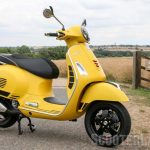

Piaggio recently invited us down for a ‘group test’ of their entire test fleet. Naturally we ignored all those boring motorcycles they seem obsessed with these days, and got stuck in with the Vespas…
What’s new?
Well this year all the new models must switch to Euro-4 specification, which not only means a raft of further-tightened emission requirements, but also additional safety enhancements like ABS braking (linked CBS brakes for some smaller models).
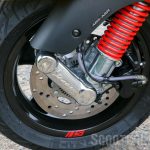
For the latest GTS, old is the new new, at least in terms of front suspension. Gone is the round-bushed front shock of the 2014-2016 models, returning to the same type of 2-bolt shock used on the earlier GTS. Nobody from Piaggio has so far managed to tell us why they have reverted to the old type of shock but that original design has worked perfectly well since the PX of the 1970s.

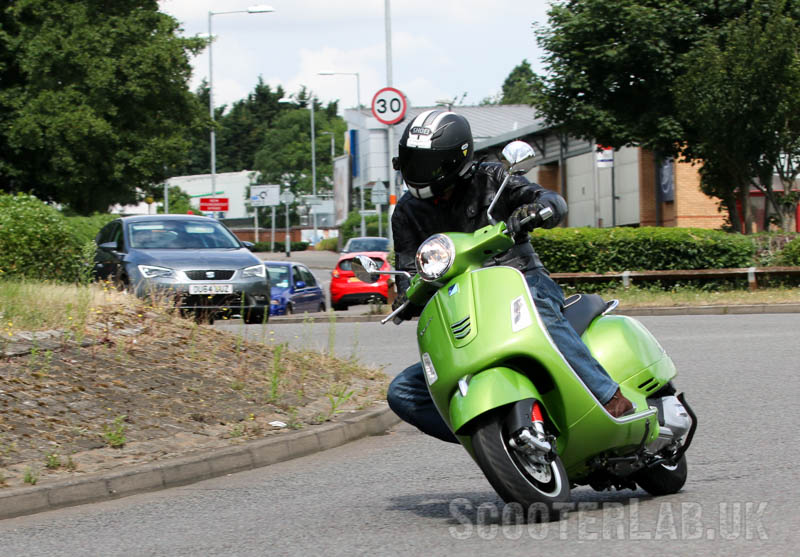
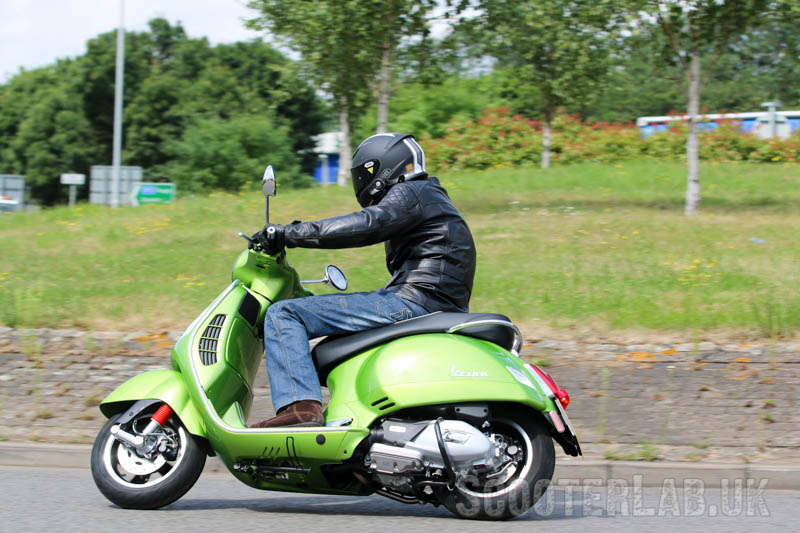
Vespa GTS 125 2017
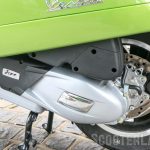
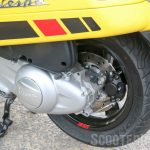
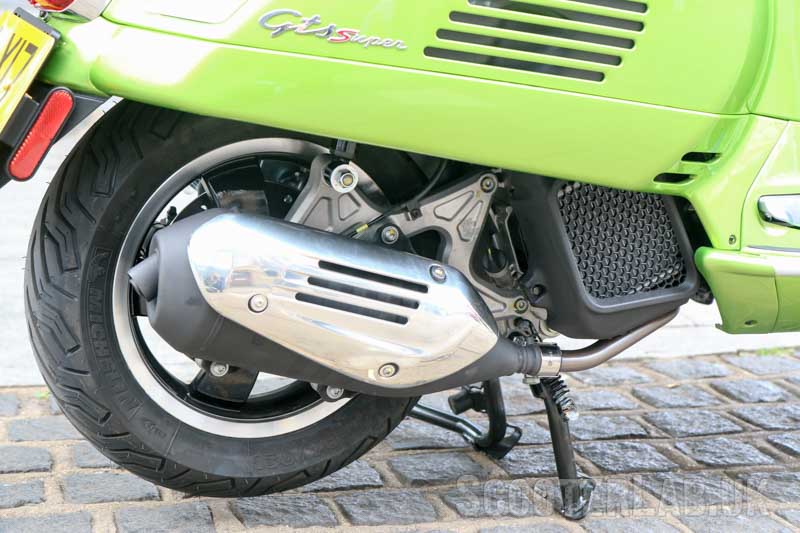
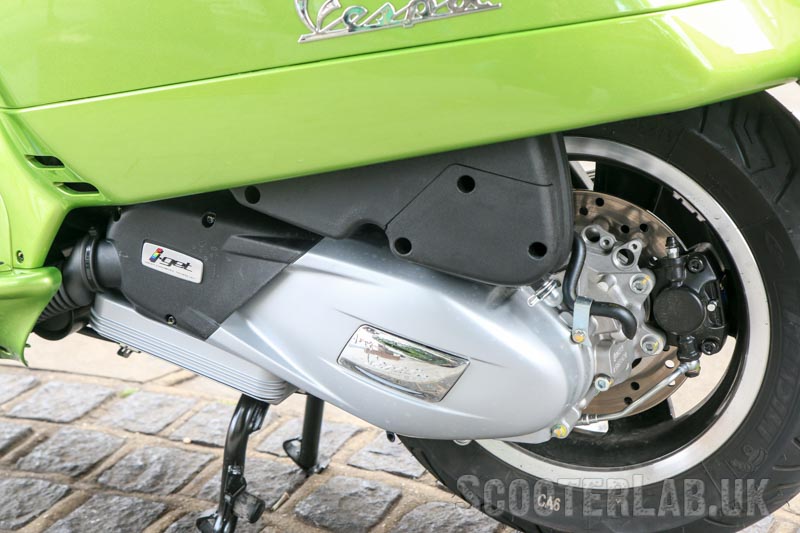
The big change for the GTS has been a complete change of engine for the learner-legal models to the 4-valve water-cooled iGet engine as used in the Piaggio Medley. This is a ‘plug and play’ liquid cooled engine with the radiator mounted on the side of the motor over a small fan.
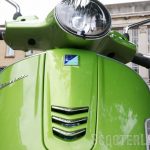
This means that there’s no need for chassis-mounted radiators or plumbing, so there are plastic blanking plates either side of the front mudguard where previously there would be radiator grilles.
This motor brings automatic Engine Stop-Start technology to the Vespa range for the first time, saving petrol, emissions (and the planet, obviously) every time you sit stationary for a few seconds. It caught me out the first time the engine died at a set a of traffic light but you just have to remember that simply twisting the throttle will restart the motor and send you accelerating away.

125 Performance
If you have Stop-Start activated (you can turn it on or off via a switch on the right handlebar) then the engine only idles for a few seconds before cutting out. The idle period varies between 3 to 7 seconds depending on engine temperature.
The good thing about the Piaggio Stop-Start system is that it only uses electro-magnetism to spin the crankshaft. There are no mechanical parts to wear out like there would be with a traditional starter-motor. The downside of the Piaggio Stop-Start tech is that it’s just a tiny bit slower to activate than the comparable Honda version used on the ever-popular PCX. With the added weight penalty of the metal Vespa chassis, the GTS is definitely not the fastest 125 off the traffic lights, but it’s still adequate for a learner.
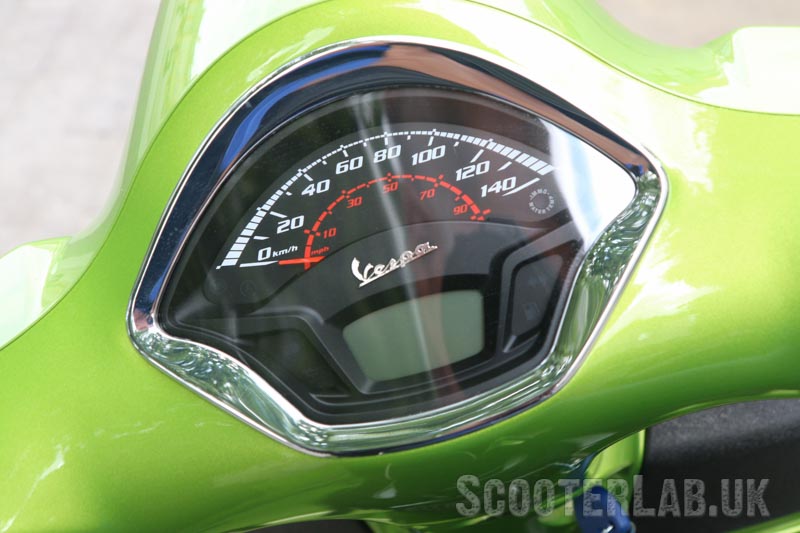
Top speed – registered by the speedo – was 67mph (108kmh) at which point you could feel the rev limiter kicking in, but I only hit this downhill with the wind behind me. On the flat the GTS 125 showed closer to 62mph (100kmh) but it would soon drop back to 50mph (80kmh) when faced with a hill. This was a virgin motor, which presumably will loosen up after a few more miles of ‘gentle’ running in.

iGet ya..
Important practicalities of the new iGet engine are extended servicing intervals and improved fuel ecomony. Oil and filter changes are at 10,000 km and valve adjustments only every 20,000 km. Vespa GTS 125 has a stated WMTC consumption figure of 41.6 km/litre or 117 miles per gallon in old money!
One additional requirement of Euro-4 regs is to fit 125cc machines with either linked brakes (CBS) or a proper Anti-lock Brake System (ABS). Having compared the two options, proper ABS is far preferable but also more expensive for a manufacturer. Given the Vespa’s ‘premium’ status, Piaggio have fitted ABS to the GTS 125 which helps to justify the £4,499 price tag (correct July 2017).
What is Idle-start-stop like and how does it compare to Honda's version?

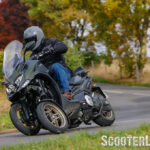
Vespa GTS 300 Super 2017
The bigger brother version of the GTS doesn’t get a new engine or Engine Stop-Start. Instead the previous QUASAR engine simply gets re-tweaked to meet the current emission regulations. Thankfully, for anyone worrying that this might mean a massive loss of performance, the demo scooter didn’t feel noticeably slower than the old one, however such a quick spin didn’t give us massive opportunity for a real comparison. Piaggio’s quoted performance figures are 21.2 HP (15.6 kW) at 7,750 rpm with maximum torque of 22 Nm at 5,000 rpm. Compared to the 2011 model this represents a small loss of only 0.8hp and 0.3Nm of torque.


Price drop
The GTS 300 does now come with ABS as standard but unlike the 125 this is a full 2-channel system with modulation of the brakes on both wheels. Early ABS systems were very intrusive, cutting in early to release the brakes and generally lengthening emergency braking distances.
By contrast the new system used on the Vespa is well set-up to the point where you could just about get the rear tyre to start howling under heavy braking before the ABS kicked in.
As a by-product of the ABS system you also get ASR (Automatic Slip Reduction), which is a type of traction control that uses various systems to reduce torque to the tyre if the rear wheel starts to massively out-accelerate the front wheel. This is not a superbike where you have a surplus of power to wheelspin out of 60mph corners, but ASR will still come in handy if you are greedy with the throttle on cobbled roads or wet roundabouts.
The natural penalty to being forced to fit in all this extra technology is price. In the post-Brexit currency crash Piaggio UK put the Vespa GTS 300 up to almost £5,300, but subsequently have made an adjustment and the basic models now sell for £4,999.
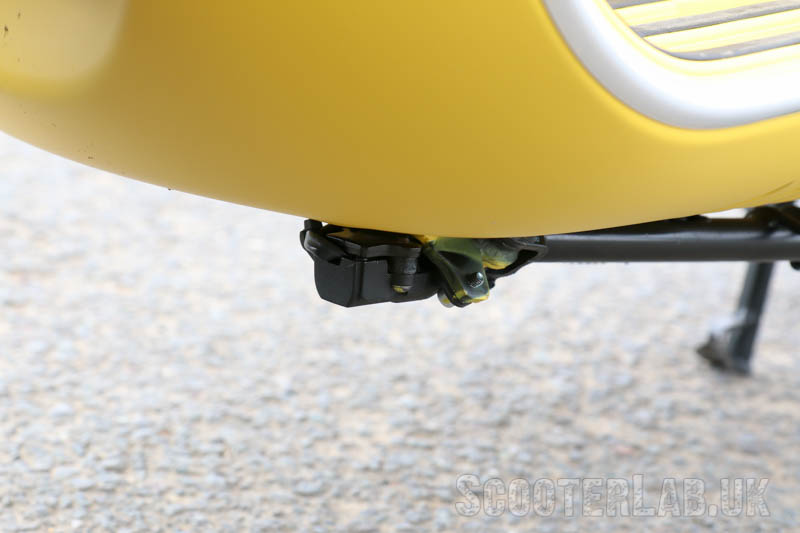
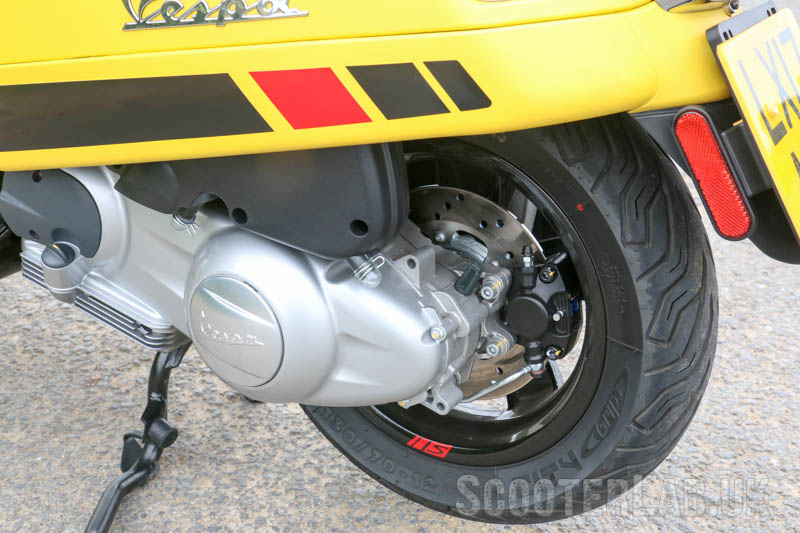
The model I tested was the SuperSport model defined by different graphics and a matt yellow paint scheme. You’ll pay £5,300 for this version.
VIDEO | Quick spin on the GTS 300 Euro 4
Vespa Tech – tracker coming?
All these Vespas are upgradable to the Vespa Multimedia Platform – a fandabidozy mobile app that can transform a phone mounted onto the scooter to become a “full-fledged complex computer able to simultaneously display information such as tachometer, rev meter, and also instantaneous engine power and torque, longitudinal acceleration, instant and average fuel consumption, average speed and battery voltage and much more. The smartphone connected to the Vespa Multimedia Platform also makes it possible to display maps and routes as well as identify petrol stations and Service Stations. The tyre condition monitoring feature takes synergistic advantage of the vehicle and smartphone sensors to monitor tyre wear and inflation, immediately alerting the rider of any potentially critical situations. The general analysis feature monitors vehicle condition.”
All these features are excellent gimmicks but the reality of modern inner-city life is that scooters are targets for thieves and scooter-jackers. Mounting a valuable phone on the handlebars is just another incentive to a would-be-robber.
Far more usefully, we understand that Piaggio are working on an integrated system for tracking the Vespa, which should be massively useful if your scooter is stolen and therefore – hopefully – act as a huge theft deterrent. So far we have only heard this as a rumour so we have no details if this will be a monitored subscription service or if it is included in the price. Nor do we have details about when this system will be available but it certainly won’t be during 2017.
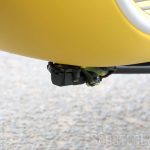
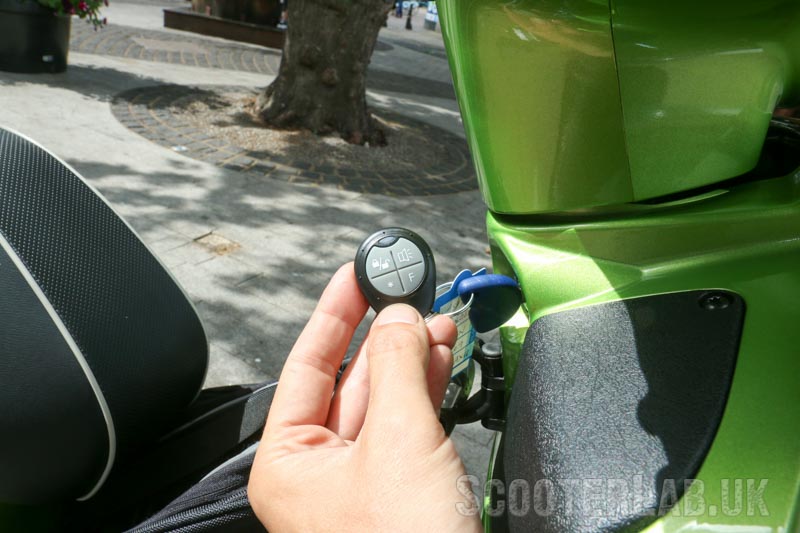
Piaggio have already taken some steps to make the GTS slightly more theft-resistant than earlier models, but this is an arms race. Anything extra that the manufacturers can do to prevent theft will be more than welcome.
Sticky
Riding shots: Mark Forsyth




Check out our exclusive SLUK GTS products






The old 2015 Vespa GTS 125 was better:
* dual-channel ABS
* full 15 hp watercooled engine
* anti-dive ’round-bushed’ front shock
* had the same Vespa Multimedia platform as the new Euro-4 models
* cheaper new
If you can get a hold of the old model, and you’re stuck with a A1 license, that would be the best bet.
Sticky, as ever, very good reviews. Just one thing, the ASR. I have it on authority from Piaggio and an experienced Vespa tech that this works by retarding the ignition and reducing the fuel to the injector when the rear wheel starts to slip and is not controlled by the rear brake functioning. As such it’s not quite as crude as you mention. The fuel supply being cut off completely if the slip is substantial until traction is regained. This seems to be the case with my own 2016 GTS300 euro 3 version at least. When moving off on deep gravel with ASR engaged (not switched off) the rear wheel begins to slip (the bike not even moving at this point) and the engine begins to slow and will momentarily cut out to gain grip if the throttle is kept at the same setting. The rear brake being observed by a tech friend who confirmed the brake pads did not operate and it was an engine function that was responsible for the dip in power to regain traction. I’ve had my GTS300ie abs/asr for 4 months now and it’s just fantastic. Love the bike, and it’s the one I go to all the time instead of my bigger now defunct motorcycles. They’ll be going. Please keep up the good work!
Thanks for the extra input, article edited as a result of your comments.