Around seven years ago I sat in an Alpinestars Tech-Air presentation and watched their fledgling airbag-equipped road suit being demonstrated. It was impressive, expensive and at the time only available fitted to a leather suit for world-class racers and rich road riders. Even now it’s still pricey but is starting to become more accessible to ‘ordinary’ riders and is also available in Alpinestars textiles ‘off the shelf’. ScooterNova editor, Andy Gillard delves a little deeper to see if it’s something worth considering…
Iggy
In the Beginning…
Airbags aimed at motorcycle and scooter riders have been around for a number of years now. In fact back in the late 90s Sticky and I tested some strap-on items (no, not that sort) whilst commuting back from our magazine offices in Weston-super-Mare to London by scooter. They were an early form of rip-cord operated air bags from Asia and were so bad that we managed to get all the way from our scooters parked at the petrol pump and into the shop counter before remembering the airbags were being worn. Nope, they didn’t work!
MotoAirbag baseball bat attack
Honed and Working
That particular arrangement of a separate air-bag unit operated via a rip-cord clipped to the scooter has been perfected over the years, with a unit by Moto-AirBag of Italy being particularly successful and adopted by the likes of Tucano Urbano who have developed jackets specifically to accommodate them. You can see the SLUK video of a volunteer being whacked by a baseball bat whilst wearing one above.
As a jacket/ airbag combo it’s not too bad, a little heavier than a normal jacket fitted with regular body armour however, and of course there is always the issue of being tethered to the scooter – something you must remember each and every time you dismount to avoid accidental inflation. As you have probably guessed, the rip-cord system activates the airbag once the rider and scooter become separated, eg. in the event of a crash.
The Motoairbag system comes as a separate gilet (£425) or vest (£575) and you can also buy a separate front air bag to go with it at (£185). Frontal impact to the major organs is one of the major killers in a bike accident, most riders just worry about their head, so it’s wise to protect as much as possible.
Racing Technology
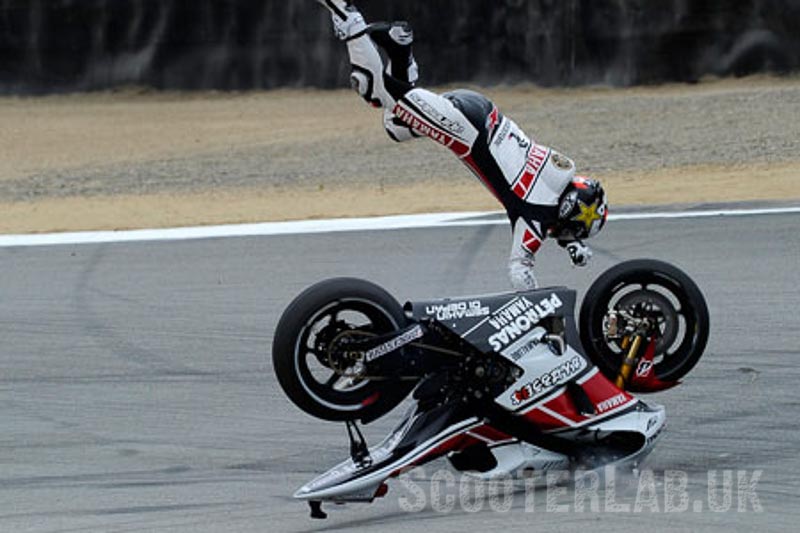
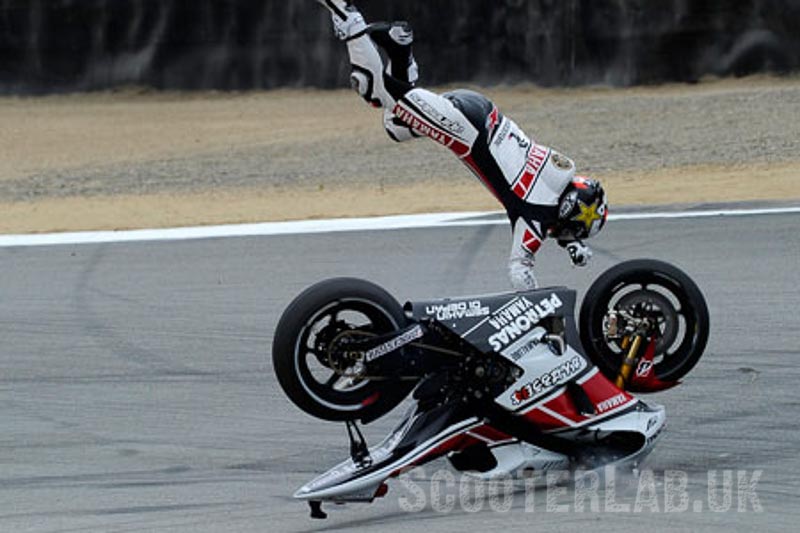
Meanwhile, back on the race track, Italian clothing manufacturer Alpinestars pioneered airbag protection for the racers they sponsor. Their Tech-Air system was at first used just in racing leather suits, but they have slowly started to filter down to road riders with their ‘street airbag system’ now being built into jackets designed for road use, in both male and female (Stella) cuts.
Unlike the rip-cord type of operation, the Tech-Air System uses groundbreaking hi-tech electronic sensors built into the airbag system that detect when the airbag needs to be deployed. These sensors are close to the rider’s body, and with a micro-processor powered by an internal battery they regularly monitor the rider’s movements.
This kind of technology has been explained to me but to be honest, it is in depth and a little head-wrecking. I also had it explained in layman’s terms, and being someone who also watches MotoGP on television and has seen it deployed in action that was much easier to digest. Basically the technology is very, very clever, and it can differentiate when a racer goes into a speed wobble, almost loses it but almost magically regains control and carries on racing, against when a racer goes into a speed wobble and loses it, crashing.
- In situation 1, the last thing the rider needs is an airbag inflating around him when trying to regain control of a high-powered race bike.
- In situation 2, the rider needs that airbag to inflate and protect him before he hits the ground. The Tech-Air System does both.
On the road
Not only that, but Alpinestars have re-programmed the version for use in their street airbag system because of course, on the roads we face different dangers to those on the race track, and behave differently too while riding.
How fast?
The Tech-Air System typically detects an impact within 30-60 milliseconds, and the gas inflated airbag takes just 25 milliseconds to fully inflate, basically it’s during the ‘Oh shit what have I done’ phase of a crash. On the street version it protects the upper body to the back, shoulders, kidney areas and chest.
Rechargeable
In the jacket the battery lasts for around 25 hours between charging, and there is an LED indicator on the sleeve which you check before riding for battery level and to make sure everything is ok with the system.
Styles
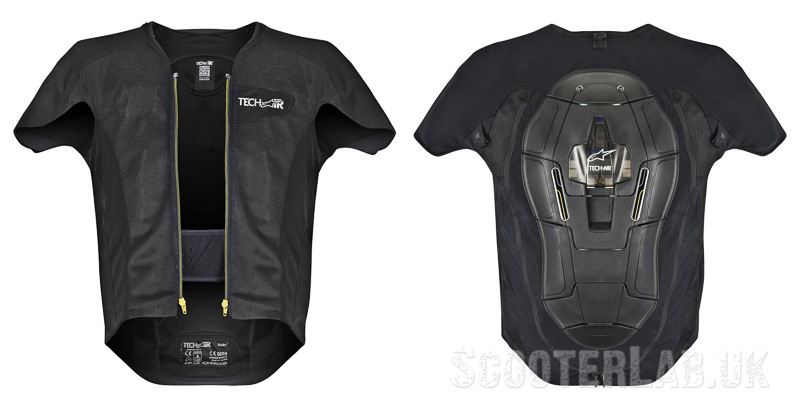
The jackets are sold separately to the Tech-Air System, and Alpinestars currently offer two; the Valparaiso For Tech-Air (£514) or the Viper For Tech-Air (£277). The former is an all weather jacket, ideal for touring, and has matching trousers available too (available for both ladies and gents), the latter is a summer jacket with mesh panels for keeping you cool (male only version for now). Both feature CE approved shoulder and elbow armour, and once installed, the Tech-Air System is activated once the jackets are closed by a specific tab fastened across your chest. Don’t get too excited though, you have to purchase the Tech Airbag Vest separately (pictured above).
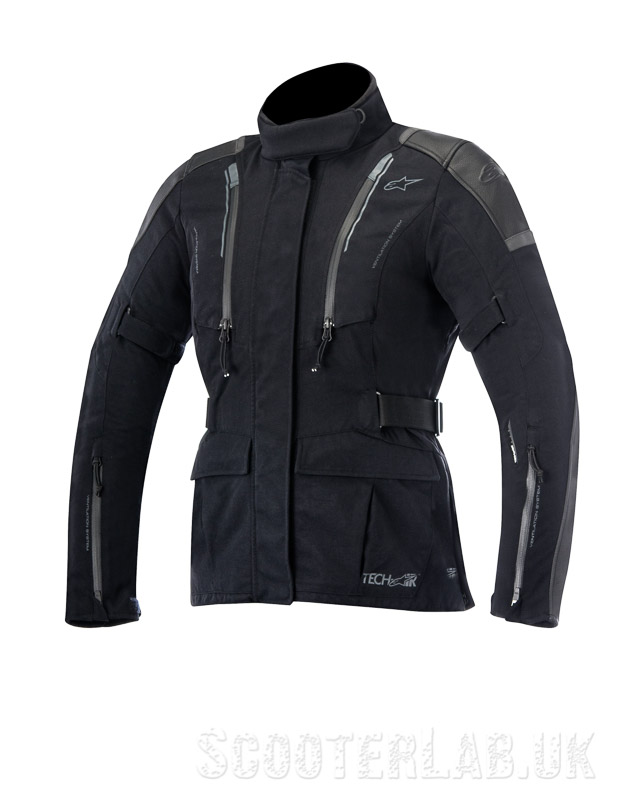 Valparaiso Tech-Air, available in male and also Stella ladies styles
Bear Hugs
At a motorcycle trade show I tried one of the jackets on, having it inflated artificially by a compressor. Before inflation, the jacket was very comfortable (I’m an Alpinestars fan anyway and know how good their products are), it was a snug fit without being restrictive, and the added Tech-Air System added very little weight. Certainly it felt less cumbersome than an add-on airbag as mentioned earlier.
The inflation process was breath-taking. Despite warning – and having experienced other air bag systems previously – the Tech-Air inflated in less than an instant, and this was via a slower hand operated compressor method too! Once fully inflated, it surprisingly didn’t feel too bulky, more like I was getting a tight bear hug from a bear with very big arms. Possibly two bears actually… I could still move, but at the same time felt secure. The system then starts to deflate by the way, again this being a slower process on the road than the track.
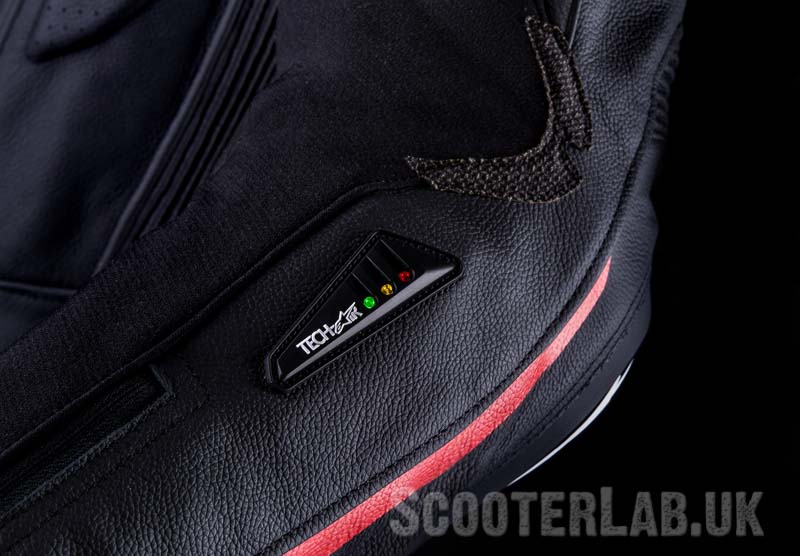 LED lights show you battery condition and whether the Tech Air is armed
Price
Of course there is a price for all this clever technology, and it ain’t cheap I’m afraid. The Tech-Air System alone will cost you £1057, plus the price of the jacket. Of course you could always argue, what price your safety? As with all new things, they will inevitably get cheaper as time goes on. Watch the Alpinestars video below and decide for yourself if it’s a worthwhile investment, also visit Alpinestars Tech Air Street for more info.
Andy Gillard
Buying from the SLUK Shop helps support ScooterLab
-

SLUK Clip bridge fitting kit for Lambretta S1 S2 & S3
£13.99
-

AVAILABLE NOW!! SCOOTERBOYS – THE LOST TRIBE
Rated 5.00 out of 5 £16.95
-

Vespa GTS/GTV SLUK Guard Original
Rated 4.75 out of 5 £34.00 – £36.50
-

Vespa GTS/GTV SLUK Guard Ultra
£34.00 – £36.05
-

SLUK Support ‘Sprint’ | Lambretta S3/ Scomadi
Rated 5.00 out of 5 £39.00
-

Scomadi TL SLUK Sports screen
Rated 5.00 out of 5 £77.50 – £82.50
-

NEW Improved Coast to Coast Lambretta screen – GP/DL type
£77.50 – £82.50
-

Vespa GTS/GTV SLUK Guard + Tail DOUBLE-PACK
Rated 5.00 out of 5 £55.00 – £60.00
-

Vespa PX/LML SLUK Sports screen
Rated 5.00 out of 5 £64.00 – £68.00
-

ScooterNova – issue 2 | MAGAZINE
£5.00
Around seven years ago I sat in an Alpinestars Tech-Air presentation and watched their fledgling airbag-equipped road suit being demonstrated. It was impressive, expensive and at the time only available fitted to a leather suit for world-class racers and rich road riders. Even now it’s still pricey but is starting to become more accessible to ‘ordinary’ riders and is also available in Alpinestars textiles ‘off the shelf’. ScooterNova editor, Andy Gillard delves a little deeper to see if it’s something worth considering…
Iggy

In the Beginning…
Airbags aimed at motorcycle and scooter riders have been around for a number of years now. In fact back in the late 90s Sticky and I tested some strap-on items (no, not that sort) whilst commuting back from our magazine offices in Weston-super-Mare to London by scooter. They were an early form of rip-cord operated air bags from Asia and were so bad that we managed to get all the way from our scooters parked at the petrol pump and into the shop counter before remembering the airbags were being worn. Nope, they didn’t work!
Honed and Working
That particular arrangement of a separate air-bag unit operated via a rip-cord clipped to the scooter has been perfected over the years, with a unit by Moto-AirBag of Italy being particularly successful and adopted by the likes of Tucano Urbano who have developed jackets specifically to accommodate them. You can see the SLUK video of a volunteer being whacked by a baseball bat whilst wearing one above.
As a jacket/ airbag combo it’s not too bad, a little heavier than a normal jacket fitted with regular body armour however, and of course there is always the issue of being tethered to the scooter – something you must remember each and every time you dismount to avoid accidental inflation. As you have probably guessed, the rip-cord system activates the airbag once the rider and scooter become separated, eg. in the event of a crash.
The Motoairbag system comes as a separate gilet (£425) or vest (£575) and you can also buy a separate front air bag to go with it at (£185). Frontal impact to the major organs is one of the major killers in a bike accident, most riders just worry about their head, so it’s wise to protect as much as possible.

Racing Technology
Meanwhile, back on the race track, Italian clothing manufacturer Alpinestars pioneered airbag protection for the racers they sponsor. Their Tech-Air system was at first used just in racing leather suits, but they have slowly started to filter down to road riders with their ‘street airbag system’ now being built into jackets designed for road use, in both male and female (Stella) cuts.
Unlike the rip-cord type of operation, the Tech-Air System uses groundbreaking hi-tech electronic sensors built into the airbag system that detect when the airbag needs to be deployed. These sensors are close to the rider’s body, and with a micro-processor powered by an internal battery they regularly monitor the rider’s movements.
This kind of technology has been explained to me but to be honest, it is in depth and a little head-wrecking. I also had it explained in layman’s terms, and being someone who also watches MotoGP on television and has seen it deployed in action that was much easier to digest. Basically the technology is very, very clever, and it can differentiate when a racer goes into a speed wobble, almost loses it but almost magically regains control and carries on racing, against when a racer goes into a speed wobble and loses it, crashing.
- In situation 1, the last thing the rider needs is an airbag inflating around him when trying to regain control of a high-powered race bike.
- In situation 2, the rider needs that airbag to inflate and protect him before he hits the ground. The Tech-Air System does both.
On the road
Not only that, but Alpinestars have re-programmed the version for use in their street airbag system because of course, on the roads we face different dangers to those on the race track, and behave differently too while riding.
How fast?
The Tech-Air System typically detects an impact within 30-60 milliseconds, and the gas inflated airbag takes just 25 milliseconds to fully inflate, basically it’s during the ‘Oh shit what have I done’ phase of a crash. On the street version it protects the upper body to the back, shoulders, kidney areas and chest.
Rechargeable
In the jacket the battery lasts for around 25 hours between charging, and there is an LED indicator on the sleeve which you check before riding for battery level and to make sure everything is ok with the system.
Styles
The jackets are sold separately to the Tech-Air System, and Alpinestars currently offer two; the Valparaiso For Tech-Air (£514) or the Viper For Tech-Air (£277). The former is an all weather jacket, ideal for touring, and has matching trousers available too (available for both ladies and gents), the latter is a summer jacket with mesh panels for keeping you cool (male only version for now). Both feature CE approved shoulder and elbow armour, and once installed, the Tech-Air System is activated once the jackets are closed by a specific tab fastened across your chest. Don’t get too excited though, you have to purchase the Tech Airbag Vest separately (pictured above).

Bear Hugs
At a motorcycle trade show I tried one of the jackets on, having it inflated artificially by a compressor. Before inflation, the jacket was very comfortable (I’m an Alpinestars fan anyway and know how good their products are), it was a snug fit without being restrictive, and the added Tech-Air System added very little weight. Certainly it felt less cumbersome than an add-on airbag as mentioned earlier.
The inflation process was breath-taking. Despite warning – and having experienced other air bag systems previously – the Tech-Air inflated in less than an instant, and this was via a slower hand operated compressor method too! Once fully inflated, it surprisingly didn’t feel too bulky, more like I was getting a tight bear hug from a bear with very big arms. Possibly two bears actually… I could still move, but at the same time felt secure. The system then starts to deflate by the way, again this being a slower process on the road than the track.

Price
Of course there is a price for all this clever technology, and it ain’t cheap I’m afraid. The Tech-Air System alone will cost you £1057, plus the price of the jacket. Of course you could always argue, what price your safety? As with all new things, they will inevitably get cheaper as time goes on. Watch the Alpinestars video below and decide for yourself if it’s a worthwhile investment, also visit Alpinestars Tech Air Street for more info.
Andy Gillard
Buying from the SLUK Shop helps support ScooterLab