
How to track down and cure those elusive pressure leaks on your Vespa or Lambretta.
Leak-down testing is potentially the most useful resource to spot engine problems before they occur on a 2-stroke engine.
OK, so you’ve built your engine and bunged it up so you can conduct a leak-down pressure test as described previously in this article on SLUK. You’ve pumped the motor up but the gauge slowly descends. What do you do now?
The usual way of tracking a leak remains the same as it was when you were taught how to mend punctures on a pushbike: soapy water and looking for the tell-tale expanding bubbles of foam caused by air escaping.
This time however, you can’t find any leaks on the outside of the motor despite very liberal spraying with soapy water.
Maybe the leak is the oilseal or gasket behind the flywheel? You take the ignition off and spray the area but there are fewer Bubbles than Michael Jackson’s phone book?
What next?
If there are no leaks from the flywheel side then we need to get into the transmission side. Sadly there are lots of steel components in here (bearings, gears, clutch and chain etc) which do not respond well to water. If you want to find a leak here then you need another fluid.
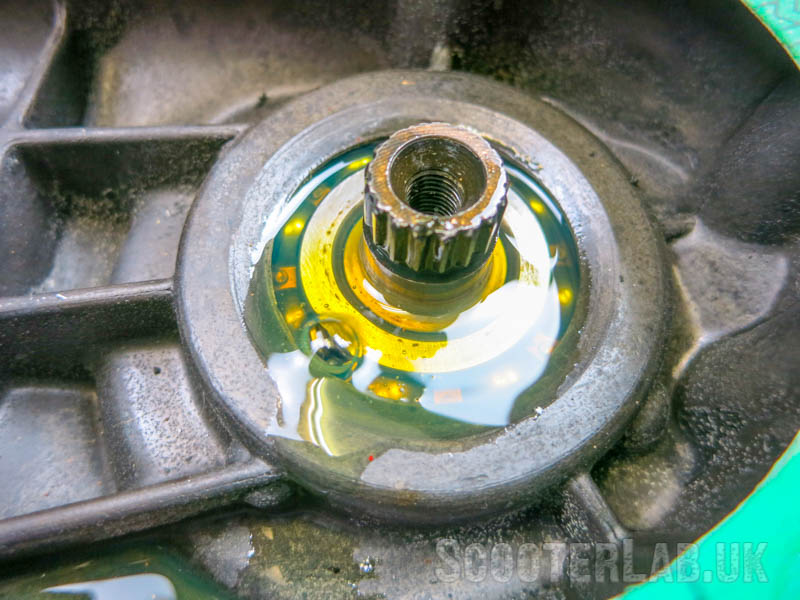
It turns out that fresh gearbox oil – the sort that you normally run – works perfectly if the engine is held flat on its side. Simply fill the man bearing or its housing to the brim with oil and pump up the jam (‘the jam’ in this case being your blood pressure pump). Any leakage will very easily form visible bubbles up through the oil.
All that remains is to strip it down and fix it.
For that bit you are on your own…
Words, video and images: Sticky